

| Le Provençal de Paris - May 03, 1925 |
|
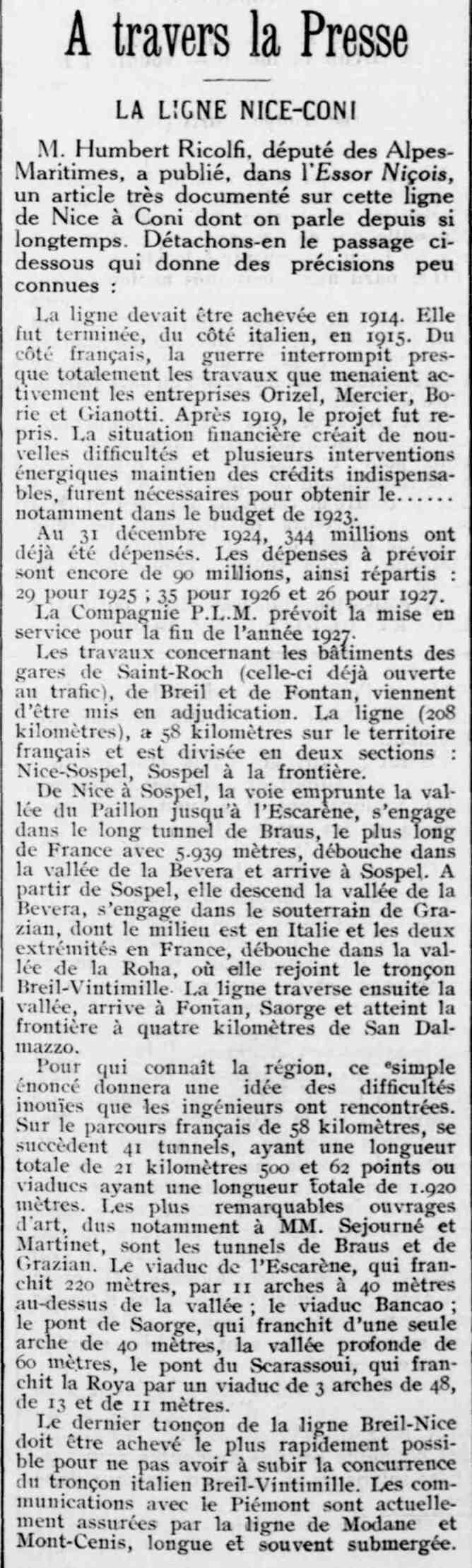
Through the Press
THE NICE-CUNEO LINE Mr. Humbert Ricolfi, Member of Parliament for the Alpes-Maritimes, published a well-documented article in L'Essor Niçois on this long-rumored Nice-Cuneo line. Let's highlight the following passage, which provides some little-known details:
The line was supposed to be completed in 1914. It was completed, on the Italian side, in 1915. On the French side, the war almost completely interrupted the work being actively carried out by the Orizel, Mercier, Borie, and Gianotti companies. After 1919, the project was resumed. The financial situation created new difficulties, and several vigorous interventions were necessary to secure the necessary funding, particularly in the 1923 budget.
As of December 31, 1924, $344 million had already been spent. Projected expenditures are still 90 million, distributed as follows: 29 for 1925; 35 for 1926; and 26 for 1927. The P.L.M. Company plans to open the line by the end of 1927. Work on the station buildings at Saint-Roch (the latter already open to traffic), Breil, and Fontan has just been put out to tender. The line (208 kilometers) is 58 kilometers long on French territory and is divided into two sections: Nice-Sospel, and Sospel to the border.
From Nice to Sospel, the line follows the Paillon Valley to Escarène, enters the long Braus Tunnel, the longest in France at 5,939 meters, opens into the Bevera Valley, and arrives at Sospel. From Sospel, it descends the Bevera Valley, enters the Grazian tunnel, whose center is in Italy and its two ends are in France, and opens into the Roha Valley, where it joins the Breil-Ventimiglia section. The line then crosses the valley, arrives at Fontan and Saorge, and reaches the border four kilometers from San Dalmazzo. For anyone familiar with the region, this simple statement will give an idea of the incredible difficulties the engineers encountered. Along the 58-kilometer French route, there are 41 tunnels, with a total length of 21.5 kilometers, and 62 bridges or viaducts with a total length of 1,920 meters. The most remarkable engineering structures, notably those designed by Messrs. Sejourné and Martinet, are the Braus and Grazian tunnels. The Escarène viaduct, which spans 220 meters, through 11 arches 40 meters above the valley; the Bancao viaduct; the Saorge bridge, which spans the 60-meter deep valley with a single 40-meter arch; and the Scarassoui bridge, which crosses the Roya river with a viaduct of three arches, each 48, 13, and 11 meters high.
The final section of the Breil-Nice line must be completed as quickly as possible to avoid competition from the Italian Breil-Ventimiglia section. Communication with Piedmont is currently provided by the Modane and Mont-Cenis line, which is long and often submerged.
|
| Back - May 03, 1925 |