

| Le Provençal de Paris - May 24, 1925 |
|
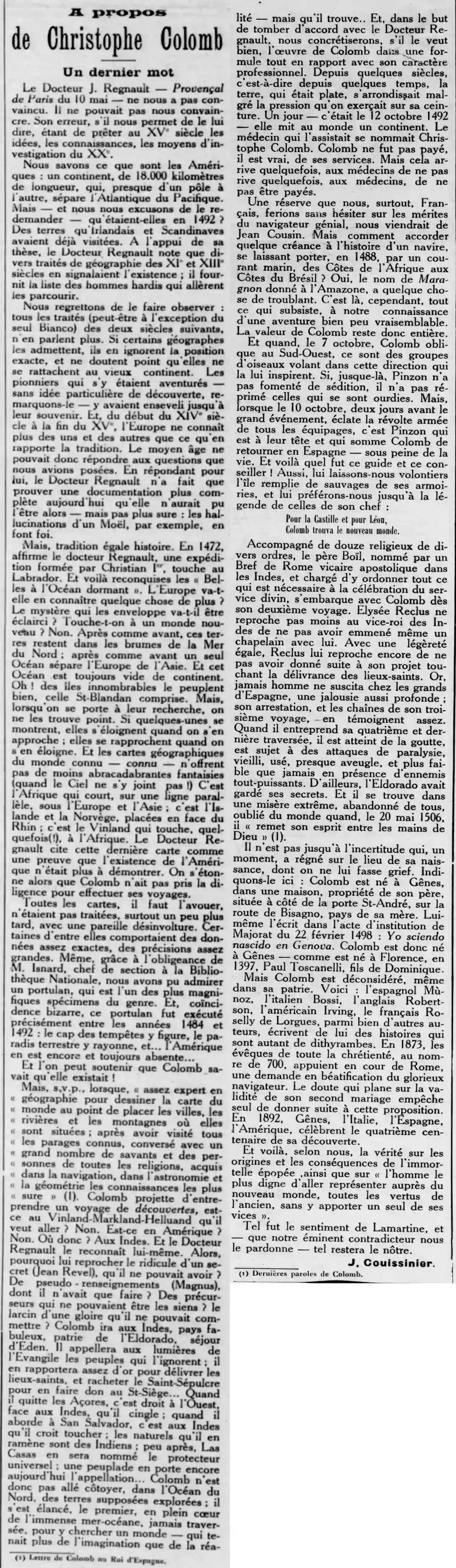
About Christopher Columbus Dr. J. Regnault, in Le Provençal (Paris) on May 10, did not convince us. He could not convince us. His mistake, if he may say so, was to attribute to the 15th century the ideas, knowledge, and means of investigation of the 20th. We know what the Americas are: a continent, 18,000 kilometers long, which, almost from pole to pole, separates the Atlantic from the Pacific. But—and we apologize for asking again—what were they like in 1492? Lands that the Irish and Scandinavians had already visited. In support of his thesis, Doctor Regnault notes that various geographical treatises of the 11th and 13th centuries noted their existence; he provides a list of the bold men who went to explore them. But tradition equals history. In 1472, claims Doctor Regnault, an expedition formed by Christian I reached Labrador. And so the "Belles of the Sleeping Ocean" were reconquered. Will Europe ever learn more about them? Will the mystery surrounding them be solved? Are we approaching a new world? No. Afterward, as before, these lands remain shrouded in the mists of the North Sea; afterward, as before, a single ocean separates Europe from Asia. And this ocean is always empty of continents. Oh! Countless islands do populate it, including St. Blandan. But when one goes looking for them, one cannot find them. If a few appear, they move away when one approaches them; they move closer when one moves away. And the geographical maps of the known world offer no No less preposterous fantasies (when Heaven doesn't join in!) It is Africa that runs, in a parallel line, beneath Europe and Asia; it is Iceland and Norway, located opposite the Rhine; it is Vinland that touches, sometimes(!), Africa. Doctor Regnault cites this last map as proof that the existence of America was no longer in doubt. It is surprising, then, that Columbus did not take the stagecoach to make his voyages. Not all maps, it must be admitted, were treated, especially a little later, with such nonchalance. Some of them contained fairly accurate data, quite precise. Even, thanks to the kindness of Mr. Isnard, section head at the National Library, we were able to admire a portolan chart, which is one of the most magnificent specimens of its kind. And, coincidentally, Strangely, this portolan chart was executed precisely between the years 1484 and 1492: the Cape of Storms appears there, the earthly paradise shines there, and... America is still and always absent... And one can maintain that Columbus knew that it existed! But, please, when, "expert enough in geography to draw the map of the "world" to the point of placing the cities, rivers and mountains where they are located; after having visited all the known areas, conversed with a large number of scholars and people of all religions, acquired in navigation, in astronomy and geometry" the most reliable knowledge" (1). Columbus plans to undertake a voyage of discovery, is it to Vinland-Markland-Helluand that he wants to go? No. Is it to America? No. Where then? To the Indies. And Doctor Regnault himself recognizes it. So, why reproach him for the ridiculousness of a secret (Jean Revel), which he could not have? For pseudo-information (Magnus), which he had no use for? For precursors who could not have been his? The theft of a glory that he could not commit? Columbus will go to the Indies, a fabulous country, the homeland of El Dorado, the abode of Eden. He will call to the light of the Gospel the peoples who are ignorant of it; he will bring back enough gold to deliver the holy places, and to redeem the Holy Sepulchre to donate it to the Holy See... When he leaves the Azores, he sails straight to the West, facing the Indies; when he lands at San Salvador, he believes he is reaching the Indies; the natives he brings back are Indians; shortly after, Las Casas will be named its universal protector; a tribe still bears this name today... Columbus therefore did not go to coast, in the Northern Ocean, lands supposedly explored; He set off, the first, into the heart of the immense Ocean Sea, never crossed, to seek a world that was more imaginary than real, but which he found... Even the uncertainty that, for a time, reigned over the place of his birth is a cause for complaint. Let us state it here: Columbus was born in Genoa, in a house owned by his father, located next to the Porta St. Andrew, on the road to Bisagno, his mother's country. He himself wrote it in the act of institution of Majorat dated February 22, 1498: Yo sciendo nascido en Genova. Columbus was therefore born in Genoa as was born in Florence, in 1397, Paul Toscanelli, son of Dominic. But Columbus is discredited, even in his homeland. Here are the Spaniard Mùnoz, the Italian Bossi, the Englishman Robertson, the American Irving, the Frenchman Roselly de Lorgues, among many other authors, who write stories of him that are so many dithyrambs. In 1873, 700 bishops from all over Christendom supported a request for the beatification of the glorious navigator in the Roman court. Only the doubt surrounding the validity of his second marriage prevented this proposal from being followed through. In 1892, Genoa, Italy, Spain, and America celebrated the fourth centenary of his discovery. And this, in our opinion, is the truth about the origins and consequences of the immortal epic, as well as about "the man most worthy of going to represent to the new world all the virtues of the old, without bringing with him a single one of its vices." Such was Lamartine's sentiment, and, may our eminent opponent forgive us, such will remain ours. J. Couissinier. (1) Letter from Columbus to the King of Spain. |
| La Bignole found no information on J. Regnault or J. Couissinier. |
| Back May 24, 1925 |