|
LUNCH DISHES
Calf's Head with Vinaigrette (119)
Cheese Pastries (120)
Alsatian Spinach (109)
Roast Beef (121)
Semolina Pudding (80)
DINNER DISHES
Parmentier Soup (16)
Calf's Liver Cake (122)
Scallop Loaf (123)
Minced Meat (124)
Cherry Tart
119. Calf's Head with Vinaigrette.
Half a calf's head, one onion studded with two cloves, one glass of white wine, and a bouquet garni.
Cut the skin of your half a calf's head into pieces and soak it for one or two hours in cold water with vinegar. Then place the pieces in a pot with enough cold water to cover them; boil and skim off the foam as with the pot-au-feu. When no more foam forms, add the same condiments as with the veal blanquette (onion, cloves, white wine, bouquet garni) and cook for another two hours.
Once the head is blanched, serve it with a good vinaigrette sauce.
120. Cheese Crusts.
One and a half tablespoons of flour, one cup of milk, 100 grams of cheese, 25 grams of fresh butter or "Végétaline", 50 grams of fat, salt, and pepper.
Make a thick sauce with a knob of butter, one and a half tablespoons of flour, one cup of milk, a pinch of salt, and add three-quarters of the grated cheese. Also, prepare eight nice slices of bread and fry them in the hot fat. On four of these slices, spread a layer of the sauce, cover them with the other four slices, and sprinkle them with the remaining cheese. Place the crusts in the oven until they are well puffed and a nice color. Serve hot.
Second method: Brown rectangular slices of bread, half a centimeter thick, in the hot fat. Between two of these slices, place a slice of cheese of the same thickness. Arrange these crusts on a baking sheet and place them in the oven until the cheese begins to melt; then remove and eat hot.
121. Roast beef.
One and a half pounds of sirloin, a little white wine, a knob of fresh butter.
If the roast beef is from the sirloin, it is best to have it deboned by a butcher; the bones will be used to make broth. Place the meat in the casserole dish with a piece of fat for three-quarters of an hour, basting occasionally. If the oven is not hot enough, roast the roast beef on the stovetop. Add salt towards the end of cooking.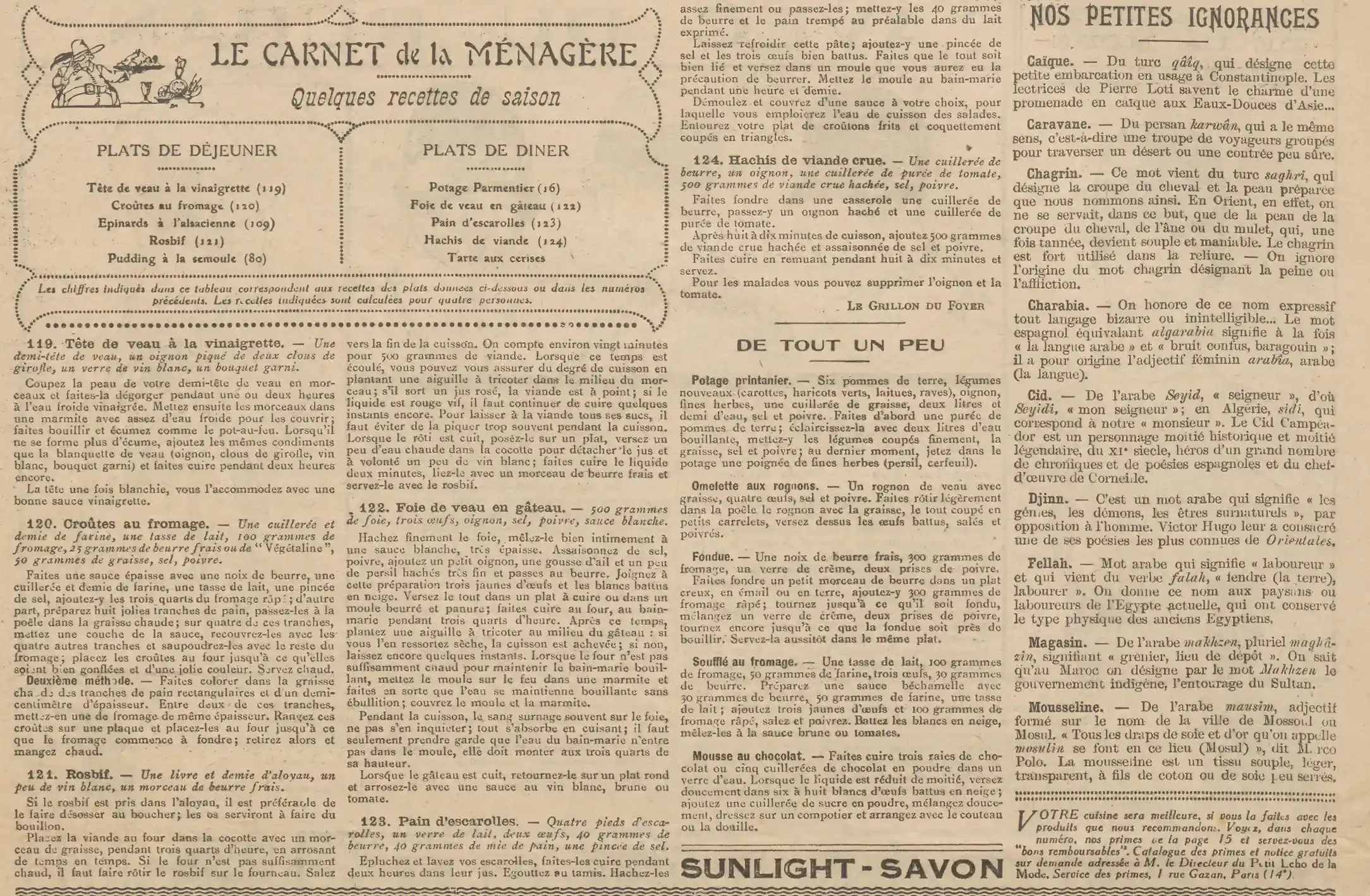
This takes about twenty minutes for 500 grams of meat. When this time is up, you can check the doneness by inserting a knitting needle into the center of the piece; if pink juices come out, the meat is ready; if the liquid is bright red, continue cooking for a few more moments. To preserve all the meat's juices, avoid piercing it too often during cooking. When the roast is cooked, place it on a platter, pour a little hot water into the casserole dish to loosen the juices, and a little white wine if desired. Cook the liquid for two minutes, thicken it with a knob of fresh butter, and serve with the roast beef.
122. Calf's Liver Cake.
500 grams of liver, three eggs, onion, salt, pepper, white sauce.
Finely chop the liver and mix it thoroughly with a very thick white sauce. Season with salt and pepper, add a small onion, a clove of garlic, and a little parsley, chopped very finely and tossed in butter. Add three egg yolks and the egg whites, beaten until stiff. Pour everything into a buttered and breaded baking dish or mold; bake in a bain-marie for three-quarters of an hour. After this time, insert a knitting needle into the center of the cake: if it comes out dry, it's done; if not, leave it for a few more moments. When the oven is not hot enough to maintain the bain-marie boiling, place the mold on the stove in a pot and keep the water boiling, but not boiling. Cover the pan and the pot.
During baking, blood often floats on the liver; don't worry; it will all be absorbed as it cooks. Just be careful that the water from the bain-marie doesn't enter the pan; it should rise three-quarters of its height.
When the cake is baked, turn it out onto a round platter and drizzle it with a white, brown, or tomato wine sauce.
123. Escarolle Bread.
Four escarole stalks, a glass of milk, two eggs, 40 grams of butter, 40 grams of breadcrumbs, and a pinch of salt.
Peel and wash your escaroles and cook them for two hours in their own juices. Drain in a sieve. Chop them fairly finely or pass them through a sieve; add the 40 grams of butter and the bread, previously soaked in expressed milk.
Let this paste cool; add a pinch of salt and the three well-beaten eggs. Mix well and pour into a buttered mold. Place the mold in a bain-marie for an hour and a half.
Remove from the mold and cover with a sauce of your choice, using the salad cooking water. Surround your dish with fried croutons, elegantly cut into triangles.
124. Raw Minced Meat.
One tablespoon of butter, one onion, one tablespoon of tomato puree, 500 grams of raw minced meat, salt, and pepper.
Melt one tablespoon of butter in a saucepan, add one chopped onion and one tablespoon of tomato puree.
After eight to ten minutes of cooking, add 500 grams of raw minced meat, seasoned with salt and pepper. Cook, stirring, for eight to ten minutes and serve.
For those who are sick, you can omit the onion and tomato.
THE HEARTH CRICKET
A LITTLE BIT OF EVERYTHING
Spring Soup.
Six potatoes, young vegetables (carrots, green beans, lettuce, turnips), onion, herbs, one tablespoon of fat, two and a half liters of water, salt, and pepper.
First, make mashed potatoes; Thin it with two liters of boiling water, add the finely chopped vegetables, the fat, salt, and pepper; at the last moment, toss a handful of herbs (parsley, chervil) into the soup.
Kidney Omelet.
One veal kidney with fat, four eggs, salt, and pepper.
Lightly roast the kidney with the fat in a pan, cut into small pieces, and pour over the beaten eggs, seasoned with salt and pepper.
Fondue.
A knob of fresh butter, 300 grams of cheese, a glass of cream, and two pinches of pepper.
Melt a small piece of butter in a deep enamel or earthenware dish, add 300 grams of grated cheese; stir until melted, add a glass of cream, two pinches of pepper, and stir again until the fondue is almost boiling. Serve immediately in the same dish.
Cheese Soufflé.
One cup of milk, 100 grams of cheese, 50 grams of flour, three eggs, and 30 grams of butter.
Prepare a béchamel sauce with 30 grams of butter, 50 grams of flour, and one cup of milk; add three egg yolks and 100 grams of grated cheese, season with salt and pepper. Beat the egg whites until stiff and fold them into the brown or tomato sauce.
Chocolate Mousse.
Cook three chocolate stripes or five spoonfuls of chocolate powder in a glass of water. When the liquid has reduced by half, gently pour in six to eight beaten egg whites; add a spoonful of powdered sugar, mix gently, pipe onto a fruit bowl, and arrange with a knife or piping bag.
OUR LITTLE IGNORANCE
Caïque - a small boat used in Constantinople. Pierre Loti's readers know the charm of a trip in a caïque to the Eaux-Douces d'Asie…
Caravan - From the Persian karwân, which has the same meaning, that is, a group of travelers gathered to cross a desert or an unsafe region.
Sorrow - This word comes from the Turkish saghri, which refers to the horse's rump and the prepared hide that we call by this name. In the East, in fact, only the hide from the rump of a horse, donkey, or mule was used for this purpose; once tanned, it becomes supple and manageable. Sorrow is widely used in bookbinding. The origin of the word grief, meaning pain or affliction, is unknown.
Gibberish - This expressive name is given to any bizarre or unintelligible language... The equivalent Spanish word algarabia means both "the Arabic language" and "confused noise, gibberish"; it comes from the feminine adjective arabia, Arabic.
From the Turkish qatq, which designates this (language).
Cid - From the Arabic Seyid, "lord," hence Seyidi, "my lord"; in Algeria, sidi, which corresponds to our "sir." The Cid Campeador is a half-historical, half-legendary figure from the 11th century, the hero of many Spanish chronicles and poems, and of Corneille's masterpiece.
Djinn - This is an Arabic word meaning "genies, demons, supernatural beings," as opposed to humans. Victor Hugo dedicated one of his most famous poems, Orientales, to them.
Fellah - An Arabic word meaning "plowman" and derived from the verb falah, "to split (the earth), to plow." This name is given to the peasants or plowmen of present-day Egypt, who have retained the physical appearance of the ancient Egyptians.
Magazin - From the Arabic makhzen, plural maghazin, meaning "granary, storage place." It is known that in Morocco, the word Makhzen refers to the indigenous government, the Sultan's entourage.
Muslin - From the Arabic mausim, an adjective derived from the name of the city of Mosul. "All the silk and gold cloths called mosulin are made in this place (Mosul)," said Marco Polo. Muslin is a soft, lightweight, transparent fabric made from loosely woven cotton or silk threads.
|