

| Le Petit Écho de la Mode - June 7, 1925 |
|
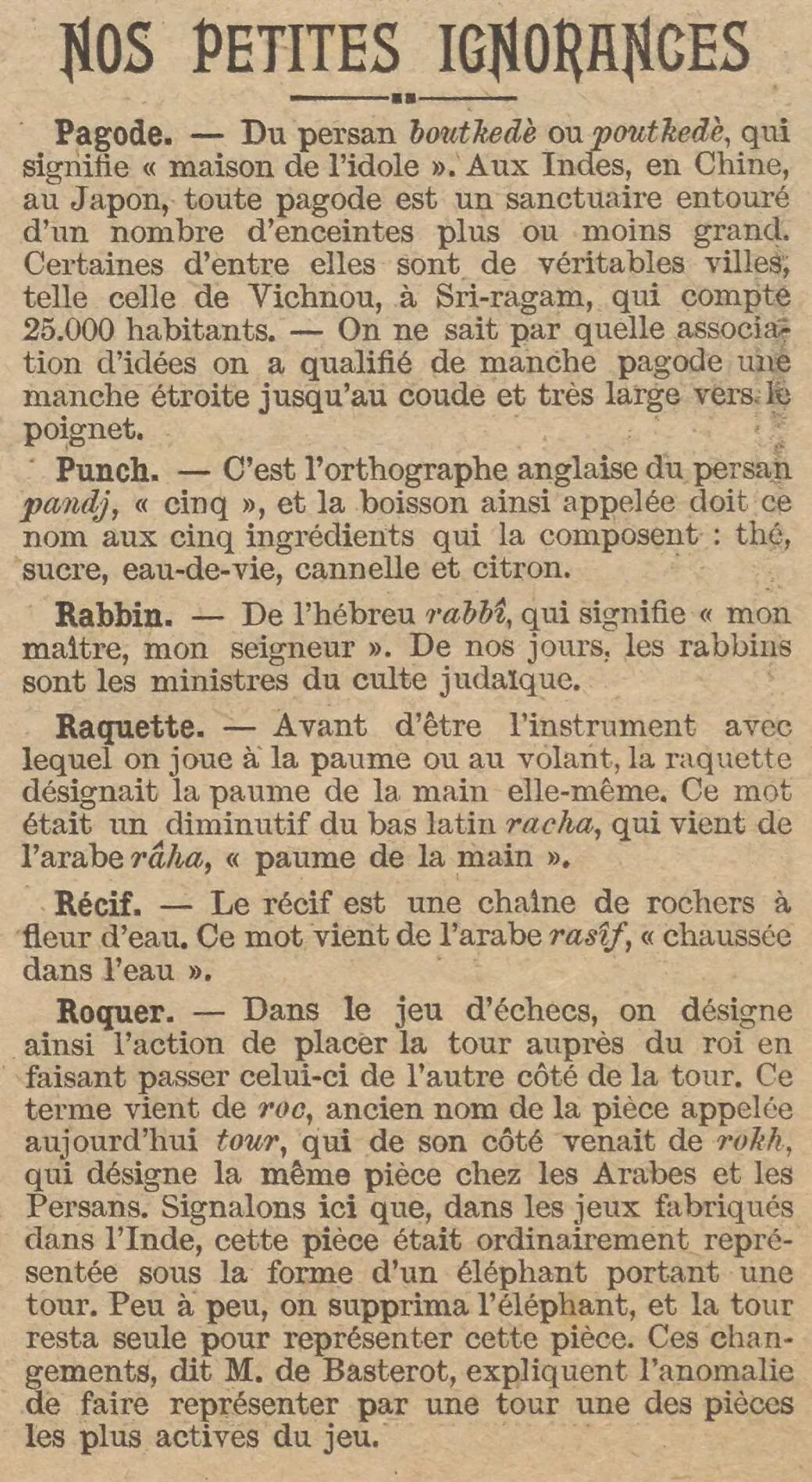
OUR LITTLE IGNORANCES - Pagoda. - From the Persian boutkedè or poutkedè, which means "idol house." In India, China, and Japan, every pagoda is a sanctuary surrounded by a greater or lesser number of enclosures. Some of them are real cities, such as that of Vishnu, in Sri-ragam, which has 25,000 inhabitants. We don't know by what association of ideas a sleeve narrow to the elbow and very wide towards the wrist was called a pagoda sleeve. - Punch. This is the English spelling of the Persian pandj, "five," and the drink thus named owes its name to the five ingredients it contains: tea, sugar, brandy, cinnamon, and lemon. - Rabbi. From the Hebrew rabbi, meaning "my master, my lord." Today, rabbis are ministers of Judaism. - Racket. Before becoming the instrument with which one plays "palm" or "shuttlecock," the "racket" referred to the palm of the hand itself. This word was a diminutive of the Late Latin racha, which comes from the Arabic ráha, "palm of the hand." - Reef. A reef is a chain of rocks at water level. This word comes from the Arabic rasif, "roadway in the water." - Roquer. - In the game of chess, this refers to the action of placing the rook next to the king by making the king pass to the other side of the rook. This term comes from roc, the ancient name for the piece now called a tower, which in turn came from rokh, which designates the same piece among the Arabs and Persians. It should be noted here that, in sets made in India, this piece was usually represented in the form of an elephant carrying a rook. Gradually, the elephant was removed, and the rook remained alone to represent this piece. These changes, says M. de Basterot, explain the anomaly of having a rook represent one of the most active pieces in the game. |
| Back June 7 1925 |