

| Le Provençal de Paris - June 21, 1925 |
|
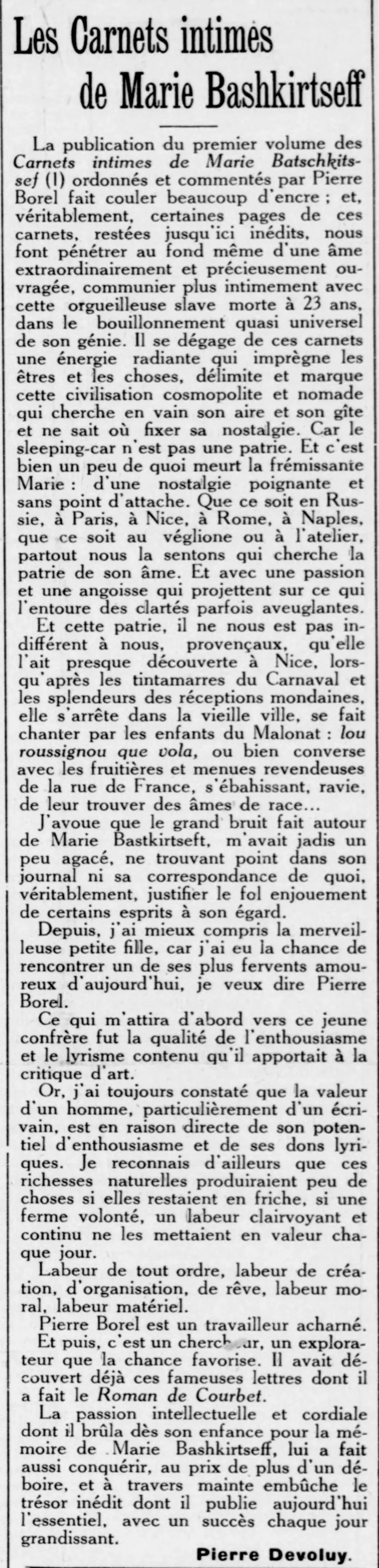
The Intimate Notebooks of Marie Bashkirtseff The publication of the first volume of the Intimate Notebooks of Marie Bashkirtseff (1), organized and annotated by Pierre Borel, has generated much discussion; and truly, certain pages of these notebooks, previously unpublished, allow us to penetrate the very depths of an extraordinarily and preciously crafted soul, to commune more intimately with this proud Slavic woman who died at the age of 23, in the almost universal ferment of her genius. A radiant energy emanates from these notebooks, permeating beings and things, delineating and marking this cosmopolitan and nomadic civilization that searches in vain for its habitat and its home and knows not where to fix its nostalgia. For the sleeping car is not a homeland. And this is precisely what the trembling Marie dies of, a poignant and unattached nostalgia. Whether in Russia, Paris, Nice, Rome, or Naples, whether at the Veglione or in the studio, everywhere we feel her searching for the homeland of her soul. And with a passion and anguish that cast sometimes blinding illuminations on her surroundings. And it's not indifferent to us Provençals that she almost discovered this homeland in Nice, when, after the din of Carnival and the splendor of social gatherings, she stops in the old town, listens to the children of Malonat sing "lou roussignou que vola," or converses with the fruit sellers and small vendors of the Rue de France, amazed and delighted to find them such purebred souls... Pierre Devoluy. |
| Retour 24 mai 1925 |