|
LISIEUX CELEBRATES THE BEATIFICATION OF SISTER THERESE
 These grandiose celebrations, which will continue until July 12, will take place amidst a considerable influx of pilgrims. These grandiose celebrations, which will continue until July 12, will take place amidst a considerable influx of pilgrims.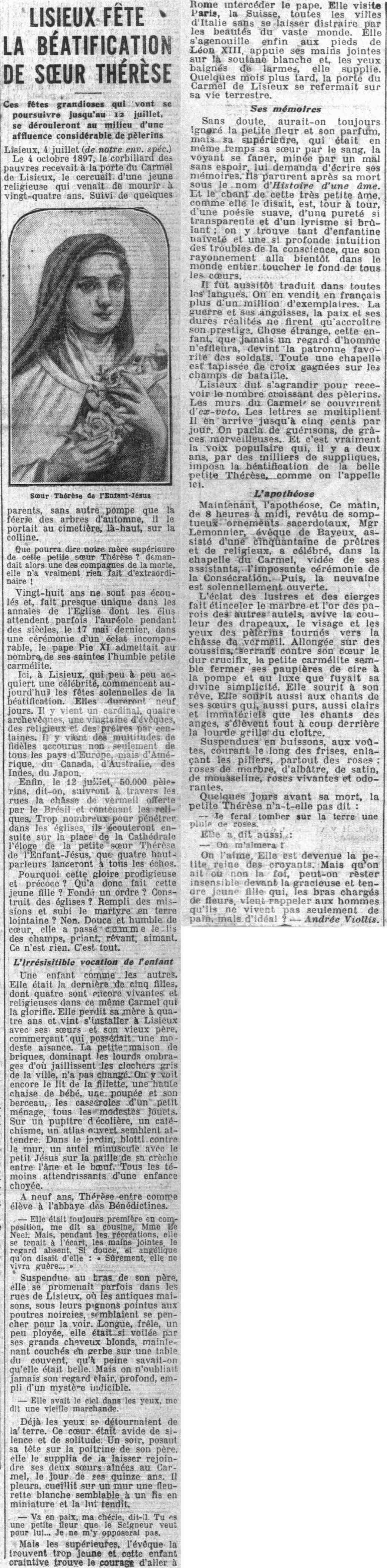
Lisieux, July 4 (from our special issue) On October 4, 1897, the hearse for the poor received at the gate of the Carmel of Lisieux the coffin of a young nun who had just died at the age of twenty-four. Followed by a few relatives, with no other pomp than the magic of the autumn trees, it carried her to the cemetery, up there on the hill.
What will our Mother Superior have to say about this little Sister Thérèse? one of the deceased's companions asked. She really didn't do anything extraordinary! Twenty-eight years have not yet passed, and, almost uniquely in the annals of the Church, whose chosen ones sometimes wait for their halo for centuries, on May 17th, in a ceremony of incomparable splendor, Pope Pius XI admitted the humble little Carmelite nun to the number of his saints.
Here in Lisieux, which is gradually acquiring celebrity, the solemn celebrations of the beatification begin today. They will last nine days. A cardinal, four archbishops, some twenty bishops, hundreds of religious and priests are attending. Multitudes of faithful have flocked not only from all the countries of Europe, but also from America, Canada, Australia, India, and Japan.
Finally, on July 12th, 50,000 pilgrims, it is said, will follow the silver-gilt shrine containing the relics through the streets, donated by Brazil. Too numerous to enter the churches, they will then listen in the Cathedral Square to the eulogy of Little Sister Thérèse of the Child Jesus, which four loudspeakers will blast to all the echoes. Why this prodigious and precocious fame? What did this young girl do? Found an order? Build churches? Fulfill missions and suffer martyrdom in distant lands? No. Gentle and humble of heart, she passed like the lily of the field, praying, dreaming, loving. It's nothing. It's everything.
The child's irresistible vocation,
A child like any other. She was the last of five daughters, four of whom are still living and religious in this same Carmel that glorifies her. She lost her mother at the age of four and came to settle in Lisieux with her sisters and her elderly father, a merchant who was modestly well-off. The small brick house, overlooking the heavy shadows from which the city's gray steeples emerge, has not changed. One can still see the little girl's bed, a tall high chair, a doll and her cradle, the pots and pans of a small household, all the modest toys. On a school desk, a catechism book and an open atlas seem to be waiting. In the garden, nestled against the wall, a tiny altar with the baby Jesus on the straw of his manger between the donkey and the ox. All the touching witnesses of a pampered childhood.
At nine, Thérèse entered the Benedictine abbey as a student.
She was always first in composition, her cousin, Madame Le Neel, told me. But during recess, she stood apart, her hands clasped, her gaze vacant. So sweet, so angelic that people said of her: "Surely, she won't live long..."
Hanging on her father's arm, she sometimes strolled the streets of Lisieux, where the ancient houses, beneath their pointed gables and blackened beams, seemed to bend down to see her. Tall, frail, and a little bent, she was so veiled by her long blond hair, now lying in a sheaf on a table in the convent, that no one knew she was beautiful. But no one ever forgot her clear, deep gaze, filled with an indescribable mystery.
She had heaven in her eyes, an old merchant woman told me.
Even then, her eyes were turning away from the earth. This heart yearned for silence and solitude. One evening, laying her head on her father's chest, she begged him to let her join her two older sisters at the Carmelite convent on her fifteenth birthday. He wept, plucked a small white flower from a wall, like a miniature lily, and held it out to her.
"Go in peace, my darling," he said. "You are a little flower the Lord wants for himself... I won't stand in the way."
But the superiors and the bishop found her too young, and this fearful child found the courage to go to Rome to intercede with the Pope. She visited Paris, Switzerland, and all the cities of Italy, without being distracted by the beauties of the wider world. She finally knelt at the feet of Leo XIII, pressed her clasped hands against the white cassock, and, her eyes bathed in tears, she supplicated. A few months later, the door of the Carmel of Lisieux closed on her earthly life.
Her Memoirs
No doubt, the little flower and its fragrance would have always been ignored, but her superior, who was also her blood sister, seeing her withering away, consumed by a hopeless illness, asked her to write her memoirs. They were published after her death under the title "Story of a Soul." And the song of this very little soul, as she said, is, by turns, of a sweet poetry, of such transparent purity, and of such burning lyricism; one finds in it so much childlike naiveté and such a profound intuition of the troubles of conscience, that its radiance soon reached the depths of every heart throughout the world.
It was immediately translated into all languages. More than a million copies were sold in French. The war and its anxieties, peace and its harsh realities, only increased its prestige. Strangely enough, this child, whom no man ever touched, became the favorite patron saint of the soldiers. An entire chapel is lined with crosses won on the battlefields.
Lisieux had to expand to accommodate the growing number of pilgrims. The walls of the Carmel were covered with votive offerings. Letters multiplied. Up to five hundred arrived a day. There was talk of healings, of marvelous graces. And it was truly the voice of the people that, two years ago, through thousands of petitions, imposed the beatification of the beautiful little Thérèse, as she is called.
The Apotheosis
Now, the apotheosis. This morning, from 8:00 a.m. to noon, dressed in sumptuous priestly vestments, Bishop Lemonnier, Bishop of Bayeux, assisted by some fifty priests and religious, celebrated the imposing ceremony of the Consecration in the Carmelite chapel, now emptied of its attendants. Then, the novena solemnly opened.
The brilliance of the chandeliers and candles made the marble and gold walls of the other altars sparkle, enlivened the color of the flags, and the faces and eyes of the pilgrims turned toward the silver-gilt shrine. Lying on cushions, clutching the hard crucifix to her heart, the little Carmelite nun seems to close her waxen eyelids to the pomp and luxury that her divine simplicity fled. She smiles at her dream. She smiles too at the songs of her sisters which, as pure, as clear, and immaterial as the songs of angels, suddenly rise up behind the heavy cloister gate.
Hanging in bushes, from the vaults, running along the friezes, entwining the pillars, roses are everywhere: roses of marble, alabaster, satin, muslin, living and fragrant roses.
A few days before her death, did not little Thérèse say: "I will make a shower of roses fall upon the earth?" She also said, "They will love me!"
They love her. She has become the little queen of believers. But whether we have faith or not, can we remain indifferent to the graceful and tender young girl who, arms laden with flowers, comes to remind men that they do not live by bread alone, but by ideals?
Andrée Viollis.
|