

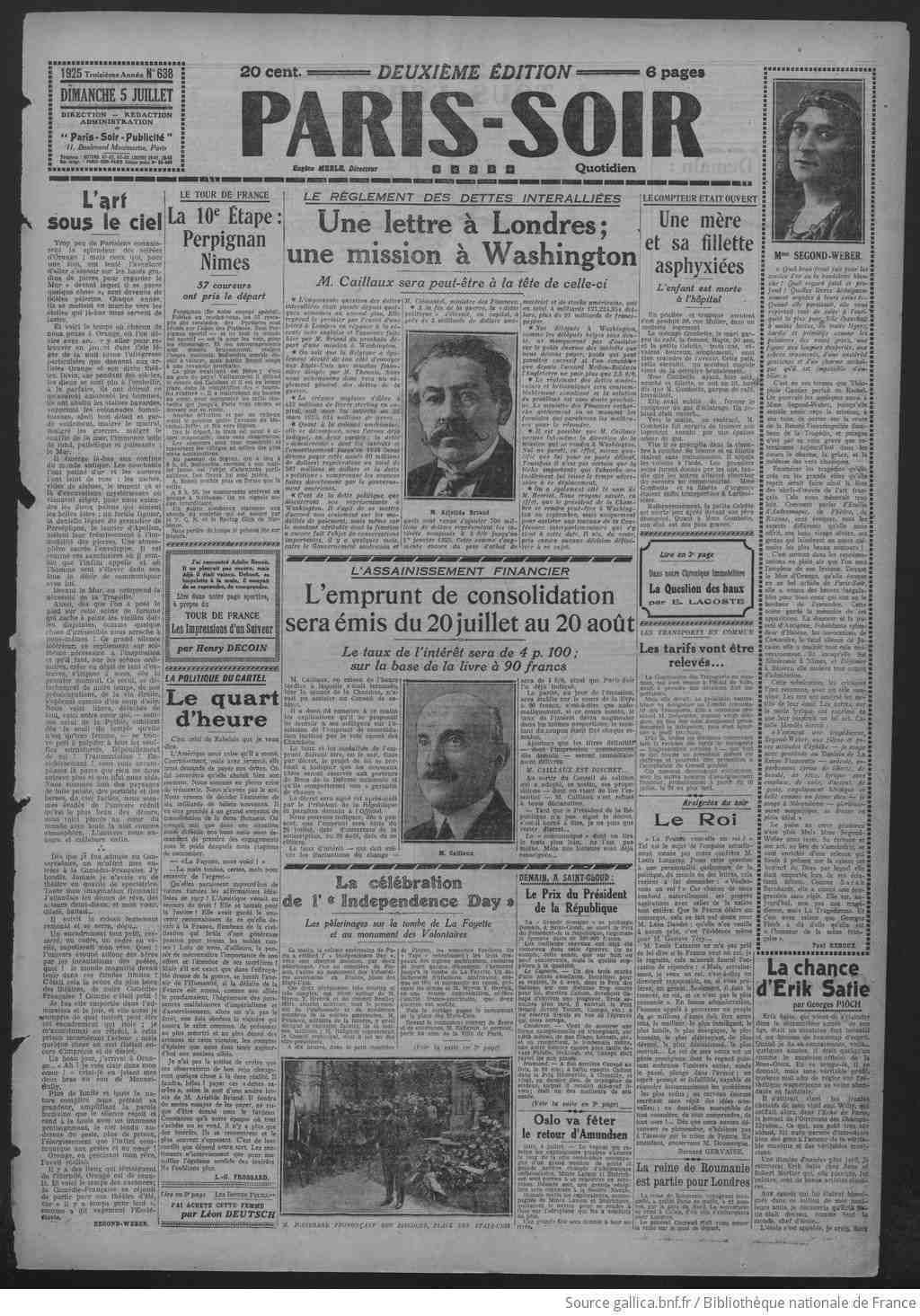
| Paris-Soir - July 05, 1925 |
|
Erik Satie's Luck
 by Georges Pioch by Georges Pioch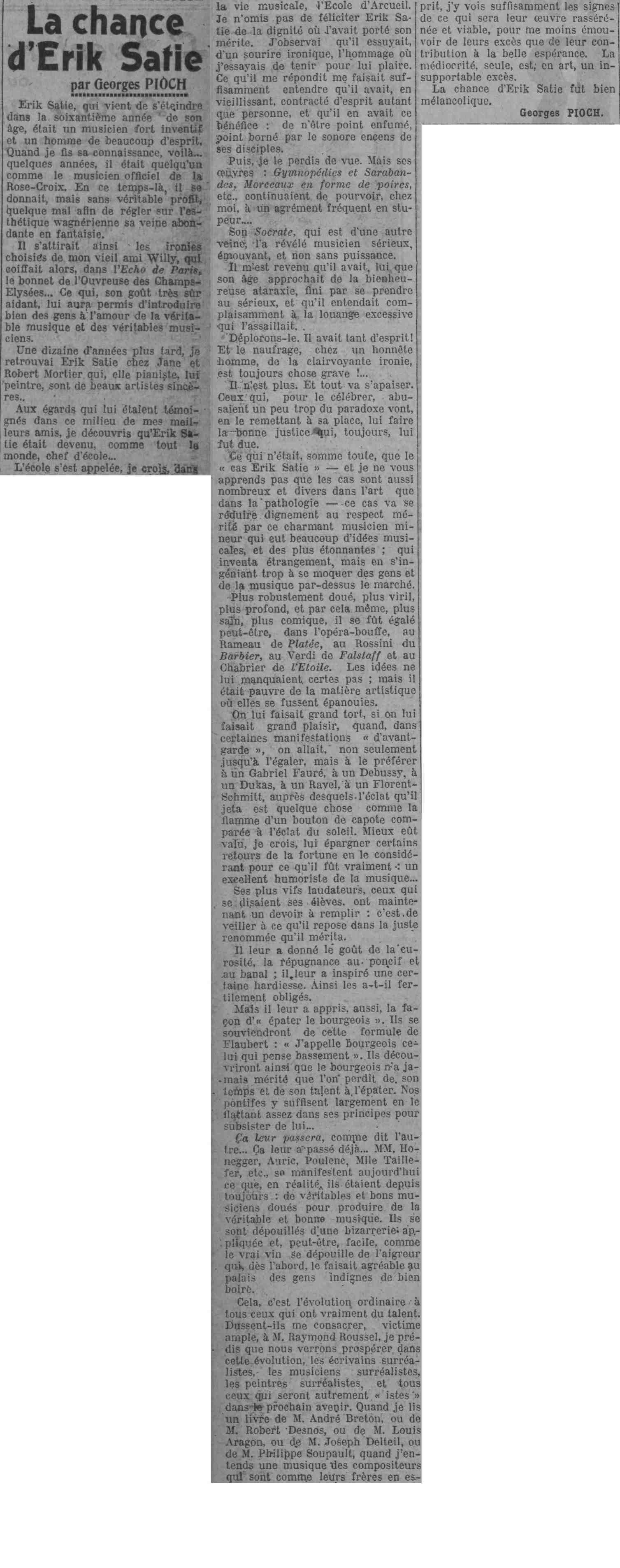 Erik Satie, who recently passed away in his sixtieth year, was a highly inventive musician and a man of great wit. When I first met him a few years ago, he was something like the official musician of the Rosicrucian Order. At that time, he was taking some pains, albeit without any real profit, to adapt his abundant vein of fantasy to Wagnerian aesthetics.
He thus attracted the chosen ironies of my old friend Willy, who at that time, in the Echo de Paris, was wearing the cap of the Usherette of the Champs-Élysées... Which, with the help of his very sure taste, allowed him to introduce many people to the love of real music and real musicians. About ten years later, I met Erik Satie again at the home of Jane and Robert Mortier, who, she a pianist, he a painter, are fine and sincere artists. From the respect shown to him in this circle of my best friends, I discovered that Erik Satie had become, like everyone else, the head of a school... The school was called, I believe, in musical life, the Arcueil School. I did not fail to congratulate Erik Satie on the dignity to which his merit had brought him. I observed that he brushed aside, with an ironic smile, the homage I tried to maintain to please him. What he replied made me understand sufficiently that, as he aged, he had contracted his mind as much as anyone else, and that he had the benefit of not being clouded, not limited by the sonorous incense of his disciples. Then, I lost sight of him. But his works Gymnopédies and Sarabandes, Pieces in the Shape of Pear, etc., continued to provide me with frequent enjoyment in stupor.... His Socrates, which is of a different vein, revealed him as a serious, moving musician, and not without power. It came back to me that he, whose age was approaching blessed ataraxia, had ended up taking himself seriously, and that he complacently listened to the excessive praise that assailed him.. Let us deplore him. He had so much wit! And the shipwreck, in an honest man, of clear-sighted irony is always a serious thing!.... He is no more. And everything will calm down. Those who, in order to celebrate him, overused the paradox a little too much will, by putting him in his place, do him the justice that was always due to him. What was, after all, only the "Erik Satie case" and I am not telling you that cases are as numerous and diverse in art as in pathology, this case will be worthily reduced to the respect deserved by this charming minor musician who had many musical ideas, and the most astonishing; who invented strangely, but by ingeniously mocking people and music into the bargain. More robustly gifted, more virile, more profound, and by that very fact, healthier, more comic, he would have perhaps equaled, in comic opera, Rameau in Platée, Rossini in The Barber, Verdi in Falstaff and Chabrier in The Star. He certainly did not lack ideas; but he was poor in the artistic material in which they would have flourished. He was greatly wronged, if he was greatly pleased, when, in certain "avant-garde" events, people went so far as not only to equal him, but to prefer him to a Gabriel Fauré, a Debussy, a Dukas, a Ravel, a Florent-Schmitt, compared to whom the brilliance he cast is something like the flame of a greatcoat button compared to the brilliance of the sun. It would have been better, I believe, to spare him certain reversals of fortune by considering him for what he truly was: an excellent humorist of music... His most ardent eulogists, those who called themselves his students, now have a duty to fulfill: to ensure that he rests in the just renown he deserved. He gave them a taste for curiosity, a repugnance for the clichéd and the banal; he inspired them with a certain boldness. Thus, he has fertilely obliged them. But he also taught them how to "amaze the bourgeois." They will remember Flaubert's phrase: "I call Bourgeois he who thinks basely." They will thus discover that the bourgeois has never deserved to have one's time and talent wasted trying to amaze him. Our pontiffs are more than enough to flatter him enough in his principles to survive on him... It will pass them, as the other one says... It has already passed them... Messrs. Honegger, Auric, Poulenc, Mlle Taillefer, etc., are showing today that, in reality, they have always been true and good musicians gifted to produce true and good music. They have stripped themselves of an oddity: applied and, perhaps, easy, like real wine stripping itself of the sourness which, from the outset, made it pleasant to the palate of people unworthy of drinking well. This is the ordinary evolution of all those who have real talent. Even if they were to dedicate me, ample victim, to Mr. Raymond Roussel, I predict that we will see prospering in this evolution, surrealist writers, surrealist musicians, surrealist painters, and all those who will be otherwise "ists" in the near future. When I read a book by André Breton, Robert Desnos, Louis Aragon, Joseph Delteil, or Philippe Soupault, when I hear music by composers who are like their brothers in spirit, I see enough signs of what will be their reassured and viable work to be less moved by their excesses than by their contribution to the beautiful hope. Mediocrity alone is, in art, an unbearable excess. Erik Satie's luck was very melancholic. Georges PIOCH. |
| Back July 05, 1925 |