|
 The public must know that the electric car is making headway. The public must know that the electric car is making headway.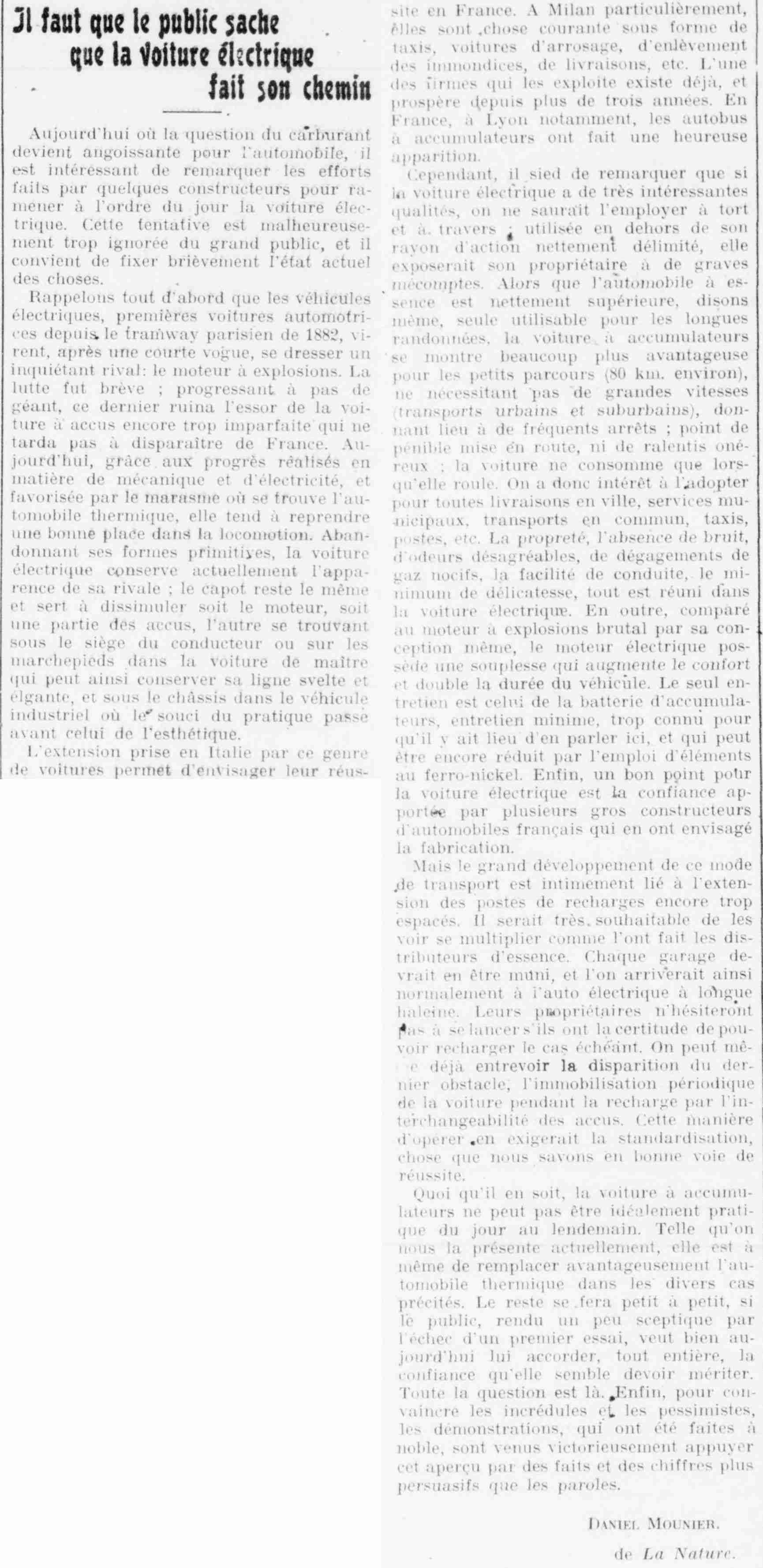
Today, when the fuel issue is becoming a major concern for the automobile industry, it is interesting to note the efforts made by some manufacturers to bring the electric car back onto the agenda. This effort is unfortunately largely ignored by the general public, and it is appropriate to briefly review the current state of affairs.
Let us first recall that electric vehicles, the first self-propelled vehicles since the Parisian tramway of 1882, saw, after a brief period of popularity, a worrying rival emerge: the internal combustion engine. The struggle was brief; progressing by leaps and bounds, the latter ruined the rise of the still imperfect battery-powered car, which soon disappeared from France. Today, thanks to advances in mechanics and electricity, and aided by the stagnation of the internal combustion engine, it is tending to regain a prominent place in locomotion. Abandoning its primitive forms, the electric car currently retains the appearance of its rival; the hood remains the same and serves to conceal either the motor or part of the batteries, the other being located under the driver's seat or on the running boards in the master car, which thus retains its slender and elegant lines, and under the chassis in the industrial vehicle, where practicality takes precedence over aesthetics.
The spread of this type of car in Italy suggests their success in France. In Milan in particular, they are commonplace in the form of taxis, watering vehicles, garbage collection vehicles, delivery vehicles, and so on. One of the companies that operates them already exists and has been thriving for over three years. In France, notably in Lyon, battery-powered buses have made a welcome appearance. However, it should be noted that although the electric car has very interesting qualities, it cannot be used indiscriminately or used outside its clearly defined range, as it would expose its owner to serious disappointments. While the gasoline car is clearly superior, let's even say, the only one usable for long trips, the battery-powered car is much more advantageous for short journeys (around 80 km), not requiring high speeds (urban and suburban transport), giving rise to frequent stops; no difficult starting, no expensive idling; the car only consumes when it is moving. It is therefore in one's interest to adopt it for all deliveries in town, municipal services, public transport, taxis, post offices, etc. Cleanliness, absence of noise, unpleasant odors, release of harmful gases, ease of driving, minimum delicacy, everything is combined in the electric car. Furthermore, compared to the combustion engine, which is brutal by its very design, the electric motor offers a flexibility that increases comfort and doubles the vehicle's lifespan. The only maintenance is that of the storage battery, a minimal maintenance requirement, too well-known to warrant discussing it here, and which can be further reduced by the use of ferro-nickel elements. Finally, a positive point for the electric car is the confidence shown by several major French car manufacturers who have considered manufacturing it.
But the major development of this mode of transportation is closely linked to the expansion of charging stations, which are still too far apart. It would be highly desirable to see them multiply, as gas stations have done. Every garage should be equipped with them, and this would normally lead to the long-term development of electric cars. Their owners will not hesitate to take the plunge if they are certain of being able to recharge if necessary. We can even already glimpse the disappearance of the last obstacle, the periodic immobilization of the car during recharging, thanks to the interchangeability of the batteries. This method of operation would require standardization, something we know is well on the way to success.
In any case, the battery-powered car cannot become ideally practical overnight. As it is currently presented to us, it is capable of advantageously replacing the internal combustion engine in the various cases mentioned above. The rest will happen little by little, if the public, made somewhat skeptical by the failure of a first trial, is now willing to give it the full confidence it seems to deserve. That is the whole question. Finally, to convince the doubters and the pessimists, the demonstrations, which were made at Noble, have victoriously supported this insight with facts and figures more persuasive than words.
DANIEL MOUNIER.
of Nature.
|