|
Feminine Comments
 REPLY TO THE SWEET NOTE REPLY TO THE SWEET NOTE
My dear Ali,
I have always lamented the fact that there are so many people jaded or indifferent to the beauty of nature, who can, thanks to their money, spend long months on a fashionable beach or in a mountain town, while there are multitudes of people of mediocre fortunes who will never experience all the poetry that rises from the sea, nor all the humble admiration that a proud peak commands. They will die, they who would have felt, who would have understood, admired, without having penetrated the magic of these words: the sea, the mountain, paradise from which they have been excluded.
To spend their vacations, they must be content with more modest joys, the sites of the Buttes-Chaumont or daydreams on the banks of the Seine... I remember a strange reflection that Gaston Cony, who has enough wit for four, wrote to me last year. In August or September, after a few days of scorching heat, the Parisians were delighted to see the rain. And Gaston Cony said: "It's the 'purotins' who are happy to treat themselves to the waters!"
Let's be serious: when I say to you, my dear Ali: the sea or the mountains for this vacation? I add: this corner of the sea or that corner of the mountains? I believe that those who don't specify the location, the type of ocean, or the type of peaks they want to see are those for whom the sea is a lot of water where they can swim without paying 1.05 francs per cubic meter, and the mountain is kilometers of coastline to climb for the measured pleasure of descending them. With me, you will recognize that these people are not admirers who should honor nature! Because, after all, each place has its own character, its colors, its appearance, its sky, its sun, its air, its smells, its fragrances that permeate our souls. I have never experienced the same feelings in front of the mountains of Lourdes and those of Cauterets or Laruns; even less so in front of the smiling greenery, the healthy freshness of the Basque mountains, and the sun-baked rock of the peaks of Catalonia.
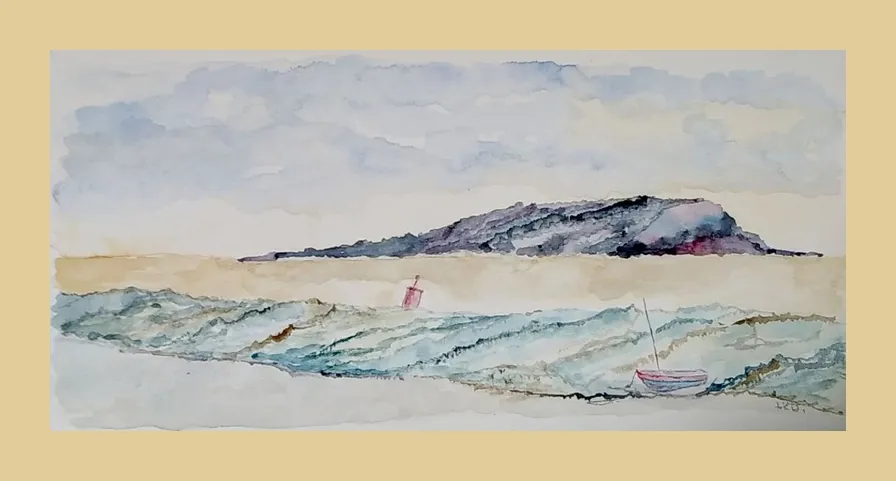
The sea of Biarritz and that of Cape Breton are not the same. Yet, everywhere the sea offers an immense expanse of water that seems to be identical: the same horizon, the same perpetual movement of the waves, the same sound... Well, no; the appearance of the beach aside, the sea of Biarritz has one style, that of Cape Breton has another.
Wherever I go on vacation, my dear Ali, I hope that your Billet Doux will follow me, to which I will not fail to respond at length. I am still
Your friend Yvette, Eda Dominjolle.
SWEET NOTE
Dear Yvette,
July 26, 1925.
The Versailles Court has just ruled on a case of embezzlement that deserves comment. Two young women, whose mother was the director of the Epinay-sur-Orge post office, had stolen 34,000 francs from the cash register in order to lead a happy life in Paris. Madeleine provided for her sister Andrée Launé, who at one point found herself in great poverty. The Court sentenced the first to four years in prison and the second to five years, and both were fined 9,500 francs. They received suspended sentences for their prison sentences.
This, in short, is the outline of this affair. Note that the mother forgave and promised to repay "by working until the end of her days." She had this admirable saying: "They did not have a father to watch over them and direct them," an argument that has its value and which can be cited when children sin because their father died in the war, or because the mother has borne the heavy burden of raising children who did not know their father, or because he abandoned them. Madeleine and Andrée Launé had been seduced and the temptation of Paris had completed this infatuation they had for dance halls, fine meals, places where one has fun. The gigolos profited from this financial contribution, but turned around when they were called as witnesses. Thus, we recognize the value of friends, by the speed with which they flee when misfortune overwhelms us. How many bad deeds are committed in the name of wanting to profit from the mirages of the big city? Childhood and adolescence are prey to continual danger. Everything around you tempts you. The street fascinates, the jewelry displays make the eyes of women passing by swoon, eager to wear beautiful jewelry. Jazz music, the bright advertisements that call to dance, to love, to easy and interested encounters invite the young girl into the whirlwind of pleasure. What willpower does it take to resist it! And then, there is "always a man not far away" to offer you his heart, his money, or his low morals. A whisper in the ear, a shining eye, a forearm encircling you, and you enter the room of trembling, skin contact, noises, scents, lights, elements that contribute to dizziness and falls, to continual falls from which one never recovers. How can society condemn us since it allows and encourages all temptations?
The war has only amplified them in all classes of society. To live in the utmost pleasure and well-being is the general cry that is not uttered, but to which one rallies in a silent agreement, reflected in the faces of our poor humanity. Earning money or stealing it without it being known: such is the modern mentality. Bankruptcies, scams, speculation, instead of "shrinking" individual consciousness, encourage it toward unacknowledged ends. The sentences imposed are paltry. Once served, the conviction is quickly forgotten. You have carte blanche to steal from other people's wallets. But don't dare steal from your grocer or your baker; you will be severely condemned and banished by those around you. Let us recall this worthy saying from our dear fabulist La Fontaine, whose fervent cult is maintained by Mr. Olivier de Gourcuff:
"Depending on whether you are powerful or miserable,
the judgments of the courts will render you white or black."
The years and events only confirm this sad truth, which will be true for all times and in all countries. Where are we going? A somber question that I dare not answer. Recently, dear Yvette, you accused me of being pessimistic. No, I do not view people and things according to an acquired or innate melancholy. The virtuous, the good, are becoming increasingly rare. These qualities of the heart are no longer in vogue. They arouse laughter or mockery. We hide them, because success in life no longer comes from there, and you know it well. Intrigues, baseness, and condescension of the flesh are the weapons of many people. Observe what goes on in the workshop, in the office, and you will easily agree with me.
If Madeleine Launé had remained well-behaved in her post office in Epinay, where she assisted her mother, she would have lived ignored like the violet whose emblem is modesty. Being pretty, she would have found a suitor, but her beauty earned her praise and some success. A peaceful existence "atrophies." There's a lack of air at home, even if it's good, so we go and breathe a worse one elsewhere.
Since the war, everyone has thirsted for freedom, adventure, and change. Relationships suffer as a result, and divorces are numerous. Educators and parents are helpless in this struggle between the outside and the inside. Andrée and Madeleine Launé were swept along by the current of modern life. The Court of Versailles was lenient with them: perhaps it understood that something had changed in the way human beings live. But what will future courts do in the face of the turmoil of money and pleasure? Who will be the ones to throw the first lifebelts? I offer you the one with my lips as a token of my affection.
Ali HÉRITIER.
|