|
What fairground artist isn't familiar with the paintings of Elisabeth Fuss-Amoré! What clown, what parade clown, what fairground wrestler,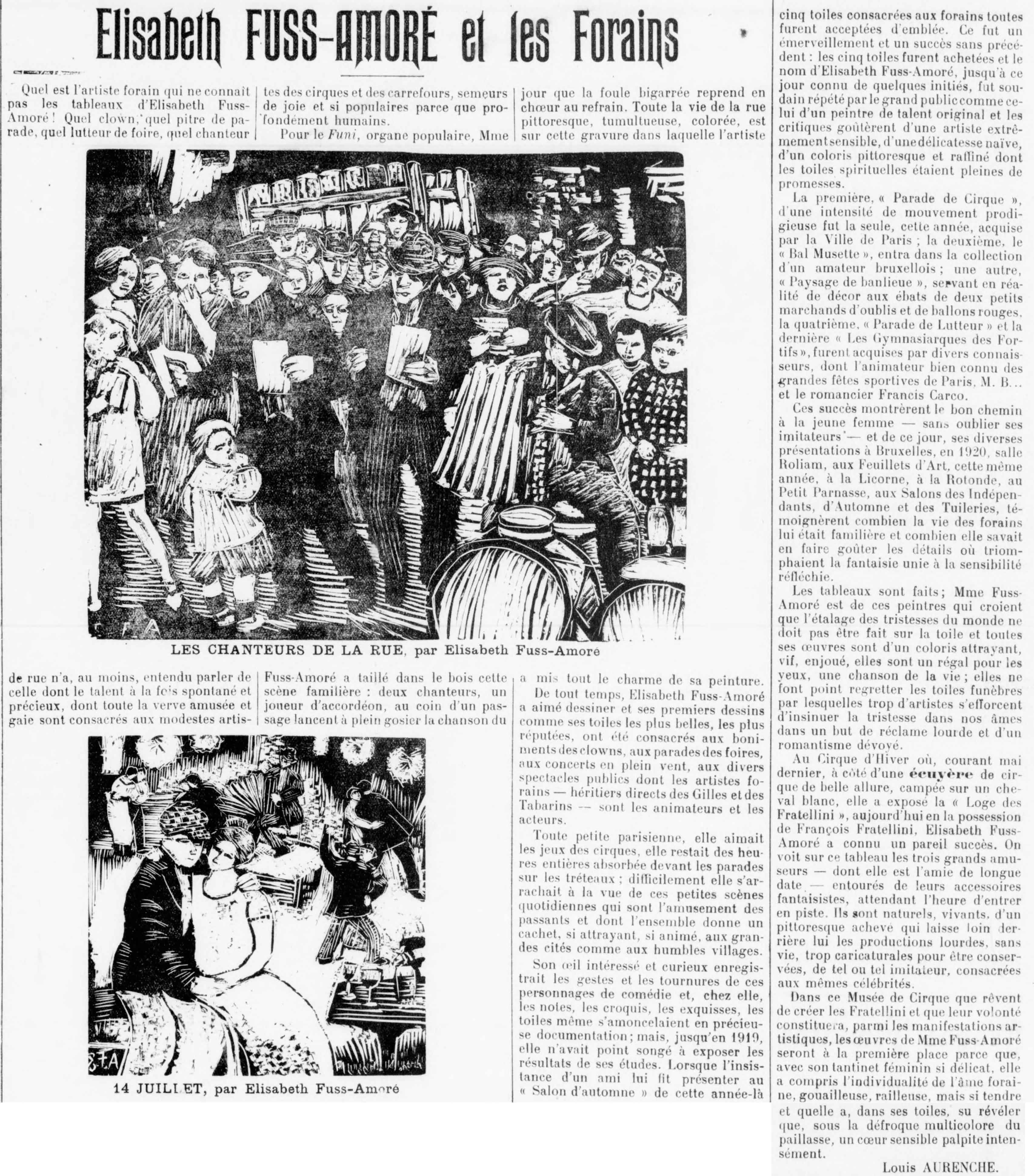  what street singer hasn't at least heard of her whose talent, both spontaneous and precious, and whose amused and joyful verve are dedicated to the humble artists of circuses and street corners, sowers of joy and so popular because they are profoundly human. what street singer hasn't at least heard of her whose talent, both spontaneous and precious, and whose amused and joyful verve are dedicated to the humble artists of circuses and street corners, sowers of joy and so popular because they are profoundly human.
For the Funi, a popular organ, Ms. Fuss-Amoré carved this familiar scene in wood: two singers, an accordion player, at the corner of a passageway, belt out the song of the day at full blast, while the motley crowd joins in the chorus. All the life of the picturesque, tumultuous, and colorful street is captured in this engraving, into which the artist has poured all the charm of her painting.
Elisabeth Fuss-Amoré has always loved drawing, and her earliest drawings, like her finest and most renowned paintings, were devoted to clown patter, fairground parades, open-air concerts, and various public spectacles in which fairground artists, direct heirs to the Gilles and Tabarins, were the entertainers and actors.
As a young Parisian, she loved circus games; she would spend hours absorbed in front of the parades on the trestle stages; she could hardly tear herself away from the sight of these small, everyday scenes that entertain passersby and, taken together, give such an attractive, lively character to large cities and humble villages alike. Her interested and curious eye recorded the gestures and turns of these comic characters, and at home, notes, sketches, exquisite drawings, and even paintings piled up as precious documentation. But, until 1919, she had never considered exhibiting the results of her studies. When, at the insistence of a friend, she presented five canvases devoted to fairground artists at the "Salon d'Automne" that year, all were immediately accepted.
It was a marvel and an unprecedented success: the five canvases were purchased, and the name of Elisabeth Fuss-Amoré, until then known only to a few insiders, was suddenly repeated by the general public as that of a painter of original talent, and the critics were delighted with an extremely sensitive artist, with a naive delicacy, a picturesque and refined color scheme, whose witty canvases were full of promise.
The first, "Parade de Cirque," with its prodigious intensity of movement, was the only one acquired by the City of Paris that year; the second, "Bal Musette," entered the collection of a Brussels art lover. another, "Landscape of the Suburbs", actually serving as a backdrop for the antics of two small sellers of forget-me-nots and red balloons, the fourth, "Parade of Wrestler" and the last "The Gymnasiarques of the Fortifs", were acquired by various connoisseurs, including the well-known host of the great sporting festivals of Paris, Mr. B... and the novelist Francis Carco. These successes showed the right path to the young woman, without forgetting her imitators, and from that day on, her various presentations in Brussels, in 1920, at the Salle Roliam, at the Feuillets d'Art, that same year, at the Licorne, at the Rotonde, at the Petit Parnasse, at the Salons des Indépendants, d'Automne and des Tuileries, testified to how familiar the life of the fairground people was to her and how she knew how to make people appreciate the details where fantasy triumphed united with thoughtful sensitivity. The pictures are done; Mrs. Fuss-Amoré is one of those painters who believe that the world's sorrows should not be displayed on canvas, and all her works are attractively colored, lively, and playful. They are a feast for the eyes, a song of life; they do not make us miss the funereal canvases with which too many artists strive to insinuate sadness into our souls for the sake of heavy-handed advertising and misguided romanticism.
At the Cirque d'Hiver, where last May, alongside a beautiful circus rider perched on a white horse, she exhibited the "Loge des Fratellini," now in the possession of François Fratellini, Elisabeth Fuss-Amoré enjoyed similar success. In this painting, we see the three great entertainers, of whom she is a longtime friend, surrounded by their fanciful accessories, waiting for the time to enter the ring. They are natural, alive, with a finished picturesqueness that leaves far behind the heavy, lifeless productions, too caricatured to be preserved, of this or that imitator, devoted to the same celebrities. In this Circus Museum that the Fratellini dream of creating and that their will will constitute, among the artistic manifestations, the works of Mrs. Fuss-Amoré will take pride of place because, with her delicate feminine touch, she understood the individuality of the fairground soul, mocking, mocking, yet so tender, and she was able, in her paintings, to reveal that, beneath the multicolored trappings of the straw mattress, a sensitive heart beats intensely.
Louis AURENCHE.
|