


| L'Œuvre - March 05, 1925 |
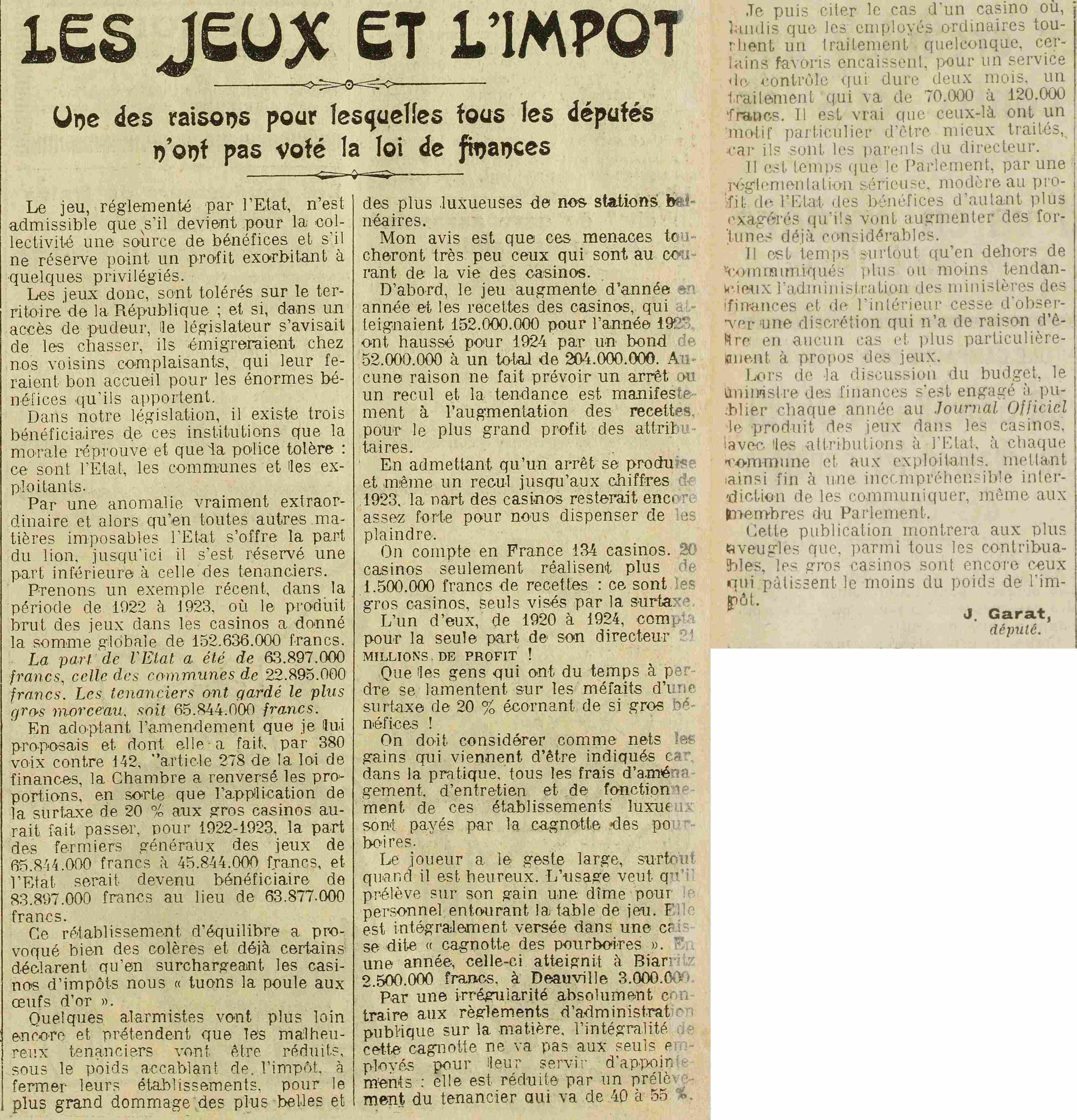
Gambling, regulated by the State, is only admissible if it becomes a source of profit for the community and if it does not reserve an exorbitant profit for a few privileged people. In our legislation, there are three beneficiaries of these institutions that morality disapproves and that the police tolerate: they are the State, the municipalities and the operators. Let us take a recent example, in the period from 1922 to 1923, where the gross product of casino games gave the total sum of 152,636,000 francs. By adopting the amendment that I proposed to it and which it made, by 380 votes to 142, Article 278 of the Finance Act, the Chamber reversed the proportions, so that the application of the 20% surcharge to large casinos would have caused, for 1922-1923, the share of the farmers general of games to go from 65,844,000 francs to 45,844,000 francs, and the State would have become the beneficiary of 83,897,000 francs instead of 63,877,000 francs. My opinion is that these threats will affect very little those who are aware of the life of the casinos. Assuming that a halt occurs and even a decline to the figures of 1923, the share of casinos would still remain high enough to exempt us from complaining about them. The winnings just indicated must be considered net because, in practice, all the costs of fitting out, maintaining and running these luxurious establishments are paid from the tip pool. The player has a generous gesture, especially when he is happy. Custom dictates that he takes a tithe from his winnings for the staff surrounding the gaming table. It is paid in full into a fund called the "tip pool". In one year, this reached 2,500,000 francs in Biarritz, and 3,000,000 in Deauville. By an irregularity absolutely contrary to the public administration regulations on the matter, the entirety of this pool does not go to the employees alone to serve as their salaries: it is reduced by a levy from the manager which ranges from 40 to 55%. I can cite the case of a casino where, while ordinary employees receive a salary of some kind, some favorites collect, for a control service that lasts two months, a salary that goes from 70,000 to 120,000 francs. It is true that these have a particular reason to be better treated, because they are the relatives of the director. It is time that Parliament, by a serious regulation, moderates for the benefit of the State profits all the more exaggerated as they will increase already considerable fortunes. It is time above all that apart from more or less biased communiqués the administration of the Ministries of Finance and the Interior ceases to observe a discretion that has no reason to exist in any case and more particularly with regard to games. During the budget discussion, the Minister of Finance committed to publishing each year in the Official Journal the proceeds of casino games, with the allocations to the State, to each municipality and to operators, thus putting an end to an incomprehensible ban on communicating them, even to members of Parliament. This publication will show the blindest that, among all taxpayers, the big casinos are still those that suffer the least from the weight of the tax J. Garat, deputy.
|
| Back March 05, 1925 |