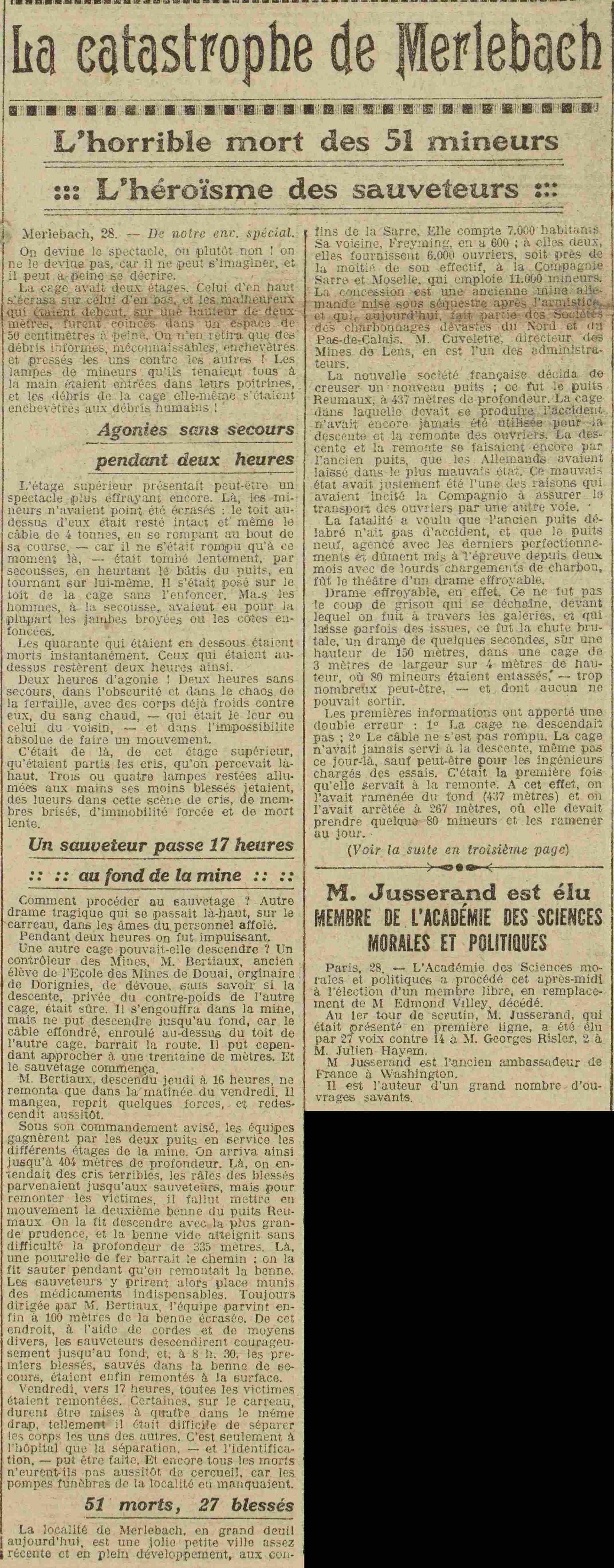
Merlebach, 28. - From our special env.
One can imagine the spectacle, or rather, no! One cannot imagine it, for it cannot be imagined, and it can hardly be described.
The cage had two levels. The upper one collapsed onto the lower one, and the unfortunate people who were standing, at a height of two meters, were trapped in a space barely 50 centimeters wide. Only shapeless, unrecognizable debris, tangled and pressed against each other, were recovered! The miners' lamps they were all holding had penetrated their chests, and the debris of the cage itself had become entangled with the human remains!
Agonies without help for two hours
The upper floor presented perhaps an even more frightening spectacle. There, the miners hadn't been crushed: the roof above them had remained intact, and even the four-ton cable, breaking at the end of its travel—for it had only broken at that moment—had fallen slowly, jerking, hitting the shaft frame, spinning around. It had landed on the roof of the shaft without breaking it. But the men, in the jolt, had mostly had their legs crushed or their ribs crushed.
The forty below had died instantly. Those above remained like that for two hours.
Two hours of agony. Two hours without help, in darkness and chaos, scrap metal, with bodies already cold against them, blood warm, their own or their neighbor's, and with the absolute impossibility of moving.
It was from there, from this upper floor, that the screams had come, and they could be heard up there. Three or four lamps, still lit in the hands of the less injured, cast a glimmer of light over this scene of screams, broken limbs, forced immobility, and slow death.
A rescuer spent 17 hours at the bottom of the mine:
How to proceed with the rescue? Another tragic drama was unfolding up there, on the floor, in the minds of the panicked personnel. For two hours, they were helpless. Could another cage descend? A Mines Inspector, Mr. Bertiaux, a former student of the Douai School of Mines, originally from Dorignies, volunteered, without knowing if the descent, deprived of the counterweight of the other cage, was safe. He plunged into the mine, but could not descend to the bottom because the collapsed cable, coiled above the roof of the other cage, blocked the way. However, he was able to approach to within thirty meters. And the rescue began,
Mr. Bertiaux, who had descended on Thursday at 4 p.m., did not return until Friday morning. He ate, regained some strength, and went back down immediately.
Under his wise command, the teams reached the different levels of the mine through the two shafts in operation. They reached a depth of 404 meters. There, terrible screams could be heard, and the death rattles of the wounded reached the rescuers, but to raise the victims, the second bucket from the Reumaux shaft had to be set in motion. It was lowered with the greatest caution, and the empty bucket reached a depth of 335 meters without difficulty. There, an iron beam blocked the way; it was blown up while the bucket was being raised. The rescuers then took their places, equipped with essential medicines. Still led by Mr. Bertiaux, the team finally reached within 100 meters of the crushed bucket.
From this point, using ropes and various means, the rescuers courageously descended to the bottom, and at 8:30 a.m., the first injured, saved in the emergency bucket, were finally brought to the surface. On Friday, around 5:00 p.m., all the victims had been brought to the surface. Some, lying on the ground, had to be placed four atop a sheet, so difficult was it to separate the bodies. It was only at the hospital that the separation and identification could be made. And even then, not all the dead received coffins immediately, as the local funeral home lacked them.
51 dead, 27 injured
The town of Merlebach, in deep mourning today, is a pretty, relatively new and rapidly developing town on the edge of the Saarland. It has 7,000 inhabitants. Its neighbor, Freyming, has 600; Between them, they provided 6,000 workers, nearly half of its workforce, to the Sarre et Moselle Company, which employed 11,000 miners. The concession was a former German mine sequestered after the armistice and which today is part of the Sociétés des charbonnages dévastés du Nord et du Pas-de-Calais. Mr. Cuvelette, director of the Lens Mines, was one of its directors.
The new French company decided to sink a new shaft; this was the Reumaux shaft, 437 meters deep. The shaft in which the accident occurred had never before been used for lowering and raising workers. The descent and ascent were still carried out through the old shaft, which the Germans had left in the worst condition. This poor condition had been one of the reasons that had prompted the Company to arrange for the transport of workers by another route. Fate would have it that the old, dilapidated shaft did not have an accident, and that the new shaft, designed with the latest improvements and duly tested for two months with heavy loads of coal, was the scene of a terrible tragedy.
A terrible tragedy indeed. It wasn't the firedamp explosion that raged, from which people fled through the galleries, and which sometimes left exits; it was the sudden fall, a tragedy lasting a few seconds, from a height of 150 meters, into a cage 3 meters wide by 4 meters high, where 80 miners were crammed—perhaps too many, and none of whom could escape. Initial reports revealed a double error:
1. The cage was not descending;
2. The cable did not break.
The cage had never been used for descent, not even that day, except perhaps for the engineers in charge of the tests. It was the first time it had been used for hauling. For this purpose, it was brought up from the bottom (437 meters) and stopped at 267 meters, where it was to pick up some 80 miners and bring them back to the surface.
See the rest on the third page (full edition in french)
| Freyming-Merlebach in Moselle since 1971 |
Merlebach before 1971 and the origin of the term "CRS-SS", which does not date from May 68, but from October 48 |
|
|