


| L'Œuvre - April 05, 1925 |
|
AFTER THE SAINT-BENOIT CATASTROPHE
The Paris-Orleans engineers were expecting disaster. We knew that on the Orléans network, as we said yesterday, a disaster was inevitable. The information received on this subject from Mr. Franck, General Secretary of the Union Syndicale des Techniciens (U.S.T.I.C.A.), which he shared with us, provides further proof:
Sir,
To support your argument regarding the poor condition of the tracks on the P.-O., I would like to offer you not only my own testimony, but also that of a company engineer with whom I traveled between Bordeaux and Paris after the Saint-Benoît disaster. First of all, it is common knowledge that the condition of the tracks on the Paris-Bordeaux line is deplorable. For many months, for anyone who has traveled, particularly on the Paris-Bordeaux express train leaving Paris at 7 p.m. 10, it is almost impossible to eat a meal in a dining car located at the end of the train and subject to violent jolts between Paris and Tours. In another section of the track, between Bordeaux and Poitiers, numerous subsidences occur as the cars pass; each bogie seems to fall into a hole. The situation, moreover, is well known since, the engineer in question told me, the mechanics' reports have long been pointing to this situation. It will therefore be easy, I believe, for investigators to have these reports seized from the traction department, which will demonstrate with certainty that those responsible are those who, seeking above all to pay dividends to their shareholders, neglect, despite increases in transport fares, to ensure basic safety by maintaining the tracks. We would add that your argument, regarding the need to increase the weight of the rails, is entirely correct. For several years now, railway companies have been considerably increasing the weight of rolling stock and, consequently, the weight per axle, while track reinforcement has not been proportionately increased. It is not enough, in fact, to replace 40- to 45-kilogram rails with 50- to 55-kilogram rails. This is a necessary condition, but not sufficient. The entire track foundation must be re-examined and modified. Given the moving masses on modern locomotives, it is important not only that the rails be able to withstand breakage, but also that the track not shift in the winding movements that even the presence of bogies cannot completely eliminate. This is undoubtedly a major undertaking, both from a technical and economic perspective, but it is an essential study if we do not want to see railway disasters recur with increasing frequency as the weight of the equipment increases. Please, etc. The Secretary General,
FRANCK. 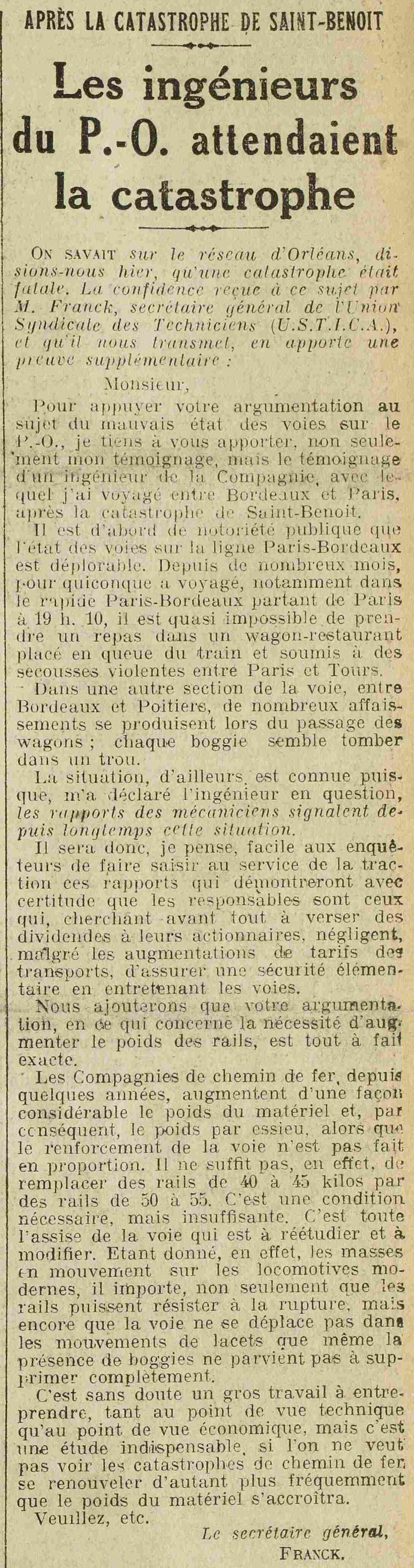 |
| Back - April 05, 1925 |