

| Le Funi - April 12, 1925 |
|
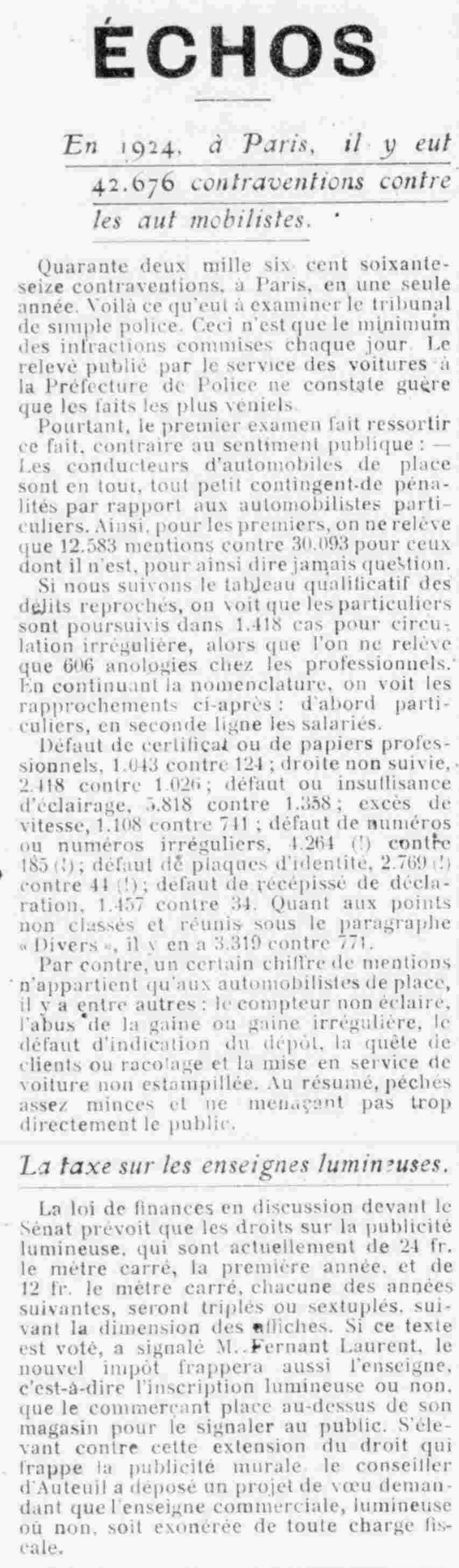
ECHOES
In 1924, in Paris, there were 42,676 traffic tickets issued to motorists.
Forty-two thousand six hundred and seventy-six traffic tickets issued in Paris in a single year. This is what the simple police court had to examine. This is only the minimum number of offenses committed each day. The report published by the vehicle service at the Police Prefecture records only the most trivial offenses. Yet, the first examination highlights this fact, contrary to public sentiment: - Drivers of private cars receive a very small contingent of penalties compared to private motorists. Thus, for the former, there are only 12,583 citations, compared to 30,093 for those who are, so to speak, never mentioned. - If we follow the classification of the offenses charged, we see that individuals are prosecuted in 1,418 cases for irregular driving, while only 606 cases of similar offenses are reported among professionals. Continuing the classification, we see the following similarities: individuals first, followed by employees. Failure to have a certificate or professional papers, 1,043 versus 121; failure to follow the right, 2,118 versus 1,026; lack of or insufficient lighting, 5,818 versus 1,358; speeding, 1,108 versus 741; lack of number plates or irregular numbers, 4,264 versus 185; lack of identification plates, 2,769 versus 41 (!); Failure to provide a receipt for the declaration, 1,457 versus 34. As for the unclassified items grouped under the "Miscellaneous" paragraph, there are 3,319 versus 771. However, a certain number of mentions apply only to motorists with a parking space. These include, among others: unlit meter, misuse of the conduit or irregular conduit, failure to indicate the depot, soliciting, and commissioning an unmarked car. In summary, these are fairly minor offenses and do not pose too direct a threat to the public. The tax on illuminated signs. The finance bill under discussion before the Senate provides that the tax on illuminated advertising, which is currently 24 francs per square meter for the first year and 12 francs per square meter for each subsequent year, will be tripled or sixfold, depending on the size of the posters. If this text is passed, Mr. Fernand Laurent pointed out, the new tax will also affect the sign, that is, the inscription, illuminated or not, that the merchant places above his store to inform the public. Rising against this extension of the tax that affects wall advertising, the Auteuil councilor submitted a draft motion requesting that the commercial sign, illuminated or not, be exempt from all tax burden.
|
| Back - April 12, 1925 |