

| L'Ouest-Éclair - April 12, 1925 |
|
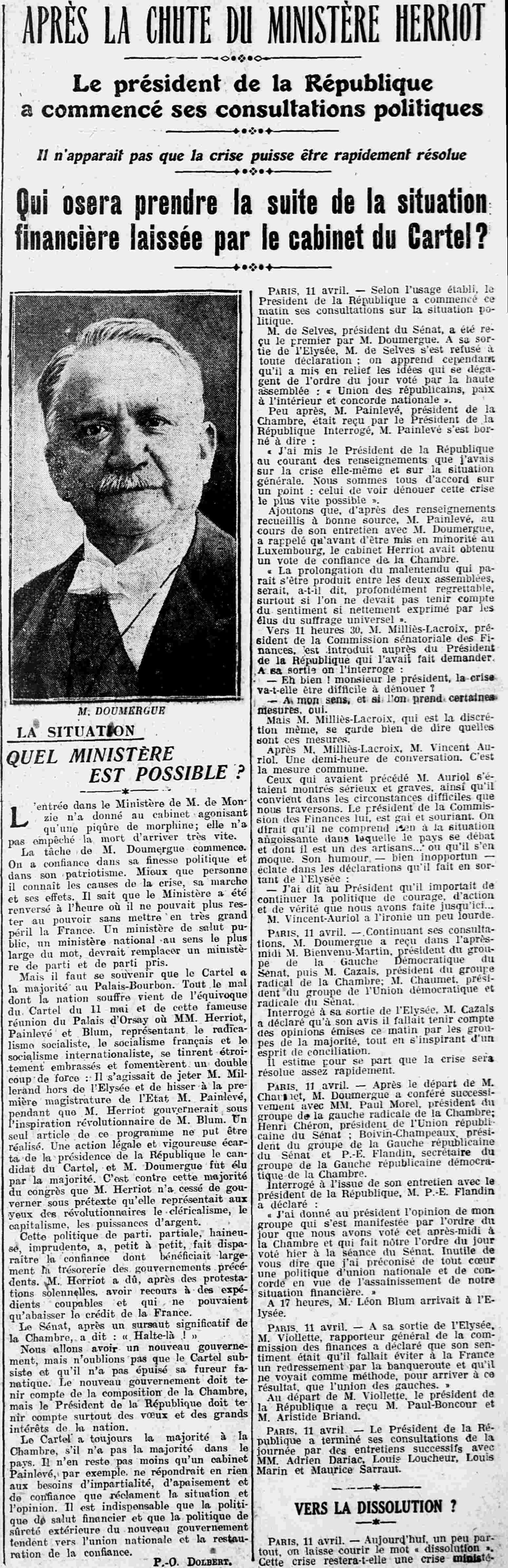
AFTER THE FALL OF THE HERRIOT MINISTRY
The President of the Republic has begun his political consultations. It does not appear that the crisis can be resolved quickly. Who will dare to take over the financial situation left by the Cartel cabinet? THE SITUATION WHICH MINISTRY IS POSSIBLE? Mr. de Monzie's entry into the Ministry only gave the dying cabinet a shot of morphine; it did not prevent death from coming very quickly. Mr. Doumergue's task begins. There is confidence in his political astuteness and his patriotism. Better than anyone, he knows the causes of the crisis, its course, and its effects. He knows that the Ministry was overthrown at a time when it could no longer remain in power without putting France in great danger. A ministry of public safety, a national ministry in the broadest sense of the word, should replace a party and biased ministry. But it must be remembered that the Cartel has the majority in the Palais-Bourbon. All the harm the nation suffers stems from the ambiguity of the Cartel of May 11 and from that famous meeting at the Palais d'Orsay where Messrs. Herriot, Painlevé, and Blum, representing socialist radicalism, French socialism, and internationalist socialism, held each other in close embrace and fomented a double coup: the aim was to throw Mr. Millerand from the Élysée and to elevate Mr. Painlevé to the highest office of the State, while Mr. Herriot governed under the revolutionary inspiration of Mr. Blum. A single article of this program could not be implemented. Vigorous legal action removed the Cartel candidate from the presidency of the Republic, and Mr. Doumergue was elected by the majority. It was against this congressional majority that Mr. Herriot continually governed, under the pretext that it represented clericalism, capitalism, and the powers of money in the eyes of the revolutionaries. This partisan, hateful, and imprudent policy gradually eroded the trust that the treasury had largely enjoyed under previous governments. Mr. Herriot was forced, after solemn protests, to resort to culpable expedients that could only lower the credibility of France. The Senate, after a significant outburst from the Chamber, said: "Stop!" We are going to have a new government, but let us not forget that the Cartel remains and has not exhausted its fanatical fury. The new government must take into account the composition of the Chamber, but the President of the Republic must above all take into account the wishes and the great interests of the nation. The Cartel still has a majority in the Chamber, if it does not have a majority in the country. The fact remains that a Painlevé cabinet, for example, would in no way meet the needs for impartiality, appeasement, and confidence demanded by the situation and public opinion. It is essential that the new government's policy of financial salvation and its policy of external security strive toward national unity and the restoration of confidence. P.-O. DOLBERT. PARIS, April 11. According to established practice, the President of the Republic began his consultations on the political situation this morning. Mr. de Selves, President of the Senate, was received first by Mr. Doumergue. Upon leaving the Élysée Palace, Mr. de Selves declined to make any statements; however, we learn that he highlighted the ideas emerging from the agenda voted on by the upper house: "Union of Republicans, Internal Peace, and National Harmony." Shortly after, Mr. Painlevé, President of the Chamber, was received by the President of the Republic. When questioned, Mr. Painlevé merely said: "I have informed the President of the Republic of the information I have on the crisis itself and on the general situation. We all agree on one point: that of seeing this crisis resolved as quickly as possible." Let us add that, according to reliable information, Mr. Painlevé, during his meeting with Mr. Doumergue, recalled that before being placed in the minority in Luxembourg, the Herriot cabinet had obtained a vote of confidence from the Chamber. "The continuation of the misunderstanding that appears to have occurred between the two assemblies would be," he said, "deeply regrettable, especially if we were not to take into account the sentiment so clearly expressed by the elected representatives of universal suffrage." Around 11:30 a.m., Mr. Milliès-Lacroix, chairman of the Senate Finance Committee, was introduced to the President of the Republic, who had sent for him. Upon his exit, he was asked: "Well! Mr. President, will the crisis be difficult to resolve?" "In my opinion, and if certain measures are taken, yes." But Mr. Milliès-Lacroix, who is the epitome of discretion, is careful not to say what these measures are. After Mr. Milliès-Lacroix, Mr. Vincent Auriol. A half-hour of conversation. It's the common measure. Those who preceded Mr. Auriol had been serious and grave, as is fitting in the difficult circumstances we are going through. The Chairman of the Finance Committee, for his part, is cheerful and smiling. One would say that he doesn't understand the distressing situation the country is struggling with and of which he is one of the architects... or that he doesn't care. His humor, quite inappropriate, bursts forth in the statements he made upon leaving the Élysée:
I told the President that it was important to continue the policy of courage, action, and truth that we have pursued until now... Mr. Vincent-Auriol's irony is a bit heavy-handed. PARIS, April 11. Continuing his consultations, Mr. Doumergue received in the afternoon Mr. Bienvenu-Martin, president of the Democratic Left group in the Senate, then Mr. Cazals, president of the Radical group in the Chamber; Mr. Chaumet, president of the Democratic and Radical Union group in the Senate. Questioned upon leaving the Élysée Palace, Mr. Cazals stated that in his opinion, the opinions expressed this morning by the majority groups should be taken into account, while still being inspired by a spirit of conciliation.
He believes, for his part, that the crisis will be resolved fairly quickly. PARIS, April 11. After Mr. Charnet's departure, Mr. Doumergue conferred successively with Mr. Paul Morel, president of the Radical Left group in the Chamber; Henri Chéron, president of the Republican Union in the Senate; Boivin-Champeaux, President of the Republican Left group in the Senate, and P.-E. Flandin, Secretary of the Democratic Republican Left group in the Chamber. Questioned after his meeting with the President of the Republic, Mr. P.-E. Flandin declared: "I gave the President the opinion of my group, which was expressed in the agenda we voted on this afternoon in the Chamber and which makes our own the agenda voted on yesterday at the Senate session. Needless to say, I wholeheartedly advocated a policy of national unity and harmony with a view to improving our financial situation." At 5:00 p.m., Mr. Léon Blum arrived at the Élysée Palace.
PARIS, April 11. Upon leaving the Élysée Palace, Mr. Viollette, General Rapporteur of the Finance Committee, declared that his feeling was that France must be prevented from going bankrupt and that he saw no other method for achieving this result than the union of the left.
Upon Mr. Viollette's departure, the President of the Republic received Mr. Paul-Boncour and Mr. Aristide Briand.
PARIS, April 11. The President of the Republic concluded his consultations for the day with successive meetings with Messrs. Adrien Dariac, Louis Loucheur, Louis Marin, and Maurice Sarraut. TOWARDS DISSOLUTION? PARIS, April 11. - Today, almost everywhere, the word "dissolution" is being bandied about. Will this crisis remain a ministerial crisis?
|
| Back - April 12, 1925 |