

| Comœdia - April 19, 1925 |
|
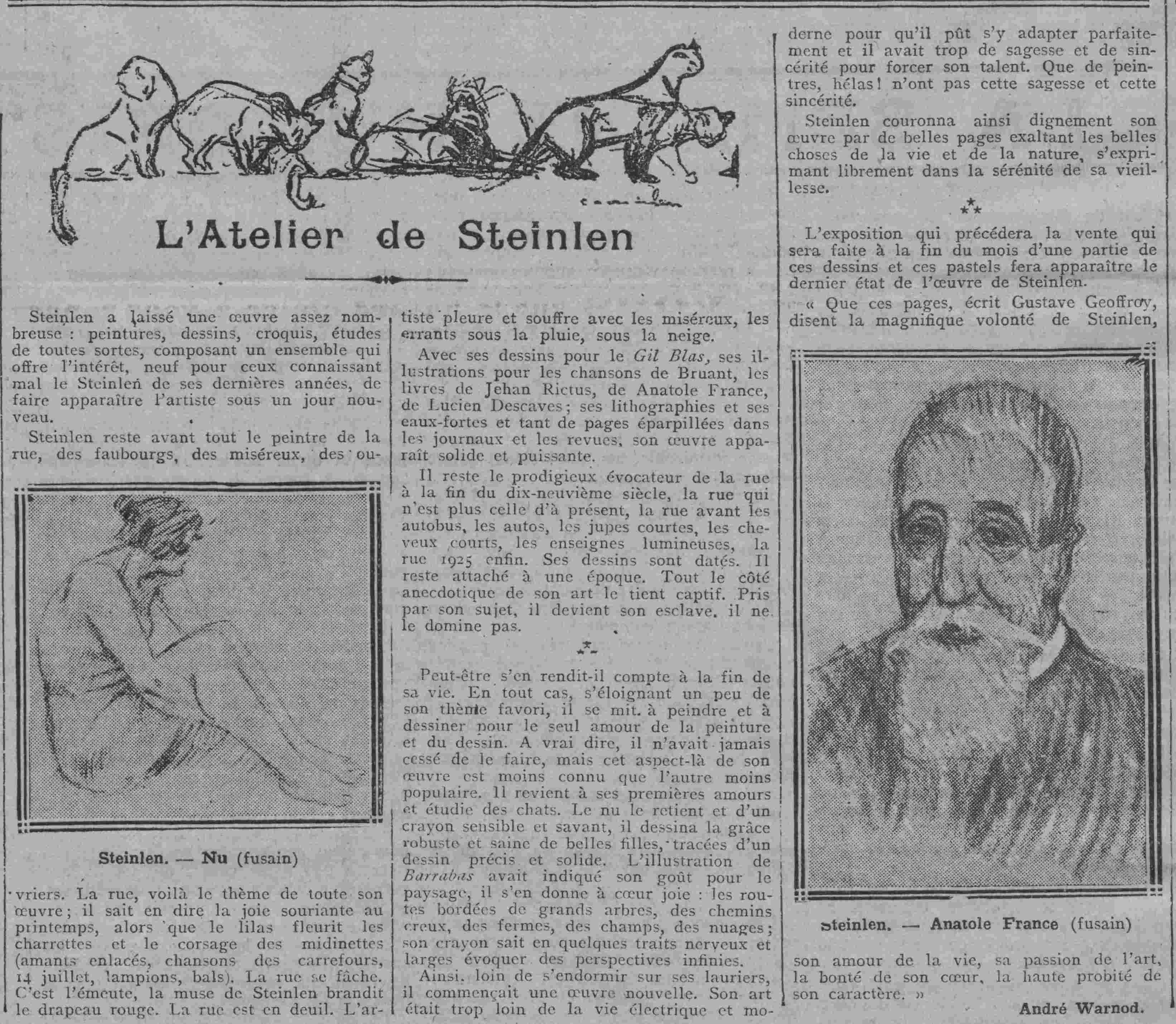
Steinlen's Studio
Steinlen left behind a fairly extensive oeuvre: paintings, drawings, sketches, and studies of all kinds, composing a collection that offers the new interest of those unfamiliar with Steinlen in his later years, revealing the artist in a new light.
Steinlen remains above all the painter of the street, of the suburbs, of the poor, of the workers. The street is the theme of all his work; he knows how to express its smiling joy in spring, when the lilacs bloom on the carts and the bodices of the young girls (embracing lovers, songs at the crossroads on Bastille Day, lanterns, balls). The street is angry. It's a riot, Steinlen's muse is waving the red flag. The street is in mourning. The artist weeps and suffers with the poor, the wanderers in the rain and the snow.
With his drawings for Gil Blas, his illustrations for Bruant's songs, the books of Jehan Rictus, Anatole France, and Lucien Descaves; his lithographs and etchings, and so many pages scattered throughout newspapers and magazines, his work appears solid and powerful.
He remains the prodigious evocator of the street at the end of the nineteenth century, the street that is no longer the one of today, the street before buses, cars, short skirts, short hair, illuminated signs, the street of 1925, in short. His drawings are dated. He remains attached to an era. The entire anecdotal side of his art holds him captive. Caught up in his subject, he becomes its slave; he does not dominate it. Perhaps he realized this at the end of his life. In any case, moving away somewhat from his favorite theme, he began... to paint and draw for the sole love of painting and drawing. In truth, he had never stopped doing so, but this aspect of his work is less well-known than the other, less popular one. He returned to his first loves and studied cats. The nude held his attention, and with a sensitive and skillful pencil, he drew the robust and healthy grace of beautiful girls, depicted with a precise and solid outline. The illustration of Barrabas had indicated his taste for landscapes, and he gave it his all: roads lined with tall trees, sunken lanes, farms, fields, clouds; his pencil knew how to evoke infinite perspectives in a few broad, nervous strokes. Thus, far from resting on his laurels, he began a new work. His art was too far removed from the electric, modern life for him to adapt to it perfectly, and he had too much wisdom and sincerity to force his talent. How many painters, alas! do not possess this wisdom and sincerity. Steinlen thus fittingly crowned his work with beautiful pages exalting the beautiful things in life and nature, expressing himself freely in the serenity of his old age.
The exhibition that will precede the sale of some of these drawings and pastels at the end of the month will reveal the final state of Steinlen's work. "May these pages," wrote Gustave Geoffroy, "express Steinlen's magnificent will, his love of life, his passion for art, the kindness of his heart, the high integrity of his character." André Warnod.
|
| back - April 19, 1925 |