


| Le Provençal de Paris 02 novembre 1924 |
|
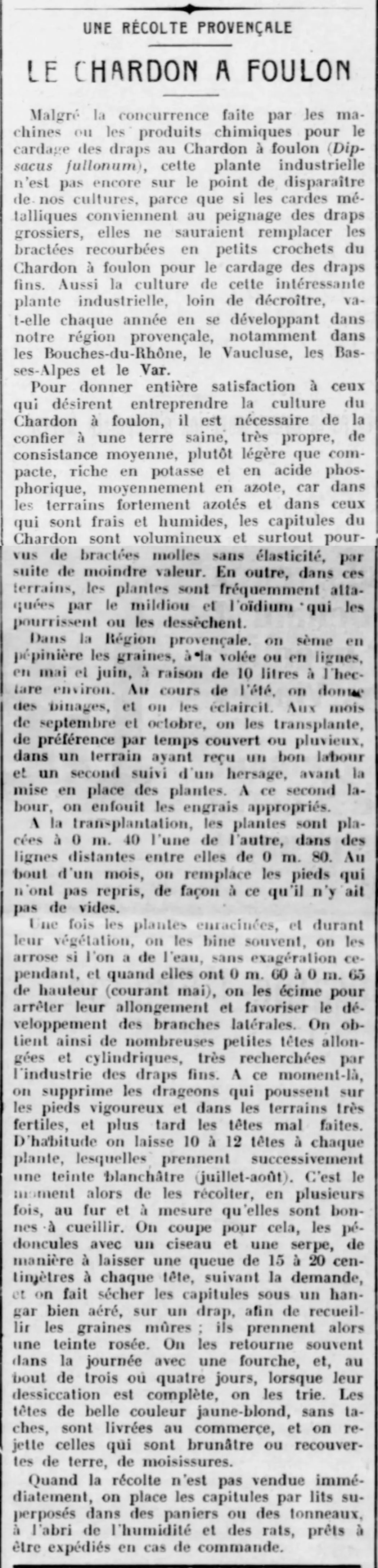
A PROVENÇAL HARVEST Despite the competition from machines or chemicals for carding cloth with Fuller's Thistle (Dipsacus fullonum), this industrial plant is not yet about to disappear from our crops, because if metal cards are suitable for combing coarse cloth, they cannot replace the bracts curved into small hooks of Fuller's Thistle for carding fine cloth. Also, the cultivation of this interesting industrial plant, far from decreasing, is developing each year in our Provençal region, particularly in Bouches-du-Rhône, Vaucluse, Basses-Alpes and Var. To give full satisfaction to those who wish to undertake the cultivation of Fuller's Thistle, it is necessary to entrust it to a healthy, very clean soil, of average consistency, rather light than compact, rich in potash and phosphoric acid, moderately in nitrogen, because in highly nitrogenous soils and in those which are fresh and humid, the capitula of the Thistle are voluminous and especially provided with soft bracts without elasticity, consequently of lesser value. In addition, in these soils, the plants are frequently attacked by mildew and powdery mildew which rot them or dry them out. In the Provençal Region, the seeds are sown in a nursery, broadcast or in lines, in May and June, at a rate of approximately 10 liters per hectare. During the summer, they are hoeed and thinned out. In September and October, they are transplanted, preferably in overcast or rainy weather, in a well-ploughed area and a second one followed by harrowing, before planting the plants. During this second ploughing, the appropriate fertilizers are buried. Once the plants are rooted, and during their vegetation, they are hoeed often, watered if there is water, without exaggeration however, and when they are 0 m. 60 to 0 m. 65 high (during May), they are topped to stop their elongation and encourage the development of lateral branches. This produces many small, elongated, cylindrical heads, highly sought after by the fine cloth industry. At this time, the suckers that grow on vigorous plants and in very fertile soil are removed, and later the poorly formed heads. Usually, 10 to 12 heads are left on each plant, which successively take on a whitish tint (July-August). This is the time to harvest them, in several batches, as and when they are ready to pick. To do this, the peduncles are cut with scissors and a billhook, so as to leave a tail of 15 to 20 centimeters on each head, depending on demand, and the capitula are dried in a well-ventilated shed, on a sheet, in order to collect the ripe seeds; they then take on a pinkish tint. They are often turned over during the day with a pitchfork, and, after three or four days, when they are completely dry, they are sorted. The heads of beautiful yellow-blond color, without spots, are delivered to the trade, and those which are brownish or covered with earth, mold are rejected. |
 |
| Retour - Back 02 novembre 1924 |