

| Le Journal 02 novembre 1924 |
|
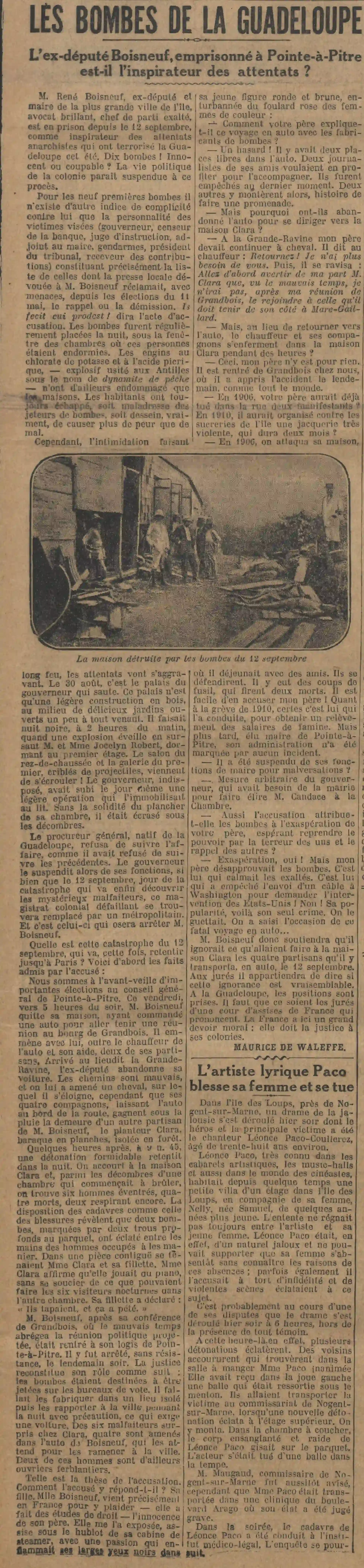
Mr. René Boisneuf, former deputy and mayor of the largest city on the island, brilliant lawyer, exalted party leader, has been in prison since September 12, as the instigator of the anarchist attacks that terrorized Guadeloupe this summer. Ten bombs! Innocent or guilty? The political life of the colony seems to be hanging on this trial. For the first nine bombs there is no other indication of complicity against him than the personality of the targeted victims (governor, bank censor, investigating judge, deputy mayor, gendarmes, president of the court, tax collector) constituting precisely the list of those whose recall or resignation the local press devoted to Mr. Boisneuf had been demanding, with threats, since the elections of May 11. Is fecit cui prodest! the indictment will say. However, as the intimidation fizzled out, the attacks got worse. On August 30, it was the governor's palace that was blown up. This palace was only a light wooden construction, in the middle of delightful gardens open to almost everyone. It was pitch black at 2 a.m. when an explosion woke up with a start Mr. and Mrs. Jocelyn Robert, sleeping on the first floor. The living room on the ground floor and the gallery on the first floor, riddled with projectiles, had just collapsed! The governor, who was unwell, had undergone a minor operation that same day that had left him bedridden. Without the solidity of the floor of his room, he would have been crushed under the rubble. The attorney general, a native of Guadeloupe, refused to follow the case, as he had refused to follow the previous ones. The governor then suspended him from his duties, so that on September 12, the day of the catastrophe that would finally uncover the mysterious criminals, this failing colonial magistrate would find himself replaced by a metropolitan. And it was he who would dare to arrest Mr. Boisneuf. What was this catastrophe of September 12, which would, this time, resound as far as Paris? Here are first the facts admitted by the accused: Mr. Boisneuf, after his conference in Grandbois, where bad weather cut short the planned political meeting, had returned to his home in Pointe-à-Pitre. He was arrested there, without resistance, the following evening. The courts reconstruct his role as follows: the bombs were intended to be thrown at the polling stations. They had to be made in an isolated place and then brought back to the city, during the night with caution, which required a car. Of the six criminals caught at Clara's, four were taken to Boisneuf's car, which was waiting for them to take them back to the city. Two of these men were tinsmiths. This is the prosecution's thesis. How does the accused respond to it? His daughter, Miss Boisneuf, is coming to France precisely to plead - she studied law - her father's innocence. She explained it to me, sitting under the porthole of her steamer cabin, with a passion that inflamed her large black eyes in her young, round, brown face, turbaned with the pink headscarf of women of color: How does your father explain this car trip with the bomb makers? My father has nothing to do with this. He came back to us from Grandbois, where he learned of the accident the next day, like everyone else. In 1906, your father had already killed two demonstrators in the street? In 1910, he had organized a very violent peasant revolt against the island's sugar factories, which lasted two months? In 1906, his house was attacked, where he was having lunch with friends. They defended themselves. There were gunshots, which left two dead. It is easy to accuse my father of this! As for the strike of 1910, it is true that he led it, to obtain an increase in starvation wages. But later, elected mayor of Pointe-à-Pitre, his administration was not marked by any incident. He was suspended from his duties as mayor for embezzlement? An arbitrary measure by the governor, who needed the town hall to have Mr. Candace elected to the Chamber. So the prosecution attributes the bombs to the exasperation of your father, father, hoping to regain power by terrorizing some and recalling others? Exasperation, yes! But my father disapproved of the bombs. It was he who calmed the fanatics. It was he who prevented a cable from being sent to Washington to request the intervention of the United States! No! His popularity, that was his only crime. He was being watched. The opportunity of this fatal car trip was seized... Mr. Boisneuf will therefore maintain that he was unaware of what the four partisans he transported there by car on September 12 were going to do at the Clara house. It will be up to the jurors to say whether this ignorance is likely. In Guadeloupe, positions have been taken. It is necessary that the jurors of a French assize court decide. France has a great moral duty here: it owes justice to its colonies. MAURICE DE WALEFFE, |
 |
| Retour - Back 02 novembre 1924 |