|
Our Cover
WARTAN MAHOKIAN
The Painter of the Sea
Introducing the great painter Wartan Mahokian to Nice may seem superfluous. His powerful and solid art has won our faithful host countless admirers. Our readers will have been happy to contemplate on the cover of this issue the features of the author of so many admirable seascapes. These would go without a comment, if we did not have the happy chance to have before our eyes a study devoted to Mahokian, by the most subtle, the most sagacious and the most sincere of critics, Camille Mauclair. We are forbidden to publish these pages here. We will try to summarize them without betraying too much the thought of our eminent collaborator.
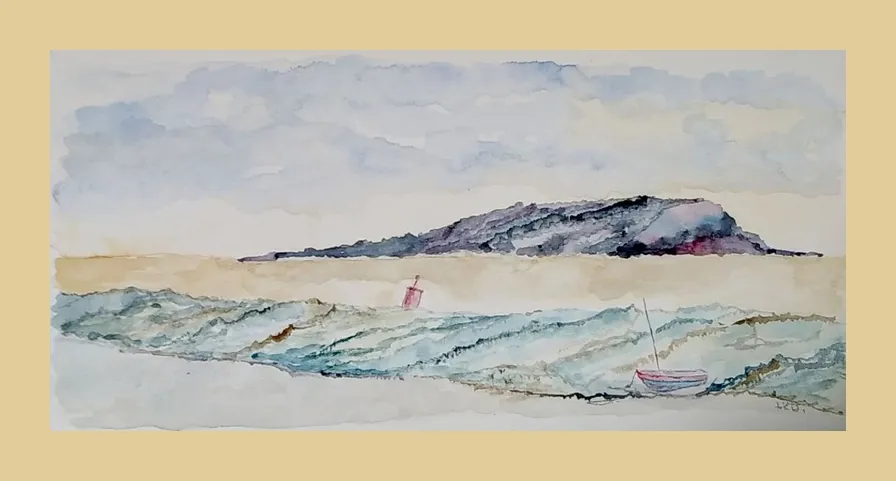
Attempting to confine Mahokian to a school is a futile task. He is a sincere contemplative who creates and does not emit theories. He painted beautiful landscapes, but he is above all the painter and poet of the waves. His favorite theme is the sea, the most difficult and the most formidable of pictorial art. Few are those who have succeeded in developing it: Van Goyen, Turner, Constable, Delacroix, in the past; among the moderns: Claude Monet, Manet, Eugène Boudin, Courbet, Whistler. These names are among the greatest. And it is the glory of Mahokian to be able to be placed in such a high lineage.
His originality is to have known how to express, better than any other, the expression of volumes and the design of decorative lines.
Here Camille Mauclair makes a remark on which we must stop. "Preoccupied with competing for speed and finesse with the multiple iridescences of water where the magic of the sky opens its suave abysses of clarity, too many painters have forgotten that water is a heavy material whose shocks are terrible." Beneath the imponderable sylphs of the foam, there is a formidable gravity, a volume as incompressible and compact as granite. A tidal wave is, by its material and its form, a sculpture. Rodin's genius had been able to perceive this aspect of the sea.
Wartan Mahokian understood this statuary massiveness of water. Its great waves come straight towards us with crushing fury. No painter like him has been able to paint the monstrous and raging sea. But beyond the drama and the storm, there is an infinite serenity:
"In this supposed chaos, the gaze of the poet painter then discovers another means of understanding and expressing: it is an ornamental drawing of prestigious richness. Each of the waves that come with as much regularity as tumult is a design composed by nature, for a moment, with as much precision, art, beauty and love as the design of an oak that will live three hundred years. Each of the waves is a masterpiece of ornamental art as patient as the most perfect and ingenious oriental embroidery or Gothic lace, and this masterpiece is dissolved as soon as it is born, and immediately replaced by another no less astonishing, and the figure of the sea is made of these millions of simultaneous and successive aspects that evoke, in an indefinable dream, all the forms of life." Mahokian knew how to reproduce all of these aspects by interpreting them, whether he set up his easel at the Pointe du Raz, on the Danish coast, in Sweden, in Capri, in Guernsey, at Cap d'Ail. And that is why in his work, of such perfect unity, no canvas resembles another. And we understand that the painter disdained "the subject", that he banished man from his paintings and with him the easy picturesque. He barely sometimes draws the silhouette of a ship or notes the flight of a seagull.
By this disdain for the "subject", his work is resolutely modern. But his art remains classical, we mean indifferent to the whims of fashion. It is of absolute probity.
Mahokian's work is "nourished by an ideal that cannot perish, revealing faith, science, continuous effort and deep inner concentration. I have not encountered such for a long time." What can be added to such a beautiful and just praise?
|