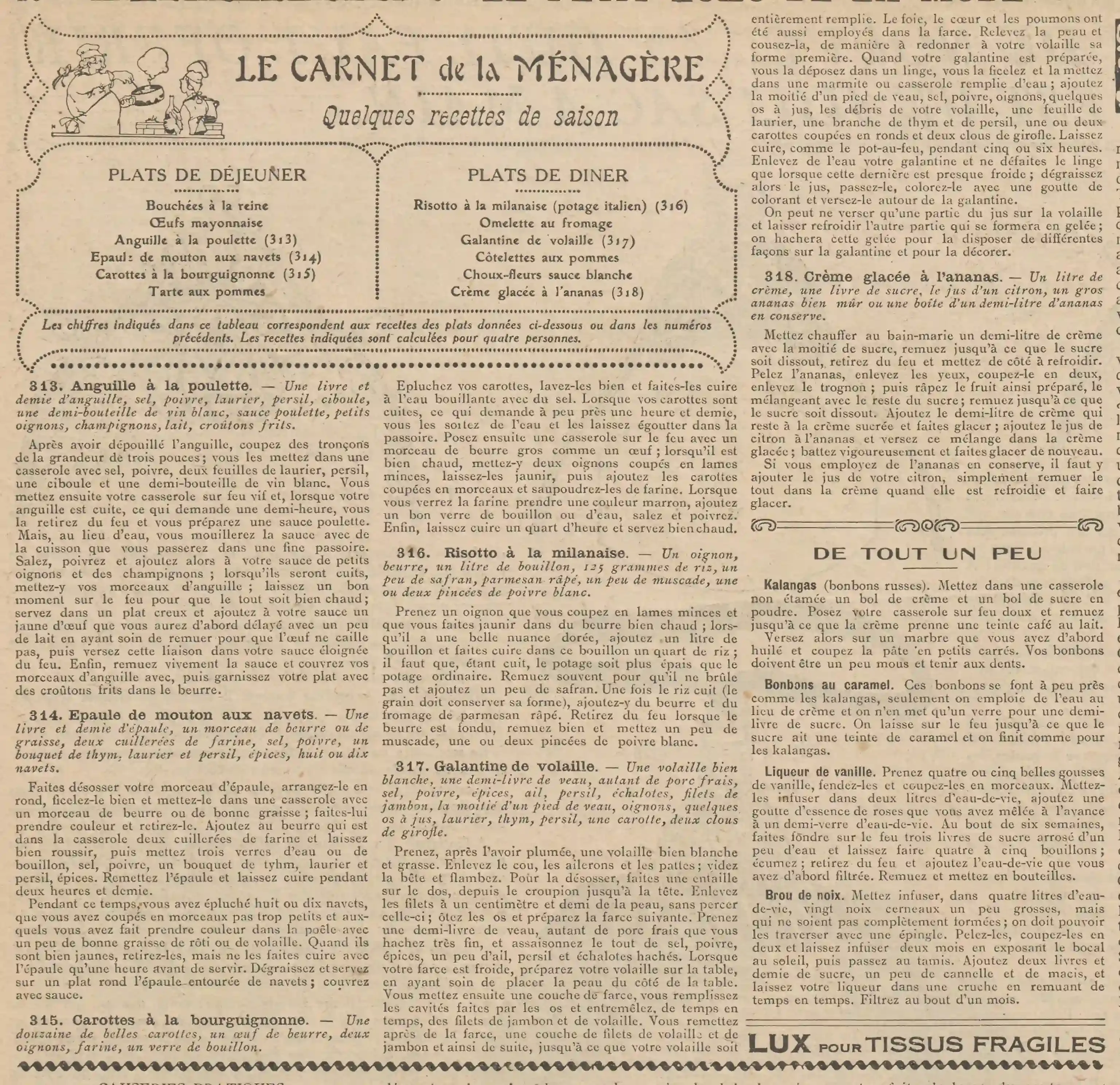
LUNCH DISHES
Bouches à la reine
Eggs mayonnaise
Eel à la poulette (313)
Shoulder of mutton with turnips (314)
Carrots à la bourguignonne (315)
Apple tart
DINNER DISHES
Risotto à la milanaise (Italian soup) (316)
Omelette with cheese
Poultry galantine (317)
Cutlets with apples
Cauliflower with white sauce
Pineapple ice cream (318)
313. Eel à la poulette.
A pound and a half of eel, salt, pepper, bay leaf, parsley, chives, half a bottle of white wine, poulette sauce, small onions, mushrooms, milk, fried croutons.
After skinning the eel, cut into three-inch pieces; you put them in a saucepan with salt, pepper, two bay leaves, parsley, a spring onion and half a bottle of white wine. You then put your saucepan on high heat and, when your eel is cooked, which takes half an hour, you remove it from the heat and prepare a poulette sauce. But, instead of water, you will moisten the sauce with cooking liquid that you will pass through a fine strainer. Salt, pepper and then add small onions and mushrooms to your sauce; when they are cooked, put your pieces of eel in; leave for a good while on the heat so that everything is nice and hot; serve in a deep dish and add to your sauce an egg yolk that you will have first diluted with a little milk, taking care to stir so that the egg does not curdle, then pour this mixture into your sauce away from the heat. Finally, stir the sauce briskly and cover your pieces of eel with it, then garnish your dish with croutons fried in butter.
314. Shoulder of mutton with turnips.
A pound and a half of shoulder, a piece of butter or fat, two spoonfuls of flour, salt, pepper, a bunch of thyme, bay leaf and parsley, spices, eight or ten turnips.
Bone your piece of shoulder, arrange it in a round, tie it well and put it in a saucepan with a piece of butter or good fat; let it take color and remove it. Add to the butter in the saucepan two spoonfuls of flour and let it brown well, then put three glasses of water or broth, salt, pepper, a bunch of thyme, bay leaf and parsley, spices. Put the shoulder back and let it cook for two and a half hours.
Meanwhile, you have peeled eight or ten turnips, which you have cut into pieces that are not too small and which you have colored in the pan with a little good roast or poultry fat. When they are nice and yellow, remove them, but do not cook them with the shoulder until an hour before serving. Skim off the fat and serve the shoulder surrounded by turnips on a round dish; cover with sauce.
315. Carrots à la bourguignonne.
A dozen beautiful carrots, an egg of butter, two onions, flour, a glass of broth.
Peel your carrots, wash them well and cook them in boiling water with salt. When your carrots are cooked, which takes about an hour and a half, you remove them from the water and let them drain in the colander. Then place a saucepan on the fire with a piece of butter the size of an egg; when it is very hot, put in two onions cut into thin slices, let them turn yellow, then add the carrots cut into pieces and sprinkle them with flour. When you see the flour take on a brown color, add a good glass of broth or water, salt and pepper. Finally, let cook for a quarter of an hour and serve very hot.
316. Risotto Milanese. An onion, butter, a liter of broth, 125 grams of rice, a little saffron, grated parmesan, a little nutmeg, one or two pinches of white pepper.
Take an onion that you cut into thin slices and that you yellow in very hot butter; when it has a beautiful golden hue, add a liter of broth and cook in this broth a quarter of rice; it is necessary that, when cooked, the soup is thicker than the ordinary soup. Stir often so that it does not burn and add a little saffron. Once the rice is cooked (the grain must retain its shape), add butter and grated Parmesan cheese. Remove from the heat when the butter is melted, stir well and add a little nutmeg, a pinch or two of white pepper.
317. Galantine of poultry.
A very white poultry, half a pound of veal, as much fresh pork, salt, pepper, spices, garlic, parsley, shallots, ham fillets, half a calf's foot, onions, a few. bones for juice, bay leaf, thyme, parsley, a carrot, two cloves.
Take, after having plucked it, a very white and fatty poultry. Remove the neck, the wings and the legs; gut the animal and flambé. To debone it, make a cut on the back, from the rump to the head. Remove the fillets one and a half centimeters from the skin, without piercing it; remove the bones and prepare the following stuffing. Take half a pound of veal, as much fresh pork that you chop very finely, and season it all with salt, pepper, spices, a little chopped garlic, parsley and shallots. When your stuffing is cold, prepare your poultry on the table, taking care to place the skin on the table side. You then put a layer of stuffing, you fill the cavities made by the bones and intertwine, from time to time, fillets of ham and poultry. You put after the stuffing, a layer of fillets of poultry and ham and so on, until your poultry is completely filled. The liver, the heart and the lungs have also been used in the stuffing. Lift up the skin and sew it, so as to give your poultry its original shape. When your galantine is prepared, you place it in a cloth, you tie it up and put it in a pot or saucepan filled with water; add half a calf's foot, salt, pepper, onions, a few bones for juice, the remains of your poultry, a bay leaf, a sprig of thyme and parsley, one or two carrots cut into rounds and two cloves. Let it cook, like the pot-au-feu, for five or six hours. Remove your galantine from the water and do not undo the cloth until it is almost cold; then skim the juice, strain it, color it with a drop of coloring and pour it around the galantine.
You can pour only part of the juice on the poultry and let the other part cool, which will form a jelly; chop this jelly to arrange it in different ways on the galantine and to decorate it.
318. Pineapple ice cream.
A liter of cream, a pound of sugar, the juice of a lemon, a large ripe pineapple or a half-liter can of canned pineapple.
Heat half a liter of cream in a bain-marie
with half the sugar, stir until the sugar is dissolved, remove from the heat and set aside to cool. Peel the pineapple, remove the eyes, cut it in half, remove the core; then grate the fruit thus prepared, mixing it with the rest of the sugar; stir until the sugar is dissolved. Add the remaining half a liter of cream to the sweetened cream and ice; add the lemon juice to the pineapple and pour this mixture into the ice cream; beat vigorously and ice again. If you use canned pineapple, you must add the juice of your lemon, simply stir it all into the cream when it is cooled and ice.
A LITTLE OF EVERYTHING
Kalangas (Russian sweets). Put in an untinned saucepan a bowl of cream and a bowl of powdered sugar. Place your saucepan over low heat and stir until the cream takes on a coffee-with-milk color. Then pour onto a marble that you have first oiled and cut the dough into small squares. Your candies should be a little soft and stick to your teeth.
Caramel candies. These candies are made in much the same way as kalangas, except that water is used instead of cream and only one glass is used for half a pound of sugar. Leave on the heat until the sugar has a caramel color and finish as for kalangas.
Vanilla liqueur. Take four or five beautiful vanilla pods, split them and cut them into pieces. Infuse them in two liters of brandy, add a drop of rose essence that you have mixed in advance with half a glass of brandy. After six weeks, melt three pounds of sugar sprinkled with a little water on the fire and let it boil four or five times; skim; remove from the heat and add the brandy that you have first filtered. Stir and bottle.
Walnut husk. Infuse, in four liters of brandy, twenty slightly large walnut kernels, but which are not completely formed; you should be able to pierce them with a pin. Peel them, cut them in half and let it infuse for two months by exposing the jar to the sun, then pass through a sieve. Add two and a half pounds of sugar, a little cinnamon and mace, and leave your liqueur in a jug, stirring from time to time. Filter after a month.
|