LET'S LEARN TO DRAW
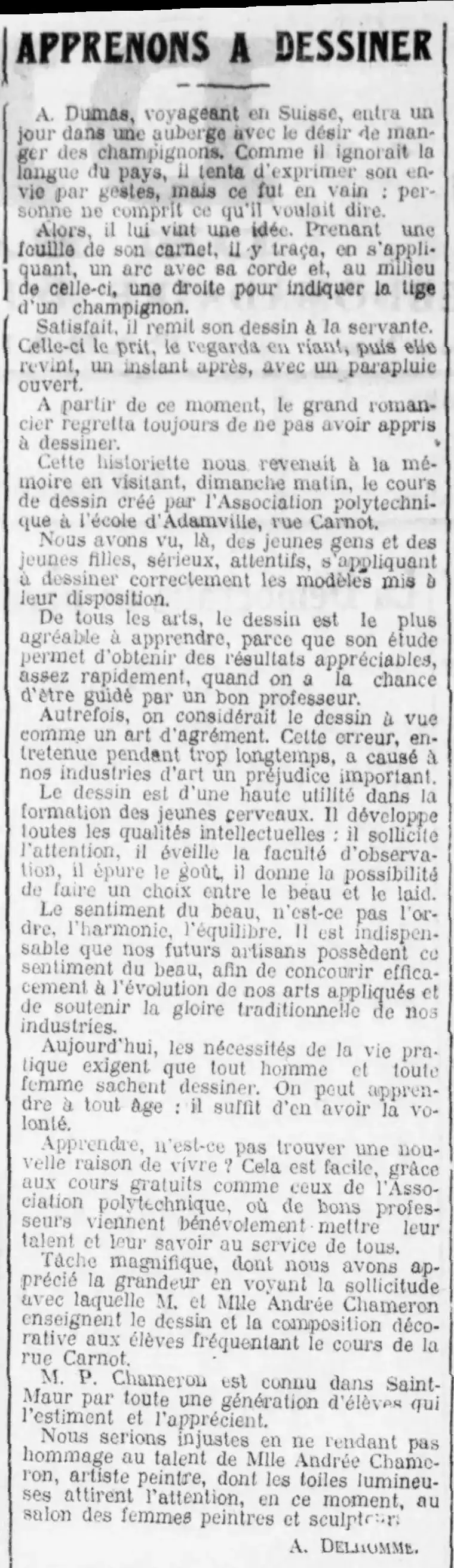
A. Dumas, traveling in Switzerland, entered an inn one day with the desire to eat mushrooms. As he did not know the language of the country, he tried to express his desire by gestures, but it was in vain: no one understood what he meant.
Then, an idea came to him. Taking a look in his notebook, he carefully traced an arc with his rope and, in the middle of it, a straight line to indicate the stem of a mushroom.
Satisfied, he gave his drawing to the servant. She took it, looked at it laughing, then she came back, a moment later, with an open umbrella.
From that moment on, the great novelist always regretted not having learned to draw.
This little story came back to us when we visited, Sunday morning, the drawing class created by the Polytechnic Association at the Adamville school, rue Carnot.
We saw there young men and women, serious, attentive, applying themselves to correctly drawing the models made available to them.
Of all the arts, drawing is the most pleasant to learn, because its study allows one to obtain appreciable results, quite quickly, when one is lucky enough to be guided by a good teacher.
Formerly, drawing at sight was considered an art of pleasure. This error, maintained for too long, has caused our art industries significant harm. Drawing is of great use in the training of young minds. It develops all intellectual qualities: it solicits attention, it awakens the faculty of observation, it purifies taste, it gives the possibility of making a choice between the beautiful and the ugly.
The feeling of beauty, is it not order, harmony, balance. It is essential that our future artisans possess this feeling of beauty, in order to contribute effectively to the evolution of our applied arts and to support the traditional glory of our industries.
Today, the necessities of practical life require that every man and woman know how to draw. One can learn at any age: one only needs to have the will.
To learn, isn't that to find a new reason to live? This is easy, thanks to free courses like those of the Polytechnic Association, where good teachers come voluntarily to put their talent and knowledge at the service of all.
A magnificent task, the grandeur of which we appreciated when we saw the concern with which Mr. and Miss Andrée Chameron teach drawing and decorative composition to the students attending the course on rue Carnot.
Mr. P. Chameron is known in Saint-Maur by a whole generation of students who esteem and appreciate him.
We would be unfair if we did not pay tribute to the talent of Miss Andrée Chameron, painter, whose luminous canvases are attracting attention, at the moment, at the Salon of Women Painters and Sculptors
A. DELHOMME.
|
The certificate of studies included drawing tests. To relieve the teachers
of this teaching, the City of Saint Maur paid specialized teachers:
in drawing, Mr. Chameron..." (page 46)
|
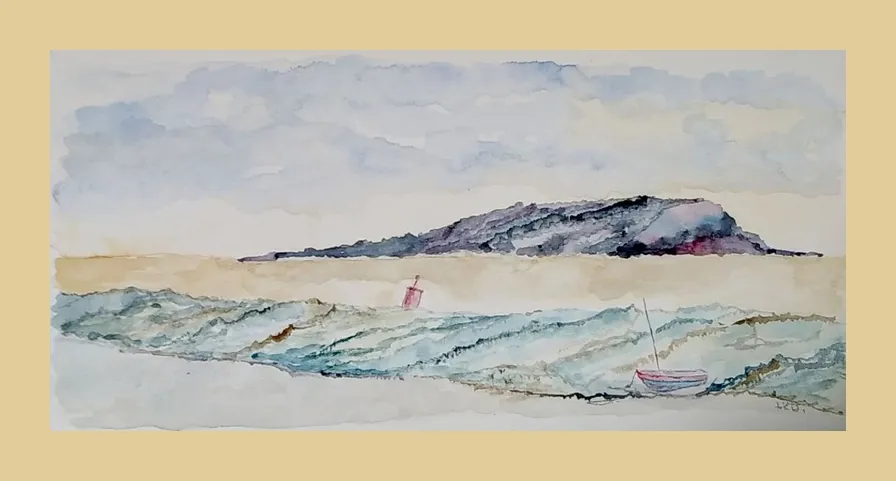
a painting by Paul Chameron: Fig. 252. Paul Chameron,
The Washhouse, the Flowery Island.
|
|
Andrée Chameron hung up her palette and brushes exactly 40 years ago, at the age of 90. |