


| Excelsior - February 08, 1925 |
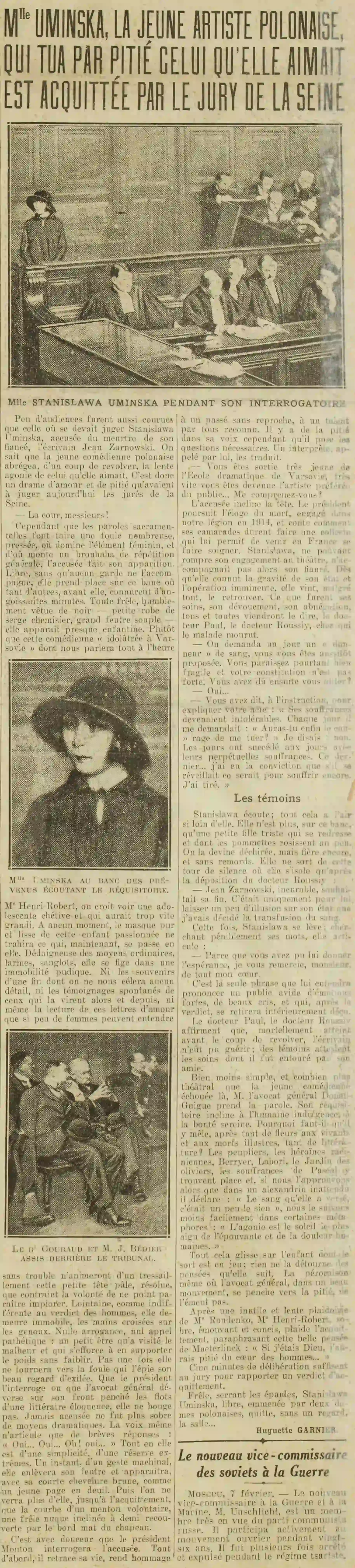
Few hearings were as well attended as the one where Stanislawa Uminska was to be judged, accused of the murder of her fiancé, the writer Jean Zarnowski. We know that the young Polish actress shortened, with a revolver shot, the slow agony of the man she loved. It is therefore a drama of love and pity that the jurors of the Seine had to judge today. The court, gentlemen! While the sacramental words silence a large, hurried crowd, dominated by the feminine element, and from which rises a hubbub of dress rehearsal, the accused makes her appearance. Free, without any guard accompanying her, she takes her place on this bench where so many others, having experienced anguished minutes. Very frail, humbly dressed in black, a little serge blouse dress, a large soft felt hat, she appears almost childish. Rather than this actress "idolatrated in Warsaw" that Mr. Henri-Robert will tell us about later, we think we see a puny adolescent who has grown up too quickly. At no time will the pure and smooth mask of this passionate child betray what is happening inside her now. Disdainful of ordinary means, tears, sobs, she freezes in a modest immobility. Neither the memories of an end of which no detail will be hidden from us, nor the spontaneous testimonies of those who saw her then and since, nor even the reading of these love letters that so few women can hear without trouble will animate with a shudder this small pale, resolute head, constrained by the will not to appear to implore. It is with gentleness that President Mouton will question the accused. First of all, he retraces her life, pays homage to a past without reproach, to a talent recognized by all. There is pity in his voice as he asks the necessary questions. An interpreter, called by him, translates them.
You graduated from the Warsaw Drama School at a very young age, and very quickly became the public's favorite artist... Do you understand me? The accused bows her head. The president continues the eulogy of the dead man, who joined our legion in 1914, and tells how his comrades had to make a collection that allowed him to come to France to be treated. Stanislawa, unable to break her commitment to the theater, did not accompany her fiancé at the time. As soon as she learned of the seriousness of his condition and the imminent operation, she came, in spite of everything, to find him. What his care, his devotion, his self-denial were, everyone will come to tell, Doctor Paul, Doctor Roussiy, at whose house the patient died. One day a blood "donor" was asked, you immediately offered yourself. However, you seem very fragile and your constitution is not strong. You then had to go to bed? Yes... You said, during the investigation, to explain your act: "His suffering was becoming intolerable. Every day he asked me: "Will you finally have the courage to kill me?" I said: no. Days followed day after day with their perpetual suffering. This last one... I was convinced that if he woke up it would be to suffer more. I shot." The witnesses Stanislawa listens; all this seems so far from her. She is no longer, on this bench, anything but a sad little girl who straightens up and whose cheekbones are a little pink. We can imagine her torn, but still proud, and without remorse. She only comes out of this tower of silence where she isolates herself after the deposition of Doctor Roussiy. Jean Zarnowski, incurable, wanted his end. It was only for him, to leave a little illusion about his condition that I had decided on the blood transfusion. This time, Stanislawa gets up; searching painfully for her words, she articulates: All this slides over the child whose fate is at stake; nothing distracts her from the thoughts she is following. Even the peroration where the attorney general, in a beautiful movement, leans towards pity, does not move her. Huguette GARNIER. Ms. UMINSKA IN THE DEFENDANTS' BENCH LISTENING TO THE INDICATION. G. GOURAUD AND Mr. J. BÉDIER SEATED BEHIND THE COURT,
   |
| Back February 08, 1925 |