

| Excelsior - February 08, 1925 |
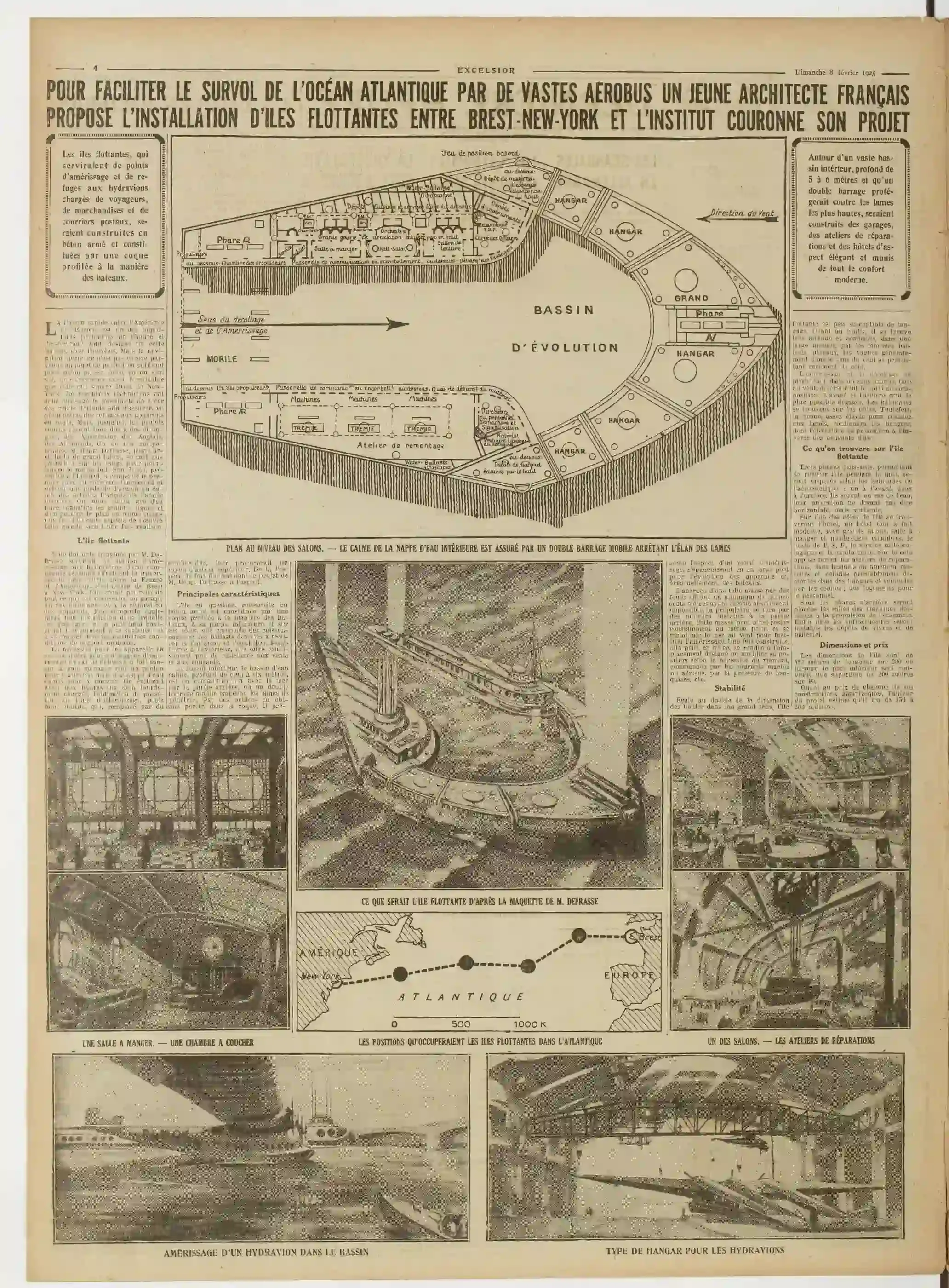
The rapid connection between America and Europe is one of the important problems of the moment and the ideal instrument for this connection is the airbus. But air navigation has not yet reached the point of perfection sufficient to make, in a single flight, a crossing as formidable as that which separates Brest from New York. Many technicians have therefore considered the possibility of creating floating relays in order to provide, in the middle of the ocean, refuges for aircraft en route. But, until now, the projects designed were all due to foreigners, Americans, English, Germans. One of our compatriots, Mr. Henri Defrasse, a young architect of great talent, is today entering the ranks to pursue the same goal. His study, presented at the Institute, won first prize in the Chenavard competition and obtained a silver medal at the Salon des artistes français last year. We would be grateful if you would make the main points known and publish the plan at the same time as the different aspects of the work as it would be once completed. The floating island The floating island imagined by Mr. Defrasse would serve as a landing station for the seaplanes of an airline making the shortest crossing between France and America, that is to say from Brest to New York. It would be equipped with everything necessary for the garage, refueling and repair of the aircraft. It also includes an installation in which passengers and flight personnel would find food and rest in the best conditions of modern comfort. Main characteristics The island in question, built in reinforced concrete, is made up of a hull profiled in the manner of boats. At its lower part and on its sides, it has caissons and ballasts intended to ensure flotation and balance. Pisciform on the outside, it offers relatively little resistance to winds and currents. Stability Equal to twice the size of the waves in its long direction, the floating island is unlikely to pitch. As for rolling, it is greatly attenuated and combated, to a large extent, by the enormous lateral ballasts, the waves generally in the direction of the wind rarely appearing on the side. Landing and takeoff occurring in a single direction, facing the wind, determine the composition. The front and rear are as clear as possible. The buildings are on the sides. However, the bow, high enough to resist the waves, will contain the hangars, the opening of which will be opposite the air currents and currents What will be found on the floating island Three powerful lighthouses, allowing the island to be located at night, will be arranged according to the habits of aeronautics: one at the front, two at the rear. They will be flush with the water, their projection not to be horizontal, but vertical. On one side of the island will be the hotel, a completely modern hotel, with large lounges, dining room and many bedrooms, the T. S. F. post, the meteorological service and the harbor master's office. On the opposite side will be the repair shops, in which engines and cells will be brought, previously dismantled in hangars and transported by the coolies; accommodation for the personnel. Under the rear lights will be placed the engine rooms intended for the propulsion of the whole. Finally, in the crevices will be installed the food and equipment depots. Dimensions and prices The dimensions of the island are 450 meters long by 230 wide, the inner harbor alone covering an area of 300 meters. out of 90.
  |
| Back February 08, 1925 |