

| La Presse - February 08, 1925 |
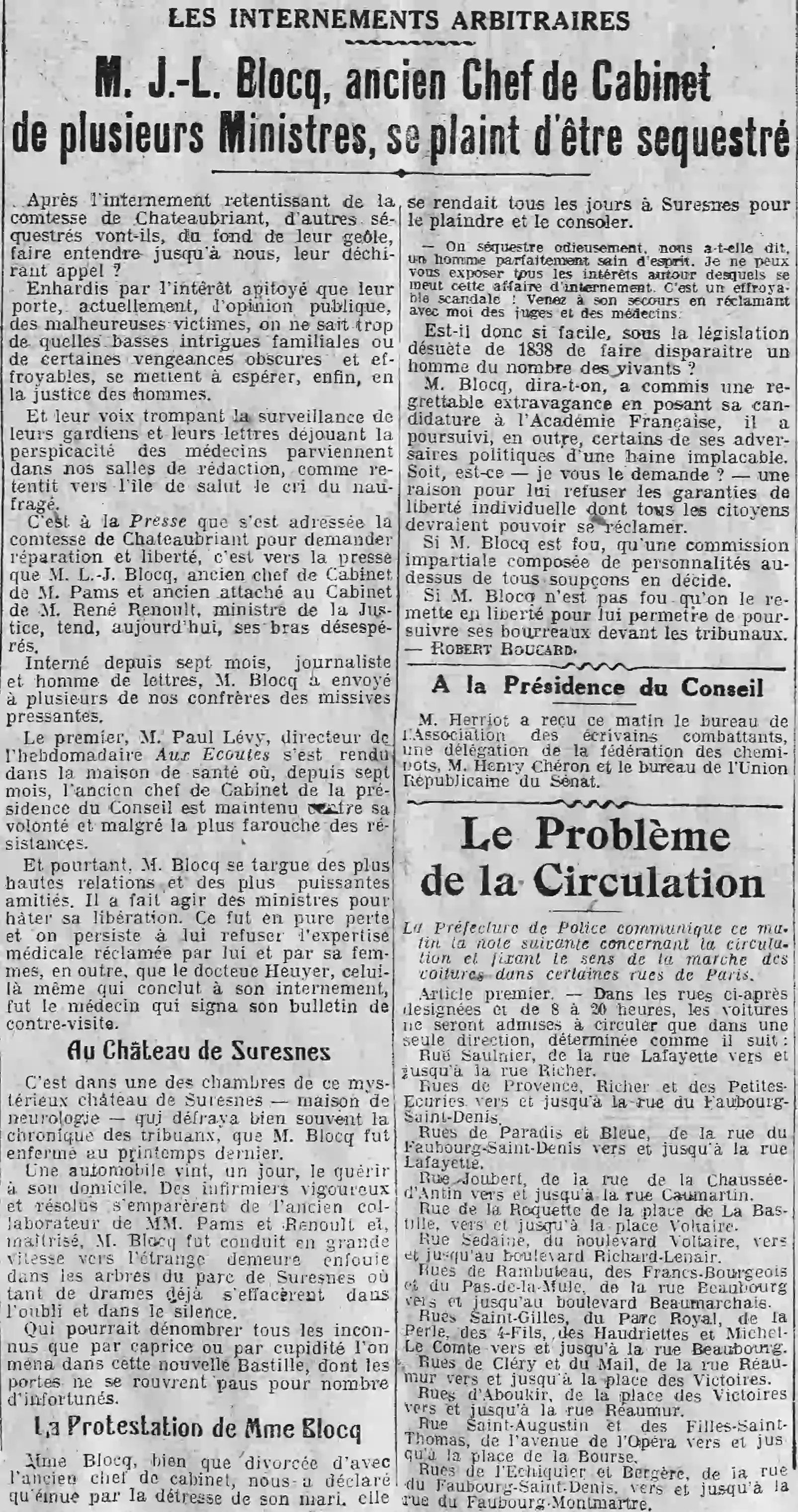
ARBITRARY INTERNMENTS Emboldened by the pitying interest that public opinion currently has in them, unfortunate victims, we do not know too much of what low family intrigues or of certain obscure and terrible vengeances, begin to hope, finally, in the justice of men. At the Château de Suresnes It was in one of the rooms of this mysterious château de Suresnes, a neurology house that often hit the headlines in the courts, that Mr. Blocq was locked up last spring. A car came one day to fetch him from his home. Vigorous and resolute nurses seized the former collaborator of Messrs. Pams and Renoult and, restrained, Mr. Blocq was driven at high speed towards the strange dwelling buried in the trees of the park of Suresnes where so many tragedies already faded into oblivion and silence. Mrs. Blocq's Protestation Anne Blocq, although divorced from the former chief of staff, told us that moved by her husband's distress, she went to Suresnes every day to pity and console him. A perfectly sane man is being odiously sequestered, she told us. I cannot explain to you all the interests around which this affair of internment moves. It is a terrible scandal! Come to his aid by calling with me for judges and doctors. Is it then so easy, under the obsolete legislation of 1838, to make a man disappear from the number of the living? Mr. Blocq, it will be said, committed a regrettable extravagance in applying to the Académie Française; he also pursued some of his political adversaries with implacable hatred. So, is that, I ask you? a reason to refuse him the guarantees of individual freedom that all citizens should be able to claim. If Mr. Blocq is mad, let an impartial commission composed of personalities above all suspicion decide. If Mr. Blocq is not mad, let him be released so that he can pursue his tormentors in court. ROBERT BOUCARD.
|
| Back February 08, 1925 |