

| Le Petit Parisien - February 08, 1925 |
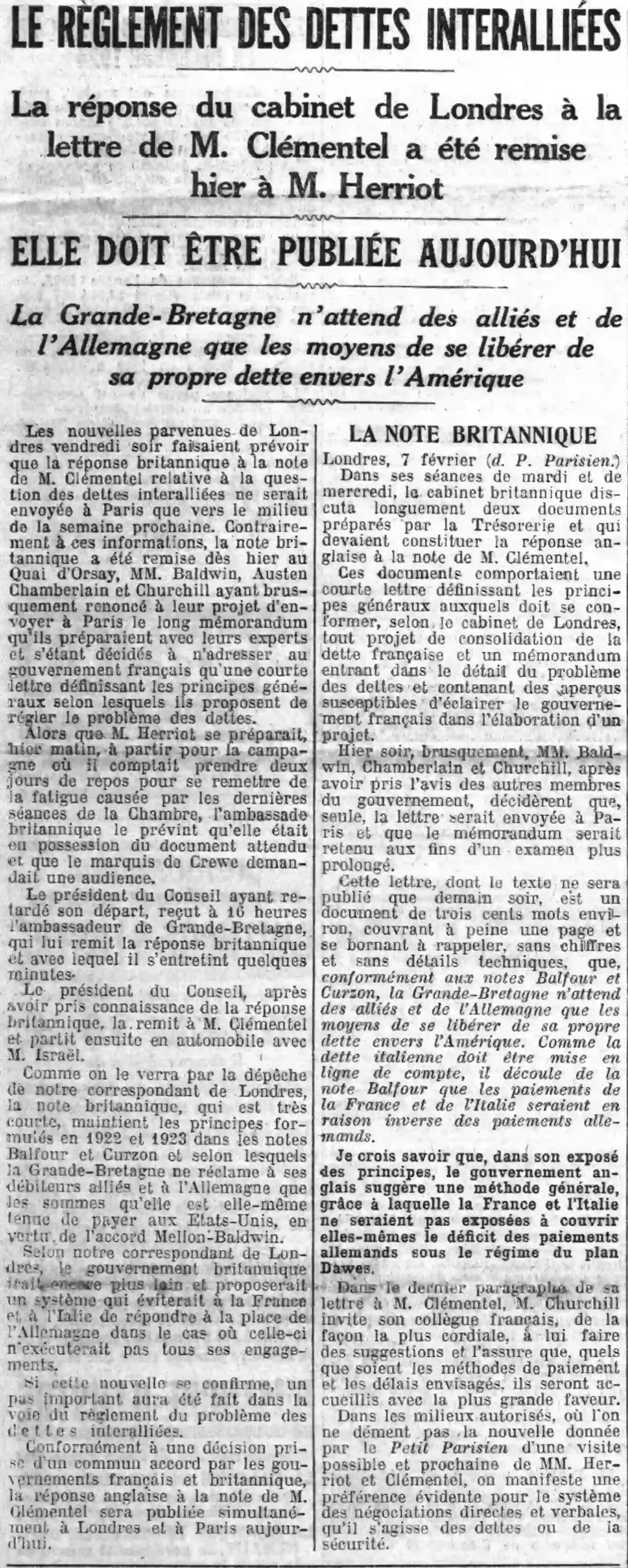
THE SETTLEMENT OF INTERALLIED DEBTS Great Britain expects from the Allies and Germany only the means to free herself from her own debt to America The news which reached London on Friday evening led to the prediction that the British reply to Mr. Clementel's note on the question of interallied debts would not be sent to Paris until the middle of next week. Contrary to this information, the British note was delivered yesterday to the Quai d'Orsay, Messrs. Baldwin, Austen Chamberlain and Churchill having abruptly abandoned their plan to send to Paris the long memorandum which they were preparing with their experts and having decided to address to the French Government only a short letter defining the general principles according to which they propose to settle the problem of debts. As Mr. Herriot was preparing yesterday morning to leave for the countryside where he intended to take two days' rest to recover from the fatigue caused by the last sessions of the Chamber, the British Embassy informed him that it was in possession of the expected document and that the Marquis of Crewe was requesting an audience. THE BRITISH NOTE London, February 7 (d. P. Parisien.) In its sessions on Tuesday and Wednesday, the British Cabinet discussed at length two documents prepared by the Treasury and which were to constitute the English reply to Mr. Clementel's note. This letter, the text of which will not be published until tomorrow evening, is a document of about three hundred words, barely a page long, and confines itself to recalling, without figures or technical details, that, in accordance with the Balfour and Curzon notes, Great Britain expects from the Allies and Germany only the means of freeing itself from its own debt to America. As the Italian debt must be taken into account, it follows from the Balfour note that the payments of France and Italy would be in inverse ratio to the German payments. I understand that, in its statement of principles, the English Government suggests a general method by which France and Italy would not be exposed to covering the deficit of German payments themselves under the Dawes Plan. In the last paragraph of his letter to Mr. Clementel, Mr. Churchill invites his French colleague, in the most cordial manner, to make suggestions to him and assures him that, whatever methods of payment and the time limits envisaged, they will be received with the greatest favour. In authorized circles, where the news given by the Petit Parisien of a possible and imminent visit by Messrs. Herriot and Clémentel is not denied, there is an obvious preference for the system of direct and verbal negotiations, whether it concerns debts or security. |
| Back February 08, 1925 |