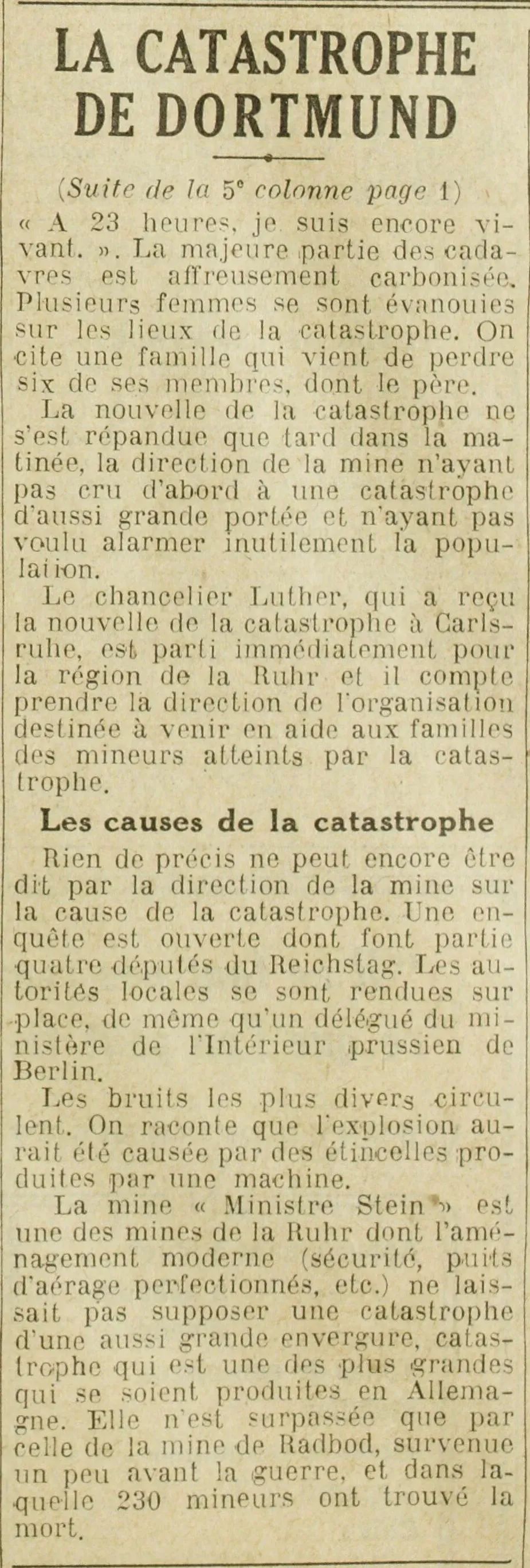
THE DORTMUND DISASTER
(Continued from the 5th column on page 1)
"At 11 p.m., I am still alive." Most of the bodies are horribly charred. Several women fainted at the scene of the disaster. A family is mentioned that has just lost six of its members, including the father.
The news of the disaster did not spread until late in the morning, the mine management not having believed at first that such a large-scale disaster had occurred and did not want to alarm the population unnecessarily.
Chancellor Luther, who received the news of the disaster in Carlsruhe, left immediately for the Ruhr region and intends to take charge of the organization intended to help the families of the miners affected by the disaster.
The causes of the disaster
Nothing precise can yet be said by the mine management about the cause of the disaster. An investigation is opened, which includes four Reichstag deputies. The local authorities went to the scene, as did a delegate from the Prussian Ministry of the Interior in Berlin.
The most varied rumors are circulating. It is said that the explosion was caused by sparks produced by a machine.
The "Minister Stein" mine is one of the mines in the Ruhr whose modern facilities (safety, improved ventilation shafts, etc.) did not suggest a catastrophe of such a large scale, a catastrophe that is one of the largest to have occurred in Germany. It is surpassed only by that of the Radbod mine, which occurred shortly before the war, and in which 230 miners died.
|