|

François ADUCCI painter of Versailles
The painter Aducci has been the guest of Versailles for some time, not a momentary guest but, we believe, a definitive one; the royal city has conquered his artist's soul. It is to celebrate its classical splendor that he abandons the luminous enchantment of the banks of Provence and Septimania.
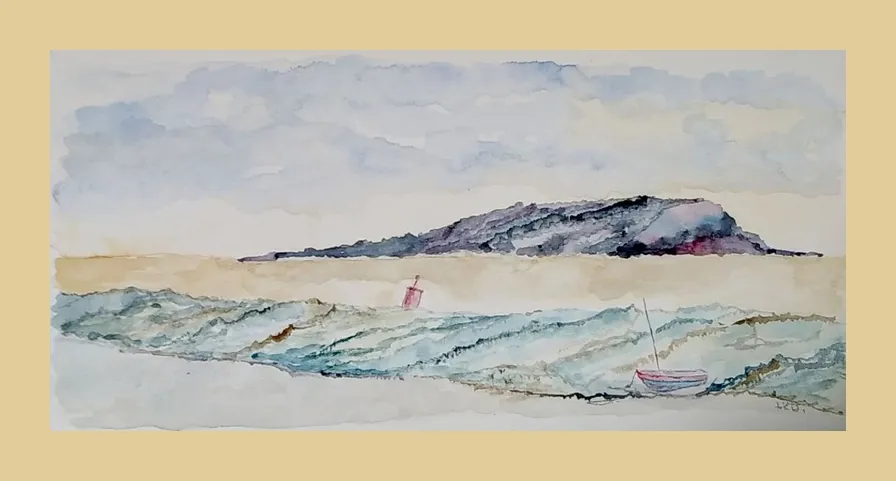
For a long time he took pleasure in noting the wonder of the clear dawns playing above the ponds of Thau and Palavas, the splendor of the twilights that crimson them, the rocks calcined by the fervor of the Occitanian middays, the hyacinth-colored shadows cast by the cypresses, the funereal and voluptuous serenity of the Alyscamps, the vernal caresses shivering on the waves of the Lez, all the magic finally of these Mediterranean horizons that seem to cross some breeze coming from the East.
However dazzling the variety of such a fresco may be, it is not the only expression in which one can measure a talent capable of renewing itself, which even seems to attract the opposition of sites, and especially of the atmosphere which permeates them. The series of studies which evoke Brittany, its low skies and the melancholy meditation of its moors has nothing in fact which yields it for the intensity of the vision, to the burning poem unfolded through the Crau or the Maguelonnais.
No place however could provide such noble material as Versailles to exercise this faculty which Aducci possesses to define the special charm of a landscape, to condense its value in a vigorous relief, to reproduce it under the multiple aspects which the return of the seasons and the hours confers on it. Nature here is not alone in tempting the artist's brush, it borrows a particular glory from the magnificent discipline which governs it. The Gardens of Versailles are made of order and clarity, they have been rightly named the Gardens of Intelligence and they remain the admirable decor created by a great king in the image of his century. Now it turns out that this quality of power, this dialectic of beauty, best serve a thoughtful temperament, more inclined towards synthesis than towards analysis. Aducci never bothers with the elegance of a detail; the concern for the whole occupies him alone, he sacrifices everything to unity, from which his work takes on a logical character and meets the spirit of Versailles. His method, in truth very personal, moves away from any school procedure, voluntarily ignores the clever concessions by which the taste of a few is satisfied. His paintings are not looked at with a magnifying glass, they give off on the other hand an impression of sincerity which moves, of audacity not aggressive, but precise and justified. Aducci is essentially the painter of light. He claims that his brush faithfully translates its play. For him "the forms no longer exist by their geometric outline but by the caress, the envelopment, the harmonious life that the light dispenses everywhere.
We can easily imagine what is original in this manner, as well as robust and penetrating. The color draws from it a prodigious richness, the perception a remarkable acuity as much in the landscape as in the portrait where the painter excels in discovering and fixing the sign that gives its own meaning to a physiognomy. Many are already the canvases that Aducci has dedicated to Versailles. Corners of the park captured in a ray of sunlight, mosaic of flowers sparkling under the heat of summer, russet foliage of autumn, paths that winter has stripped bare, mirror of water reflecting the pearly whiteness of marble or the sumptuous patina of bronze, adorn the studio on the boulevard de la Reine with an important collection destined to grow further.
François Aducci, painter of Versailles, is one of those who have best understood its prestige. Disdainful of the subtle entertainment of breaking it down, he surprises its brilliance and concentrates it and, by this, his very modern art relies in some way on the great and healthy tradition of the old masters.
E. HENNET DE GOUTEL.
|