|
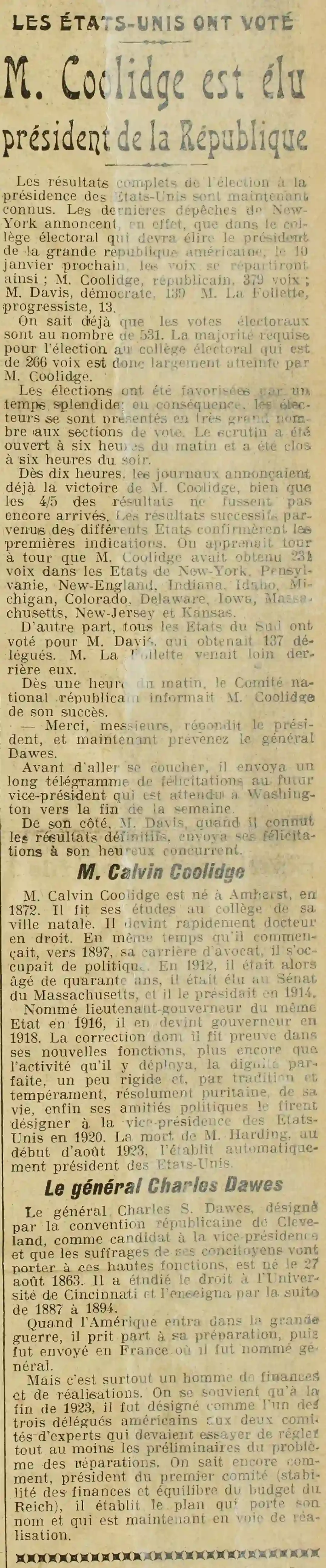
THE UNITED STATES HAVE VOTED
Mr. Coolidge is elected President of the Republic
The complete results of the election for the presidency of the United States are now known. The latest dispatches from New York announce, in fact, that in the electoral college which will elect the president of the great American republic, on January 10th, the votes will be distributed as follows: Mr. Coolidge, Republican, 379 votes; Mr. Davis, Democrat, 139 Mr. La Follette, Progressive, 13.
It is already known that the votes number 531. The majority required for election to the electoral college, which is 266 votes, is therefore largely attained by Mr. Coolidge.
The elections were favored by splendid weather; consequently, the electors presented themselves in very large numbers at the polling stations. The poll opened at six o'clock in the morning and closed at six o'clock in the evening.
By ten o'clock the newspapers were already announcing Mr. Coolidge's victory, although 4/5 of the results had not yet arrived. The successive results received from the various States confirmed the first indications. It was learned in turn that Mr. Coolidge had obtained 231 votes in the States of New York, Pennsylvania, New England, Indiana, Idaho, Michigan, Colorado, Delaware, Iowa, Massachusetts, New Jersey and Kansas.
On the other hand, all the Southern States voted for Mr. Davis, who obtained 137 delegates. Mr. La Follette came far behind them.
At one o'clock in the morning, the Republican National Committee informed Mr. Coolidge of his success.
Thank you, gentlemen, replied the President, and now inform General Dawes.
Before going to bed, he sent a long telegram of congratulations to the future Vice President who is expected in Washington towards the end of the week.
For his part, Mr. Davis, when he learned the final results, sent his congratulations to his lucky competitor.
Mr. Calvin Coolidge
Mr. Calvin Coolidge was born in Amherst, in 1872. He studied at the college of his native city. He quickly became a doctor of laws. At the same time as he began, around 1897, his career as a lawyer, he occupied himself with politics. In 1912, he was then forty years old, he was elected to the Senate of Massachusetts, and he presided over it in 1914. Appointed lieutenant-governor of the same State in 1916, he became governor in 1918. The correctness he showed in his new functions, even more than the activity he displayed there, the perfect dignity, a little rigid and, by tradition and temperament, resolutely puritan, of his life, finally his political friendships made him designated to the vice-presidency of the United States in 1920. The death of Mr. Harding, at the beginning of August 1923, automatically established him as President of the United States.
General Charles Dawes
General Charles S. Dawes, nominated by the Republican convention in Cleveland as vice-presidential candidate and who the votes of his fellow citizens were to carry to this high office, was born on August 27, 1863. He studied law at the University of Cincinnati and taught it from 1887 to 1894.
When America entered the Great War, he took part in its preparation, then was sent to France where he was appointed general.
But he is above all a man of finance and achievements. It will be remembered that at the end of 1923, he was designated as one of the three American delegates to the two committees of experts who were to try to settle at least the preliminaries of the problem of reparations. We also know how, as chairman of the first committee (stability of finances and balance of the Reich budget), he established the plan that bears his name and which is now being implemented.
|