

| Le Provençal de Paris 26 octobre 1924 |
|
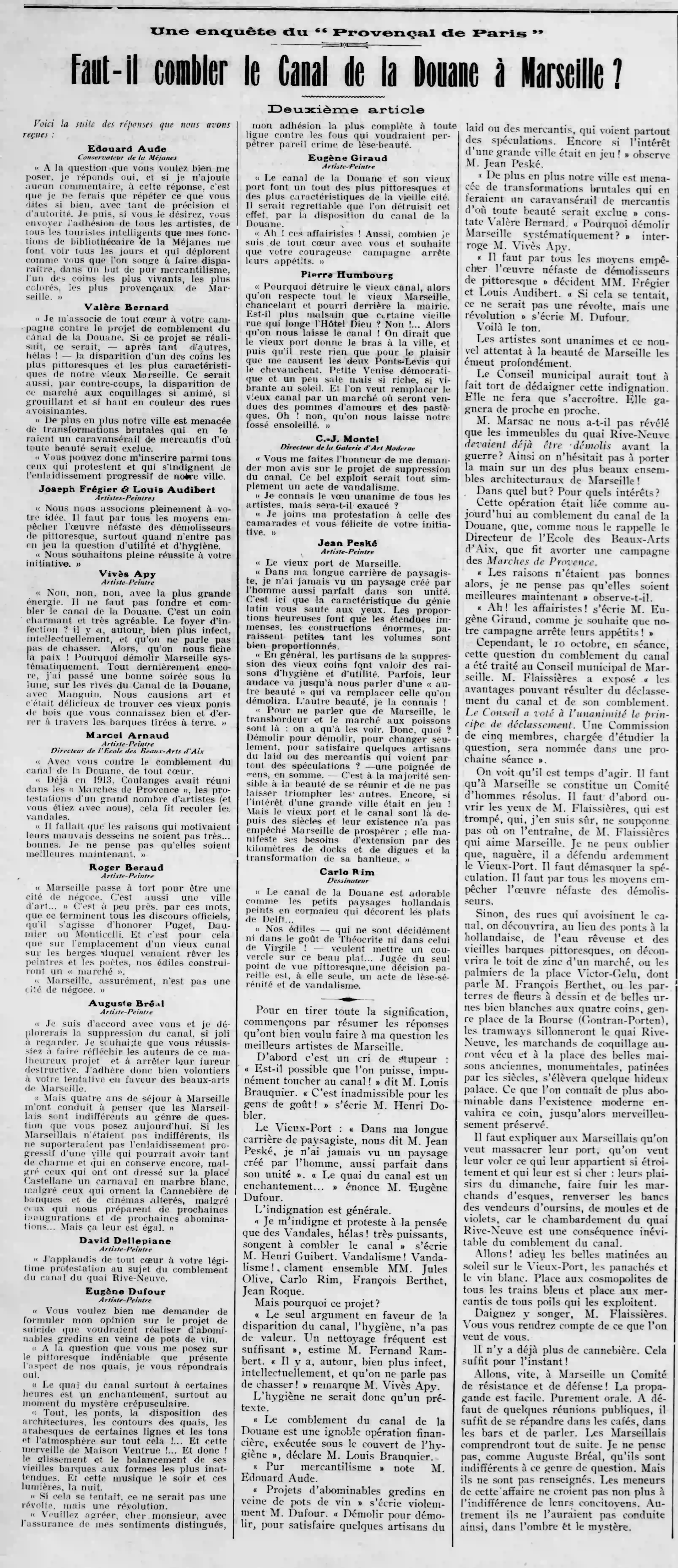
Here is the rest of the answers we received: Edouard Aude Valère Bernard Joseph Frégier & Louis Audibert Artists-Painters Vivès Apy Artist-Painter Marcel Arnaud Artist-Painter Roger Beraud Artist-Painter Auguste Bréal Artist-Painter David Dellepiane Artist-Painter Eugène Dufour Artist-Painter Eugène Giraud Artist-Painter Pierre Humbourg "Why destroy the old canal, when we respect all of old Marseille, tottering and rotten behind the town hall. Is it more unhealthy than a certain old street that runs alongside the Hôtel Dieu? No! ... So let's leave the canal to us! It seems that the old port gives the city its arm, and then it remains only for the pleasure that the two drawbridges that straddle it give me. Little Venice, democratic and a little dirty but so rich, so vibrant in the sun. And they want to replace the old canal with a market where candy apples and watermelons will be sold. Oh no, let us have our sunny moat. " C.-J. Montel Director of the Galerie d'Art Moderne "You do me the honor of asking my opinion on the project to remove the canal. This fine feat would simply be an act of vandalism. "I know the unanimous wish of all the artists, but will it be granted? "I join my protest to that of the comrades and congratulate you on your initiative. Jean Peské Artist-Painter "In my long career as a landscaper, I have never seen a landscape created by man so perfect in its Unity. This is where the characteristic of Latin genius leaps out at you. The happy proportions make the immense expanses, the enormous constructions, seem small so well proportioned are the volumes. "In general, the partisans of the suppression of old corners put forward reasons of hygiene and utility. Sometimes, their audacity goes so far as to speak to us of an "other beauty" which will replace the one which will be demolished. The other beauty, I know it! "To speak only of Marseille, the ferry and the fish market are there, we only have to see them. So, what? Demolish for the sake of demolishing, for the sake of change, to satisfy a few artisans of the ugly or the merchants who see speculation everywhere? a handful of people, in short. It is up to the majority sensitive to beauty to come together and not let the others triumph. Again, if the interest of a large city were at stake! But the old port and the canal have been there for centuries and their existence has not prevented Marseille from prospering; it shows its need for expansion by kilometers of docks and dikes and the transformation of its suburbs." Carlo Rim Cartoonist To get the full meaning out of it, let's start by summarizing the answers that the best artists in Marseille were kind enough to give to my question. First, there is a cry of stupor: "Is it possible that one can, with impunity, touch the canal!" says Mr. Louis Brauquier. "It is unacceptable for people of taste!" exclaims Mr. Henri Dobler. "Projects of abominable scoundrels in search of bribes," exclaims Mr. Dufour violently. "Demolish for the sake of demolishing, to satisfy a few artisans of the ugly or mercantile, who see speculation everywhere. Even if the interest of a large city were at stake!" observes Mr. Jean Peské. "Our city is increasingly threatened by brutal transformations that would turn it into a caravanserai of mercantiles from which all beauty would be excluded" observes Valère Bernard. "Why systematically demolish Marseille?" asks Mr. Vivès Apy. "We must by all means prevent the harmful work of the demolishers of the picturesque" decide Messrs. Frégier and Louis Audibert. "If this were attempted, it would not be a revolt, but a revolution" exclaims Mr. Dufour. That is the tone. The artists are unanimous and this new attack on the beauty of Marseille deeply moves them. The Municipal Council would be completely wrong to disdain this indignation. It will only increase. It will gain ground step by step. Didn't Mr. Marsac reveal to us that the buildings on the Quai Rive-Neuve were already to be demolished before the war? So they did not hesitate to lay hands on one of the most beautiful architectural ensembles in Marseille! For what purpose? For what interests? This operation was linked, as it is today, to the filling in of the Canal de la Douane, which, as the Director of the Ecole des Beaux-Arts d'Aix reminds us, was aborted by a campaign in the Marches de Provence. "The reasons were not good then, I don't think they are any better now," he observes. Ah! the businessmen! exclaims Mr. Eugène Giraud, how I hope that our campaign will stop their appetites! However, on October 10, in a session, this question of filling in the canal was discussed at the Municipal Council of Marseille. Mr. Flaissières explained "the advantages that could result from the declassification of the canal and its filling. The Council unanimously voted in favor of the principle of declassification. A Commission of five members, responsible for studying the question, will be appointed at a future session." We see that it is time to act. A Committee of resolute men must be formed in Marseilles. We must first open the eyes of Mr. Flaissières, who is deceived, who, I am sure, does not suspect where he is being led, of Mr. Flaissières who loves Marseilles. I cannot forget that, not long ago, he ardently defended the Old Port. Speculation must be unmasked. We must by all means prevent the harmful work of the demolitionists. Otherwise, from the streets that border the canal, instead of the Dutch bridges, one will discover dreamy water and picturesque old boats, one will discover the zinc roof of a market, or the palm trees of the Place Victor-Gelu, of which Mr. François Berthet speaks, or the flowerbeds with designs and beautiful white urns at the four corners, like the Place de la Bourse (Gontran-Porten), the trams will crisscross the Quai Rive-Neuve, the shell merchants will have lived and in place of the beautiful old houses, monumental, patinated by the centuries, some hideous palace will rise. The most abominable thing we know in modern existence will invade this corner, until then wonderfully preserved. We must explain to the people of Marseille that we want to massacre their port, steal from them what belongs so closely to them and is so dear to them: their Sunday pleasures, drive away the merchants of esques, overturn the benches of the sellers of sea urchins, mussels and violets, because the upheaval of the Rive-Neuve quay is an inevitable consequence of the filling in of the canal. Come on! goodbye to the beautiful mornings in the sun on the Old Port, the shandies and the white wine. Make way for the cosmopolitans of all the blue trains and make way for the merchants of all stripes who exploit them. Deign to think about it, Mr. Flaissières. You will realize what we want from you. There are already no more cannebière. That's enough for now! Come on, quickly, in Marseille a Committee of resistance and defense! Propaganda is easy. Purely oral. In the absence of a few public meetings, it is enough to spread out in the cafes, in the bars and to talk. The people of Marseille will understand right away. I don't think, like Auguste Bréal, that they are indifferent to this kind of question. But they are not informed. The leaders of this affair do not believe in the indifference of their fellow citizens either. Otherwise they would not have conducted it like this, in the shadows and mystery. |
 |
| retour - back 26 octobre 1924 |