

| Comœdia 19 octobre 1924 |
 |
|
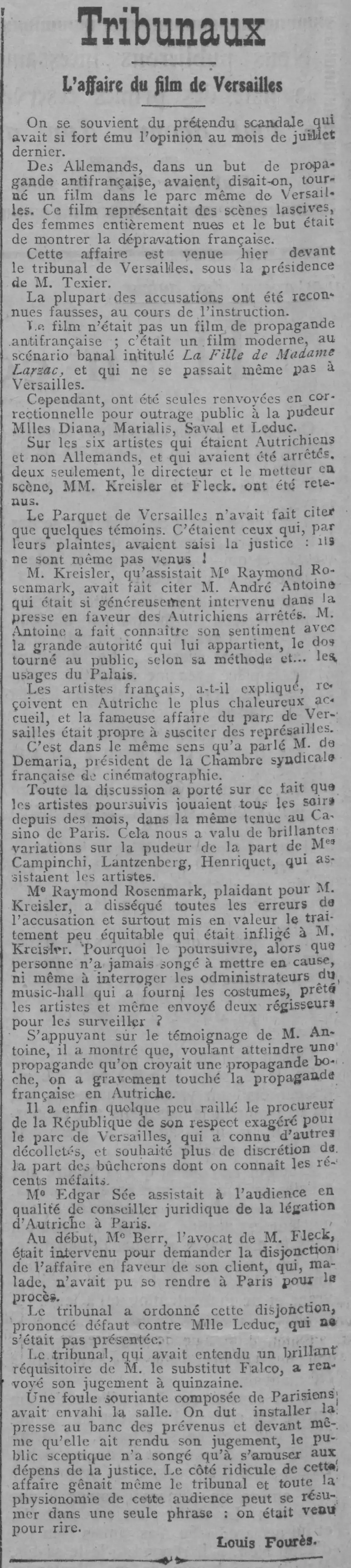
Courts The Versailles Film Affair We remember the alleged scandal that so deeply stirred public opinion last July. Germans, with the aim of anti-French propaganda, had, it was said, filmed a film in the park of Versailles itself. This film depicted lascivious scenes, completely naked women and the aim was to show French depravity. This case came before the Versailles court yesterday, under the presidency of Mr. Texier. Most of the accusations were found to be false during the investigation. However, only Miss Diana, Marialis, Saval and Leduc were sent to correctional court for public indecency. Of the six artists who were Austrians and not Germans and who had been arrested, only two, the director and the stage producer, Messrs. Kreisler and Fleck, were retained. The Versailles Public Prosecutor's Office had summoned only a few witnesses. They were those who, through their complaints, had brought the matter before the courts: they did not even come! Mr. Kreisler, assisted by Mr. Raymond Rosenmark, had summoned Mr. André Antoine who had so generously intervened in the press in favor of the arrested Austrians. Mr. Antoine made his feelings known with the great authority that belongs to him, his back turned to the public, according to his method and... the customs of the Palace. It was in the same sense that Mr. de Demaria, president of the French Chamber of Cinematography, spoke. The whole discussion focused on the fact that the prosecuted artists had been playing every night for months, in the same outfit at the Casino de Paris. This earned us brilliant variations on modesty from Messrs Campinchi, Lantzenberg, Henriquet, who assisted the artists. Mr Raymond Rosenmark, pleading for Mr Kreisler, dissected all the errors of the accusation and especially highlighted the unfair treatment inflicted on Mr Kreisler. Why prosecute him, when no one ever thought of implicating, or even questioning, the administrators of the music hall who provided the costumes, lent the artists and even sent two managers to supervise them? Mr. Edgar Sée attended the hearing as legal advisor to the Austrian legation in Paris. At the beginning, Mr. Berr, Mr. Fleck's lawyer, had intervened to request the severance of the case in favor of his client, who, being ill, had been unable to travel to Paris for the trial. The court ordered this severance, and pronounced Miss Leduc in default, who had not appeared. The court, which had heard a brilliant indictment from Mr. Falco, the substitute, postponed its judgment for a fortnight. A smiling crowd of Parisians had invaded the room. It had to be. Installing the press in the dock and even before it had rendered its judgment, the skeptical public thought only of having fun at the expense of justice. The ridiculous side of this affair embarrassed even the court and the whole physiognomy of this hearing can be summed up in a single sentence: we had come to laugh. Louis Fourès. |
| retour - back 19 octobre 1924 |