|
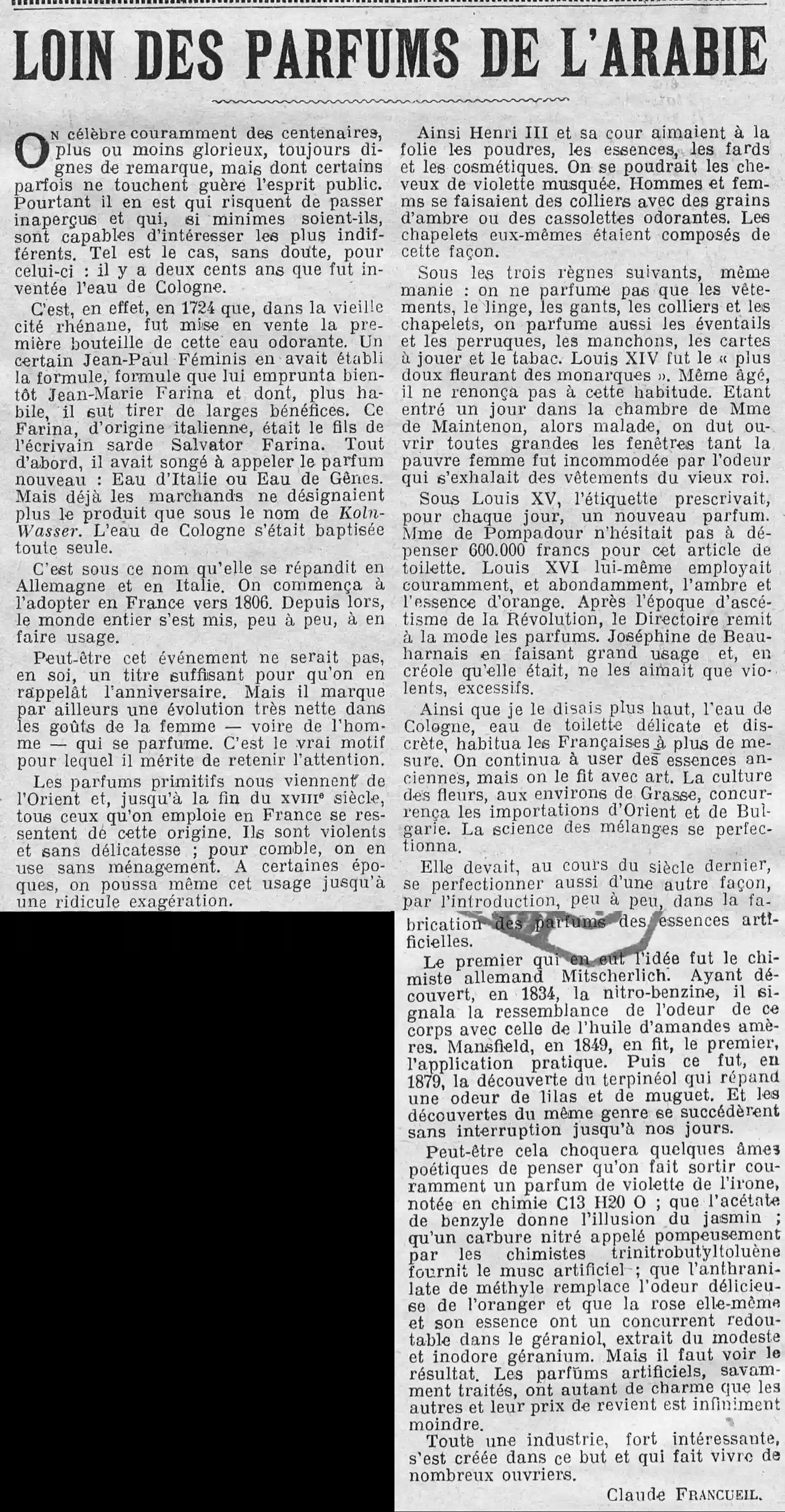
Centenaries are commonly celebrated, more or less glorious, always worthy of note, but some of which sometimes hardly touch the public mind. However, there are some that risk going unnoticed and that, however small they may be, are capable of interesting the most indifferent. This is undoubtedly the case for this one, two hundred years ago that Eau de Cologne was invented.
It was, in fact, in 1724 that the first bottle of this fragrant water was put on sale in the old Rhenish city. A certain Jean-Paul Féminis had established the formula, a formula that Jean-Marie Farina soon borrowed from him and from which, more skillful, he knew how to draw large profits.
This Farina, of Italian origin, was the son of the Sardinian writer Salvator Farina. At first, he had thought of calling the new perfume Eau d'Italie or Eau de Gênes. But already the merchants only called the product Koln-Wasser. Eau de Cologne had baptized itself.
It was under this name that it spread in Germany and Italy. It began to be adopted in France around 1806. Since then, the whole world has gradually begun to use it.
Perhaps this event would not, in itself, be a sufficient title to recall its anniversary. But it also marks a very clear evolution in the tastes of women and even men who perfume themselves. This is the real reason why it deserves attention.
Primitive perfumes come to us from the Orient and, until the end of the 18th century, all those used in France are influenced by this origin. They are violent and without delicacy; to cap it all, they are used without moderation. At certain times, this use was even pushed to a ridiculous exaggeration.
Thus Henry III and his court were madly fond of powders, essences, make-up and cosmetics. Hair was powdered with musk violet. Men and women made necklaces with amber grains or scented cassolettes. Rosaries themselves were composed in this way.
During the three following reigns, the same mania was followed: not only clothes, linen, gloves, necklaces and rosaries were perfumed, but also fans and wigs, muffs, playing cards and tobacco.
Louis XIV was the "sweetest scenting of monarchs". Even in old age, he did not give up this habit. Having entered one day into the room of Madame de Maintenon, who was then ill, the windows had to be thrown wide open because the poor woman was so inconvenienced by the smell coming from the old king's clothes.
Under Louis XV, etiquette prescribed a new perfume for each day. Madame de Pompadour did not hesitate to spend 600,000 francs on this toilet article. Louis XVI himself used amber and orange essence frequently and abundantly. After the ascetic period of the Revolution, the Directory brought perfumes back into fashion. Joséphine de Beauharnais made great use of them and, as a Creole that she was, liked them only violent and excessive.
As I said above, eau de Cologne, a delicate and discreet eau de toilette, accustomed French women to more moderation. The use of ancient essences continued, but was done with art. The cultivation of flowers, in the vicinity of Grasse, competed with imports from the Orient and Bulgaria. The science of mixtures was perfected.
It was to be perfected in another way during the last century, by the gradual introduction of artificial essences into the manufacture of perfumes.
The first to have the idea was the German chemist Mitscherlich. Having discovered nitrobenzine in 1834, he pointed out the resemblance of the odor of this substance with that of bitter almond oil.
Mansfield, in 1849, was the first to make a practical application of it. Then came, in 1879, the discovery of terpineol which gives off an odor of lilac and lily of the valley. And discoveries of the same kind have followed one another without interruption until our days.
Perhaps it will shock some poetic souls to think that a violet scent is commonly extracted from irone, noted in chemistry as C13 H20 O; that benzyl acetate gives the illusion of jasmine; that a nitrocarbide pompously called by chemists trinitrobutyltoluene provides artificial musk; that methyl anthranilate replaces the delicious odor of the orange tree and that the rose itself and its essence have a formidable competitor in geraniol, extracted from the modest and odorless geranium. But we must see the result.
Artificial perfumes, skillfully treated, have as much charm as the others and their cost price is infinitely lower.
A whole industry, very interesting, has been created for this purpose and which provides a living for many workers.
Claude FRANCUEIL.
|