|
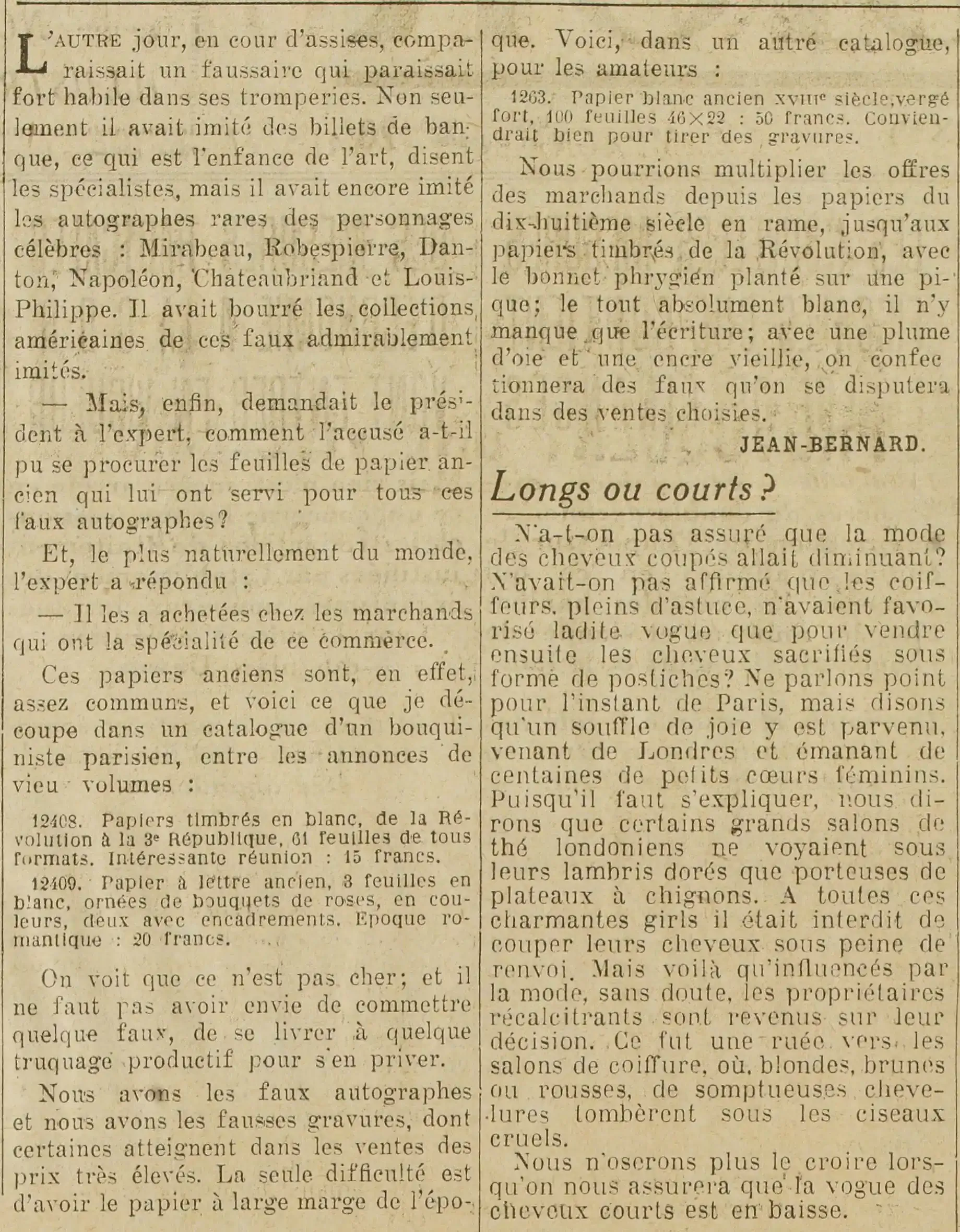
The other day, in the assize court, a forger appeared who seemed very skilled in his deceptions. Not only had he imitated bank notes, which is the infancy of art, say the specialists, but he had also imitated the rare autographs of the famous people Mirabeau, Robespierre, Danton, Napoleon, Chateaubriand and Louis-Philippe. He had stuffed the American collections with these admirably imitated forgeries.
— But, finally, the president asked the expert, how did the accused manage to obtain the sheets of old paper that he used for all these false autographs?
And, quite naturally, the expert replied:
— He bought them from the dealers who specialize in this trade.
These old papers are, in fact, quite common, and here is what I cut out of a Parisian bookseller's catalogue, between the advertisements for old volumes:
12408. Blank stamped papers, from the Revolution to the 3rd Republic, 61 sheets of all sizes. Interesting collection: 15 francs.
12409. Old letter paper, 3 blank sheets, decorated with bouquets of roses, in colour, two with frames. Romantic period: 20 francs.
You can see that it is not expensive; and you must not want to commit some forgery, to engage in some productive trickery to deprive yourself of it.
We have the fake autographs and we have the fake engravings, some of which fetch very high prices in sales. The only difficulty is to have the wide-margin paper of the time. Here, in another catalog, for amateurs:
1263. Old white paper 17th century, strong laid, 100 sheets 46X22: 50 francs. Would be good for printing engravings.
We could multiply the offers of the merchants from the papers of the eighteenth century in reams, to the stamped papers of the Revolution, with the Phrygian cap planted on a pike; all absolutely white, it lacks only the writing; with a quill pen and old ink, we will make fakes that we will fight over in selected sales.
JEAN-BERNARD.
|