

| Paris-Soir 26 octobre 1924 |
|
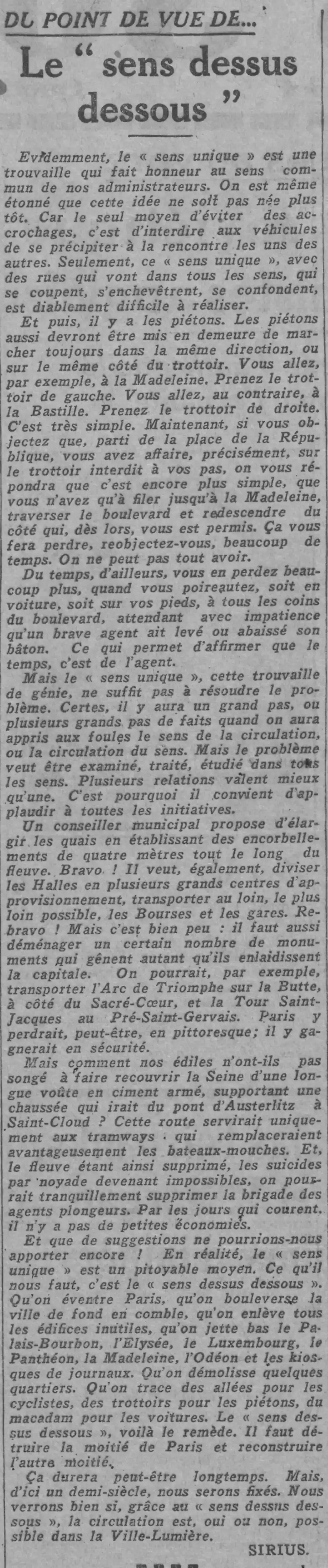
FROM THE POINT OF VIEW OF... Obviously, the "one way" is a find that honors the common sense of our administrators. We are even surprised that this idea was not born earlier. Because the only way to avoid collisions is to prohibit vehicles from rushing to meet each other. Only, this "one way", with streets that go in all directions, that intersect, intertwine, merge, is devilishly difficult to achieve. And then, there are the pedestrians. Pedestrians will also have to be ordered to always walk in the same direction, or on the same side of the sidewalk. You are going, for example, to the Madeleine. Take the left sidewalk. You are going, on the contrary, to the Bastille. Take the right sidewalk. It is very simple. Now, if you object that, having left the Place de la République, you are dealing, precisely, on the sidewalk forbidden to your steps, we will will answer that it is even simpler, that you only have to go to the Madeleine, cross the boulevard and go back down the side that, from then on, is allowed to you. That will make you lose, you object again, a lot of time. You can't have everything. Time, moreover, you lose a lot more, when you hang around, either in the car or on your feet, at every corner of the boulevard, impatiently waiting for a good policeman to raise or lower his baton. Which allows us to affirm that time is money. But the "one-way", this genius find, is not enough to solve the problem. Certainly, there will be a big step, or several big steps taken when the crowds have been taught the direction of traffic, or the traffic of the direction. But the problem needs to be examined, treated, studied in all directions. Several relationships are better than one. That is why we should applaud all initiatives. But how come our elected officials have not thought of covering the Seine with a long reinforced cement arch, supporting a roadway that would go from the Pont d'Austerlitz to Saint-Cloud? This road would only be used by trams that would advantageously replace the Bateaux-Mouches. And, the river being thus eliminated, suicides by drowning becoming impossible, we could calmly eliminate the brigade of diving agents. In these days... there are no small savings. And what suggestions could we not still make! In reality, the "one-way" is a pitiful means. What we need is the "upside down". Let us gut Paris, turn the city upside down from top to bottom, remove all the useless buildings, knock down the Palais-Bourbon, the Elysée, the Luxembourg, the Pantheon, the Madeleine, the Odéon and the newspaper kiosks. Let us demolish a few neighborhoods. Let us trace paths for cyclists, sidewalks for pedestrians, tarmac for cars. The "upside down" is the remedy. Half of Paris must be destroyed and the other half rebuilt. It may take a long time. But in half a century, we will know. We will see if, thanks to the "upside down", traffic is, yes or no, possible in the City of Light. SIRIUS.
|
 |
| retour - back 26 octobre 1924 |