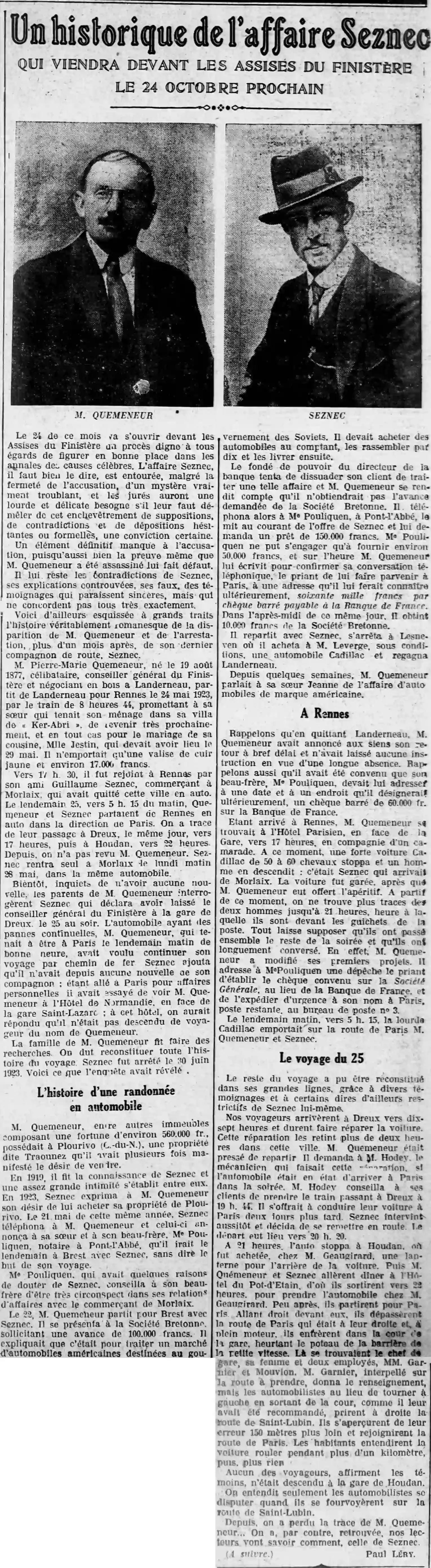
|
On the 24th of this month, a trial will open before the Assizes of Finistère, worthy in all respects of figuring prominently in the annals of famous causes. The Seznec affair, it must be said, is surrounded, despite the firmness of the accusation, by a truly troubling mystery, and the jurors will have a heavy and delicate task if they have to disentangle from this tangle of suppositions, contradictions and hesitant or formal depositions, a certain conviction.
A definitive element is missing from the accusation, since even the proof that Mr. Quemeneur was murdered is lacking. It still has Seznec's contradictions, his fabricated explanations, his forgeries, testimonies that seem sincere, but which do not all agree very exactly.
Here is a broad outline of the truly romantic story of the disappearance of Mr. Quemeneur and the arrest, more than a month later, of his last traveling companion, Seznec.
Mr. Pierre-Marie Quemeneur, born on August 19, 1877, single, general councilor of Finistère and wood merchant in Landerneau, left Landerneau for Rennes on May 24, 1923, by the 8:44 train, promising his sister who was running her house in her villa in "Ker-Abri", to return very soon, and in any case for the wedding of his cousin, Miss Jestin, which was to take place on May 29. He took only a yellow leather suitcase and about 17,000 francs.
Around 5:30 p.m., he was joined in Rennes by his friend Guillaume Seznec, a merchant in Morlaix, who had left this city by car. The next day, the 25th, at around 5:15 in the morning, Quemeneur and Seznec left Rennes by car for Paris. There is evidence of their passing through Dreux the same day at around 5:00 p.m., then through Houdan at around 10:00 p.m. Since then, Mr. Quemeneur has not been seen again. Seznec returned to Morlaix alone on Monday morning, May 28, in the same car.
Soon, worried about having no news, Mr. Quemeneur's parents questioned Seznec, who stated that he had left the general councilor of Finistère at the Dreux station on the evening of the 25th. As the car had continual breakdowns, Mr. Quemeneur, who was keen to be in Paris early the next morning, had wanted to continue his journey by train. Seznec added that he had not heard from his companion since then; having gone to Paris on personal business he had tried to see Mr. Quemeneur at the Hôtel de Normandie, opposite the Saint-Lazare station; at this hotel, they would have replied that he had not got off a traveler by the name of Quemeneur.
Mr. Quemeneur's family had some research done. They had to reconstruct the whole story of the trip. Seznec was arrested on June 30, 1923. Here is what the investigation revealed.
The story of a car ride
Mr. Quemeneur, among other properties making up a fortune of about 560,000 francs, owned in Plourivo (C.-du-N.), a property called Traounez that he had several times expressed the desire to sell.
In 1919, he met Seznec and a fairly great intimacy was established between them. In 1923, Seznec expressed to Mr. Quemeneur his desire to buy his property in Plourivo. On May 21 of that same year, Seznec telephoned Mr. Quemeneur and the latter announced to his sister and his brother-in-law, Mr. Pouliquen, a notary in Pont-l'Abbé, that he would go to Brest the next day with Seznec, without saying the purpose of his trip.
Mr. Pouliquen, who had some reason to doubt Seznec, advised his brother-in-law to be very circumspect in his business dealings with the Morlaix merchant.
On the 22nd, Mr. Quemeheur left for Brest with Seznec. He presented himself at the Société Bretonne. requesting an advance of 100,000 francs. He explained that it was to negotiate a contract for American automobiles intended for the Soviet government. He was to buy cars for cash, assemble them in tens and then deliver them.
The bank manager's attorney tried to dissuade his client from doing such a deal and Mr. Quemeneur realized that he would not get the advance requested from the Société Bretonne. He then telephoned Mr. Pouliquen, in Pont-l'Abbé, informed him of Seznec's offer and asked him for a loan of 150,000 francs. Mr. Pouliquen could only agree to provide about 50,000 francs, and immediately Mr. Quemeneur wrote to him to confirm his telephone conversation, asking him to send him in Paris, to an address he would later make known to him, sixty thousand francs by crossed check payable to the Bank of France. In the afternoon of that same day, he obtained 10,000 francs from the Société Bretonne...
He left with Seznec, stopped at Lesneven where he bought from Mr. Leverge, under certain conditions, a Cadillac automobile and returned to Landerneau.
For several weeks, Mr. Quemeneur had been talking to his sister Jeanne about the American brand automobile business.
In Rennes
Let us recall that when leaving Landerneau, Mr. Quemeneur had announced to his family his return shortly and had left no instructions for a long absence. Let us also recall that it had been agreed that his brother-in-law, Mr. Pouliquen, should send him, at a date and place that he would designate later, a crossed check for 60,000 francs on the Bank of France. Having arrived in Rennes, Mr. Quemeneur was at the Hôtel Parisien, opposite the train station, around 5 p.m., in the company of a comrade. At that moment, a large Cadillac car of 50 to 60 horsepower stopped and a man got out: it was Seznec who was arriving from Morlaix. The car was parked, after Mr. Quemeneur had offered an aperitif. From that moment on, there was no further trace of the two men until 9 p.m., when they were in front of the post office counters. Everything suggests that they spent the rest of the evening together and that they had a long conversation. In fact, Mr. Quemeneur had changed his initial plans. He sent a telegram to Mr. Pouliquen asking him to make the agreed check payable to the Société Générale, instead of the Banque de France, and to send it urgently to his name in Paris, poste restante, to post office no. 3. The next morning, around 5:15 a.m., the heavy Cadillac was carrying Mr. Quemeneur and Seznec on the road to Paris.
The journey of the 25th
The rest of the journey could be reconstructed in its broad outlines, thanks to various testimonies and to certain restrictive statements by Seznec himself.
Our travelers arrived in Dreux around 5 p.m. and had to have the car repaired. This repair kept them in this city for more than two hours. Mr. Quemeneur was in a hurry to leave. He asked Mr. Hodey, the mechanic who was doing this repair, if the car was in a condition to arrive in Paris in the evening. Mr. Hodey advised his customers to take the train passing through Dreux at 7:44 p.m. He offered to drive their car to Paris two days later. Seznec intervened immediately and decided to set off again. The departure took place around 8:20 p.m.
At 9 p.m., the car stopped at Houdan, where a lantern for the rear of the car was purchased from Mr. Geaugirard. Then Mr. Quémeneur and Seznec went to dine at the Hôtel du Pot-d'Etain, from where they left around 10 p.m. to pick up the car from Geaugirard. Shortly after, they left for Paris. Going straight ahead, they passed the Paris road which was on their right and, at full speed, they entered the station yard, hitting the post of the low-speed barrier. There were the station master, his wife and two employees, Messrs. Garnier and Mouvion. Mr. Garnier, questioned on the road to take, gave the information, but the motorists instead of turning left when leaving the yard, as they had been advised, took the Saint-Lubin road on the right. They realized their mistake 150 meters further on and joined the Paris road. The inhabitants heard the car driving for more than a kilometer, then nothing. None of the travelers, according to the witnesses, had gotten off at the Houdan station. All that was heard was the motorists arguing when they got lost on the Saint-Lubin road. Since then, we have lost track of Mr. Quemeneur... We have, however, found, our readers will know how, that of Seznec. (To be continued.)
Paul LERY.
|