

| Le Petit Parisien 26 octobre 1924 |
|
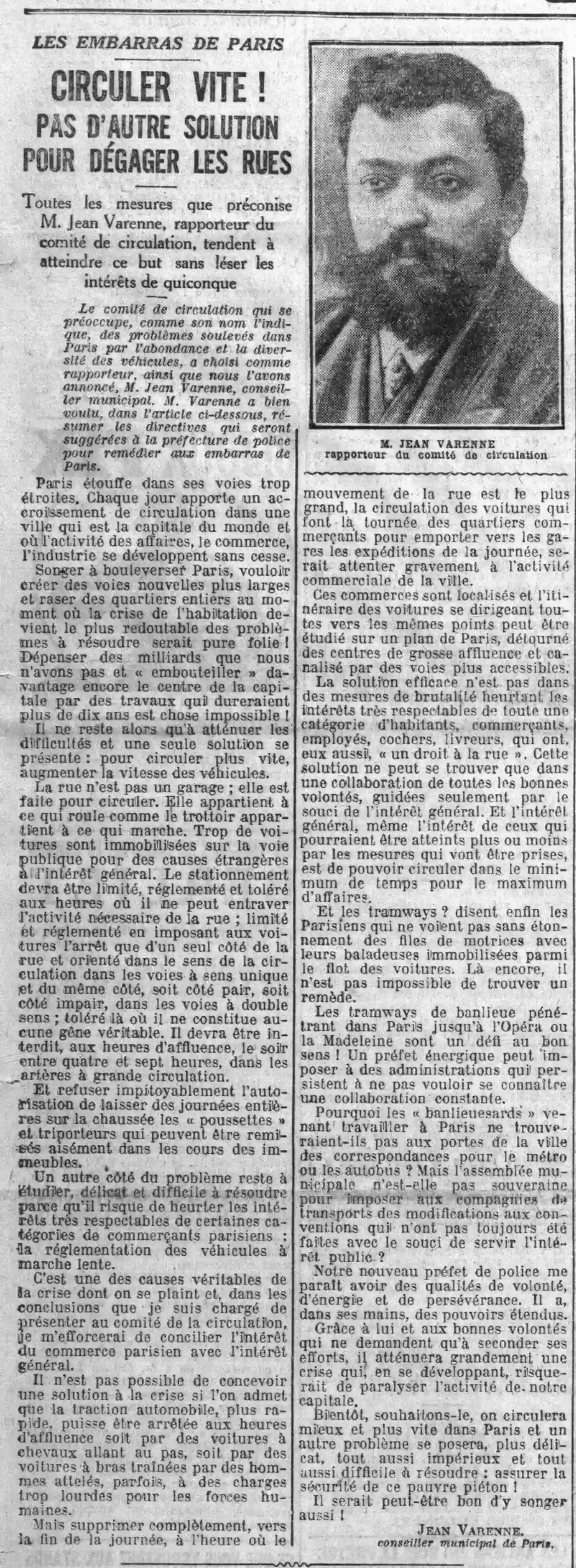
THE EMBARRASSES OF PARIS All the measures recommended by Mr. Jean Varenne, rapporteur of the traffic committee, tend to achieve this goal without harming anyone's interests The street is not a garage; it is made for movement. It belongs to those who drive as the sidewalk belongs to those who walk. Too many cars are immobilized on the public highway for reasons unrelated to the general interest. Parking must be limited, regulated and tolerated at times when it cannot hinder the necessary activity of the street; limited and regulated by requiring cars to stop only on one side of the street and facing the direction of traffic in one-way streets and on the same side, either on the even or odd side, in two-way streets; tolerated where it does not constitute any real inconvenience. It should be prohibited, during peak hours, in the evening between four and seven o'clock, on busy arteries. And mercilessly refuse permission to leave "strollers and tricycles that can be easily parked in the courtyards of buildings" on the road for entire days. Another side of the problem remains to be studied, delicate and difficult to resolve because it risks offending the very respectable interests of certain categories of Parisian traders: the regulation of slow-moving vehicles. This is one of the real causes of the crisis that people are complaining about and, in the conclusions that I am responsible for presenting to the traffic committee, I will try to reconcile the interests of Parisian commerce with the general interest. It is not possible to conceive of a solution to the crisis if we admit that automobile traction, which is faster, can be stopped at peak times either by horse-drawn carriages going at a walking pace, or by hand-drawn carriages pulled by men harnessed, sometimes, to loads too heavy for human strength. These businesses are localized and the route of the carriages all heading to the same points can be studied on a map of Paris, diverted from the centers of great affluence and channeled by more accessible routes. The effective solution does not lie in brutal measures which offend the very respectable interests of a whole category of inhabitants, shopkeepers, employees, coachmen, delivery men, who also have "a right to the street". This solution can only be found in a collaboration of all good wills, guided only by concern for the general interest. And the general interest, even the interest of those who could be affected more or less by the measures that are going to be taken, is to be able to move around in the minimum of time for the maximum of business. And the trams? finally ask the Parisians who do not see without astonishment lines of locomotives with their lamps immobilized among the flow of cars. Here again, it is not impossible to find a remedy. Why should the "suburbanites" coming to work in Paris not find connections to the metro or buses at the city gates? But is not the municipal assembly sovereign to impose on the transport companies modifications to the agreements that have not always been made with the concern to serve the public interest? Our new police prefect seems to me to have qualities of will, energy and perseverance. He has, in his hands, extensive powers. Thanks to him and the goodwill that only asks to support his efforts, he will greatly alleviate a crisis that, if it develops, risks paralyzing the activity of our capital. Soon, let us hope, we will move around better and faster in Paris and another problem will arise, more delicate, just as pressing and just as difficult to resolve: ensuring the safety of this poor pedestrian! It would perhaps be good to think about that too! JEAN VARENNE. |
 |
| retour - back 26 octobre 1924 |