

| La Presse 04 septembre 1924 |
|
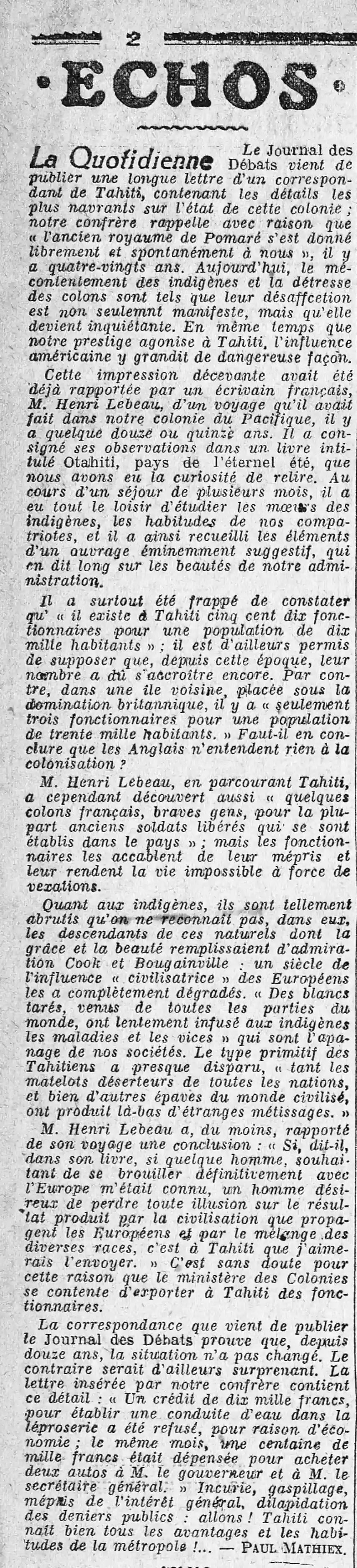
ECHOS La Quotidienne The Journal des Débats has just published a long letter from a correspondent in Tahiti, containing the most distressing details on the state of this colony; our colleague rightly recalls that "the ancient kingdom of Pomare gave itself freely and spontaneously to us" eighty years ago. Today the distress, the discontent of the natives and the colonists, are such that their disaffection is not only obvious, but it is becoming worrying. At the same time as our prestige is dying in Tahiti, American influence is growing there in a dangerous way. This disappointing impression had already been reported by a French writer, Mr. Henri Lebeau, from a trip he made to our Pacific colony, some twelve or fifteen years ago. He recorded his observations in a book entitled Otahiti, country of eternal summer, which we were curious to reread. During a stay of several months, he had plenty of time to study the customs of the natives, the habits of our compatriots, and he thus collected the elements of an eminently suggestive work, which says a lot about the beauties of our administration. He was especially struck to note that there are in Tahiti five hundred and ten civil servants for a population of ten thousand inhabitants"; it is also permissible to suppose that, since that time, their number must have increased further. On the other hand, on a neighboring island, placed under British domination, there are "only three civil servants for a population of thirty thousand inhabitants." Should we conclude from this that the English understand nothing about colonization? Mr. Henri Lebeau, however, while traveling around Tahiti, also discovered "a few French colonists, good people, for the most part former freed soldiers who have settled in the country"; but the civil servants overwhelm them with their contempt and make their lives impossible with their harassment. As for the natives, they are so stupefied that one does not recognize in them the descendants of those natives whose grace and beauty filled Cook and Bougainville with admiration. A century of the "civilizing influence of Europeans has completely degraded them. "Defective whites, coming from all parts of the world, have slowly infused the natives with the diseases and vices" which are the prerogative of our societies. The primitive type of the Tahitians has almost disappeared, "so much have the deserting sailors of all nations, and many other wrecks of the civilized world, produced strange crossbreedings there. » Mr. Henri Lebeau has, at least, brought back from his trip a conclusion: "If," he says in his book, "if any man, wishing to fall out definitively with Europe were known to me, a man desirous of losing all illusions about the result produced by the civilization that Europeans propagate and by the mixture of the various races, it is to Tahiti that I would like to send him." It is doubtless for this reason that the Ministry of Colonies is content to export civil servants to Tahiti. The correspondence that the Journal des Débats has just published proves that, for twelve years, the situation has not changed. The opposite would be surprising. The letter inserted by our colleague contains this detail: "A credit of ten thousand francs, to establish a water conduit in the leper colony was refused, for reasons of economy; the same month, a hundred thousand francs were spent to buy two cars for the governor and the secretary general." Carelessness, waste, contempt for the general interest, squandering of public funds, come on! Tahiti knows all the advantages and habits of the metropolis!... PAUL MATHIEX. |
 |
| Retour - Back 04 septembre 1924 |