


| La Justice 28 septembre 1924 |
|
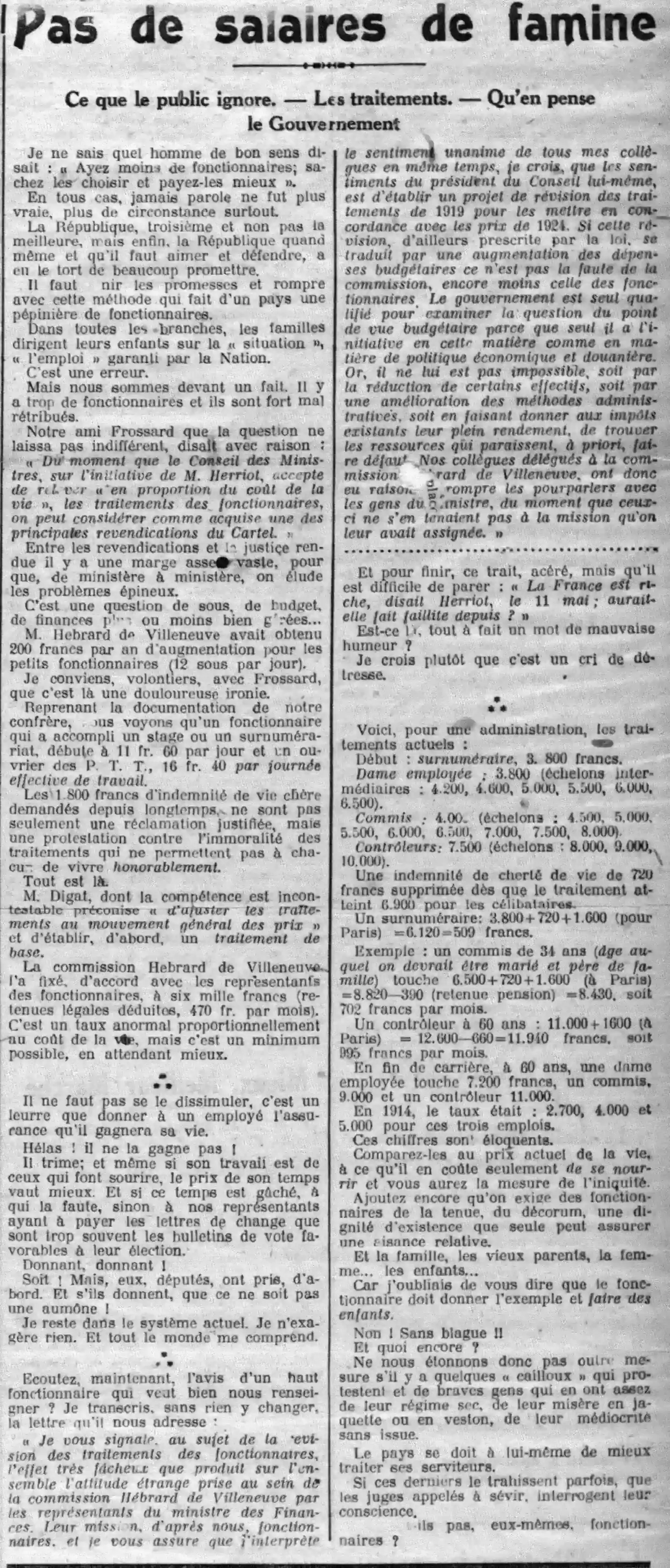
I do not know which man of good sense said: "Have fewer civil servants; know how to choose them and pay them better". In any case, never was a word truer, more appropriate especially. The Republic, third and not the best, but finally, the Republic nonetheless and which must be loved and defended, was wrong to promise a lot. We must keep our promises and break with this method which makes a country a breeding ground for civil servants. In all branches, families direct their children on the "situation", the "job" guaranteed by the Nation. This is a mistake. But we are faced with a fact. There are too many civil servants and they are very poorly paid. Our friend Frossard, who was not indifferent to the question, rightly said There is a wide enough margin between the demands and the justice rendered, so that, from ministry to ministry, thorny problems are avoided. It is a question of money, of budget, of finances more or less well managed... Mr. Hebrard de Villeneuve had obtained a 200 francs per year increase for the small civil servants (12 sous per day). I readily agree with Frossard, that this is a painful irony. Taking up the documentation of our colleague, we see that a civil servant who has completed a training course or a supernumerary, starts at 11 fr. 60 per day and a worker of the P. T. T., 16 fr. 40 per effective day of work. The 1,800 francs of cost of living allowance requested for a long time, are not only a justified claim, but a protest against the immorality of the treatments which do not allow everyone to live honorably. Everything is there. Mr. Digat, whose competence is unquestionable, recommends adjusting salaries to the general movement of prices "and establishing, first, a basic salary. The Hebrard de Villeneuve commission set it, in agreement with the representatives of the civil servants, at six thousand francs (legal deductions deducted, 470 francs per month). This is an abnormal rate in proportion to the cost of living, but it is a possible minimum, while waiting for better. Fine! But, they, deputies, took, first. And if they give, let it not be alms! I remain in the current system. I am not exaggerating anything. And everyone understands me. Listen, now, to the opinion of a senior civil servant who is willing to inform us? I am transcribing, without changing anything, the letter he sent us And to finish, this sharp line, but which is difficult to ward off: "France is rich," said Herriot, on May 11; has it gone bankrupt since then?" Here are the current salaries for an administration: Beginning: A cost of living allowance of 720 francs removed as soon as the salary reaches 6,900 for single people. Example: a 34-year-old clerk (the age at which one should be married and a father) earns 6,500+720+1,600 (in Paris) =8,820-390 (pension deduction) =8,430, or 702 francs per month. These figures speak for themselves. Compare them to the current cost of living, to what it costs just to feed oneself, and you will have the measure of the iniquity. Add to that the fact that civil servants are required to have good dress, decorum, a dignity of existence that only relative comfort can ensure. And the family, the elderly parents, the wife... the children... Because I forgot to tell you that the civil servant must set an example and have children. No! No kidding!! And what else? So let us not be overly surprised if there are a few "pebbles" who protest and good people who are fed up with their harsh regime, their misery in a jacket or a jacket, their hopeless mediocrity. The country owes it to itself to treat its servants better. If the latter sometimes betray it, let the judges called upon to punish them question their conscience. Are they not themselves civil servants? |
 |
| Retour - Back 28 septembre 1924 |