

| Paris-Soir28 septembre 1924 |
|
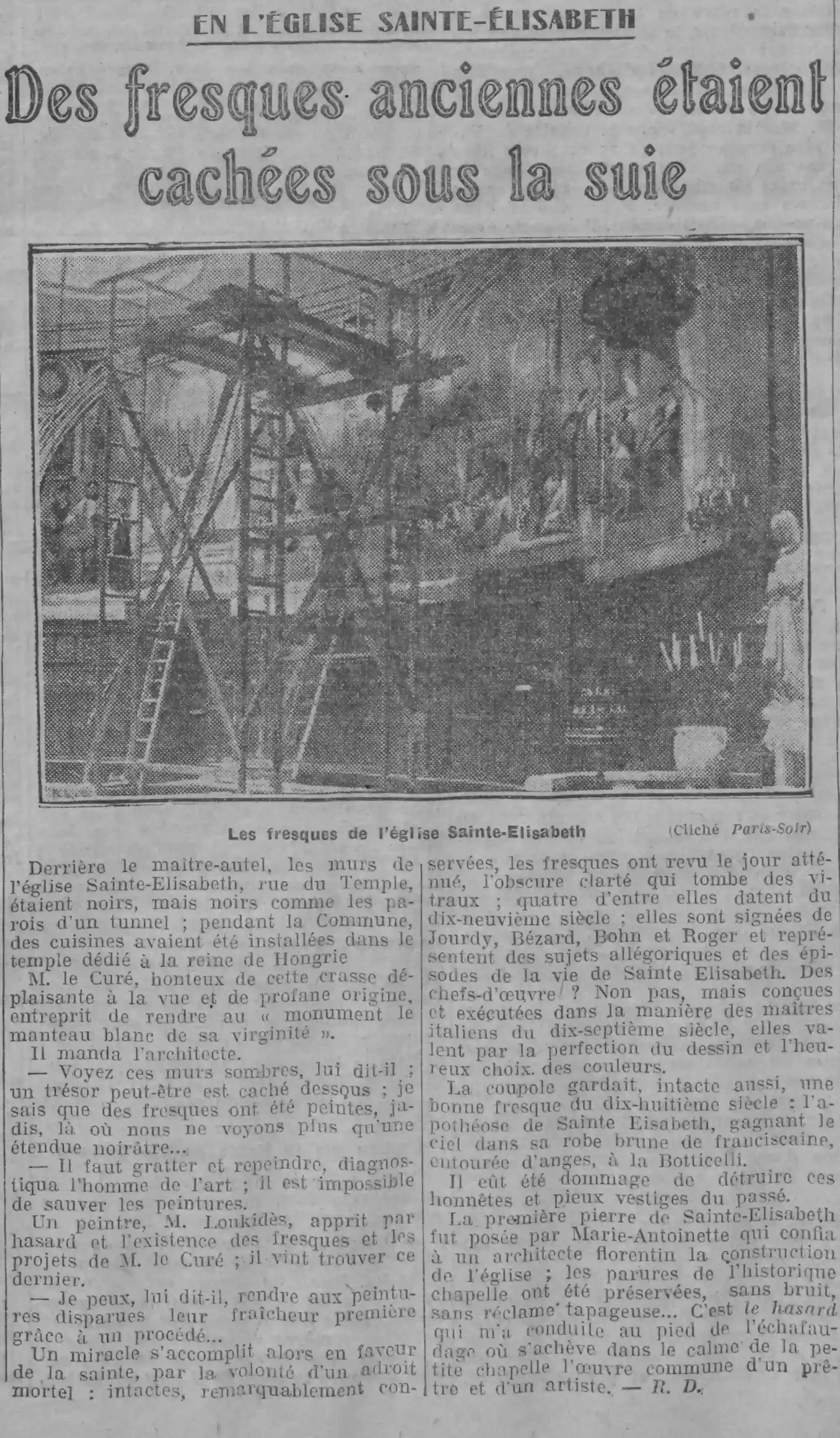
Behind the high altar, the walls of the church of Sainte-Elisabeth, rue du Temple, were black, but black as the walls of a tunnel; during the Commune, kitchens had been installed in the temple dedicated to the Queen of Hungary. The priest, ashamed of this filth that was unpleasant to the eye and of profane origin, undertook to restore to the "monument the white mantle of its virginity". He summoned the architect. Look at these dark walls, he said to him; a treasure is perhaps hidden underneath; I know that frescoes were painted, in the past, where we now see only a blackish expanse... A painter, Mr. Loukidès, learned by chance of the existence of the frescoes and of the projects of the priest; he came to find the latter. -I can, he told her, restore the lost paintings to their original freshness by a process... The dome kept, also intact, a good fresco from the eighteenth century: the apotheosis of Saint Elizabeth, gaining heaven in her brown Franciscan dress, surrounded by angels, in the style of Botticelli. It would have been a pity to destroy these honest and pious vestiges of the past. The first stone of Sainte-Elisabeth was laid by Marie-Antoinette who entrusted the construction of the church to a Florentine architect; the adornments of the historic chapel have been preserved, without noise, without noisy advertising... It was chance that led me to the foot of the scaffolding where the joint work of a priest and an artist is being completed in the calm of the small chapel. R. D. |
 |
| Retour - Back 28 septembre 1924 |