

| L'Avenir d'Arcachon 21 septembre 1924 |
|
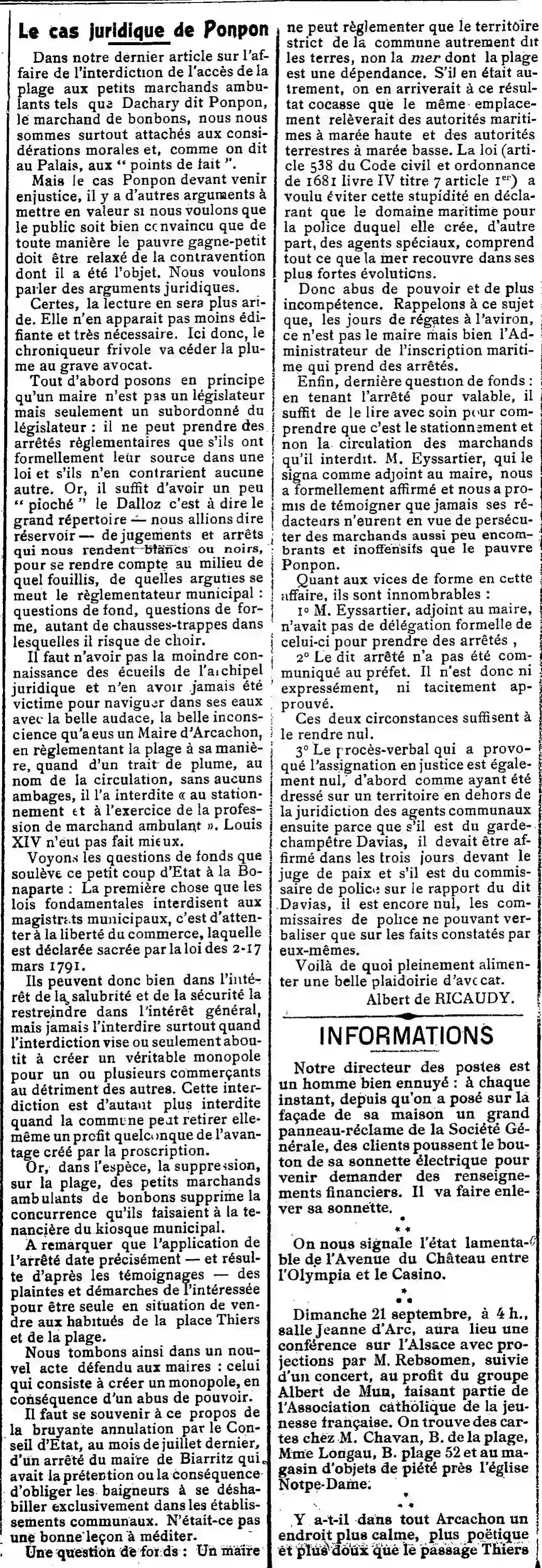
Ponpon's legal case In our last article on the case of the ban on beach access to small street vendors such as Dachary, known as Ponpon, the candy vendor, we focused mainly on moral considerations and, as they say at the Palace, on "factual points". But since the Ponpon case is due to go to court, there are other arguments to be put forward if we want the public to be convinced that in any case the poor low-income earner should be acquitted of the fine he was given. We want to talk about the legal arguments. Of course, it will be a more arid read. It is nonetheless edifying and very necessary. Here, therefore, the frivolous columnist will yield the pen to the serious lawyer. First of all, let us establish as a principle that a mayor is not a legislator but only a subordinate of the legislator: he can only make regulatory decisions if they formally have their source in a law and if they do not contradict any other. Now, it is enough to have dug a little "the Dalloz that is to say the great repertoire we were going to say reservoir of judgments and rulings that make us white or black, to realize in the middle of what a mess, what quibbles the municipal regulator moves: questions of substance, questions of form, so many pitfalls into which he risks falling. You have to have not the slightest knowledge of the pitfalls of the legal archipelago and never have been a victim of them to navigate its waters with the beautiful audacity, the beautiful unconsciousness that a Mayor of Arcachon had, by regulating the beach in his own way, when with a stroke of the pen, in the name of traffic, without any ambiguity, he prohibited it "to parking and to the exercise of the profession of traveling merchant Louis XIV would not have done better. Let us see the fundamental questions raised by this little coup d'état à la Bonaparte. The first thing that the fundamental laws prohibit municipal magistrates from doing is to infringe on the freedom of trade, which is declared sacred by the law of 2-17 March 1791. They can therefore, in the interest of health and safety, restrict it in the general interest, but never prohibit it, especially when the prohibition aims at or only results in creating a real monopoly for one or more traders to the detriment of others. This prohibition is all the more prohibited when the municipality can itself derive any profit from the advantage created by the proscription. However, in this case, the suppression, on the beach, of the small street vendors of sweets eliminates the competition that they made with the owner of the municipal kiosk. It should be noted that the application of the decree dates precisely and results from the testimonies of the complaints and steps of the interested party to be alone in a position to sell to the regulars of Place Thiers and the beach. We thus fall into a new act forbidden to mayors: that which consists of creating a monopoly, as a consequence of an abuse of power. We must remember in this regard the noisy cancellation by the Council of State, last July, of a decree of the mayor of Biarritz which had the pretension or the consequence of forcing bathers to undress exclusively in municipal establishments. Wasn't that a good lesson to meditate on. A question of substance: A mayor can only regulate the strict territory of the municipality, in other words the land, not the sea of which the beach is a dependency. If it were otherwise, we would arrive at this comical result that the same location would fall under the maritime authorities at high tide and the land authorities at low tide. The law (article 538 of the Civil Code and ordinance of 1681 book IV title 7 article ter) wanted to avoid this stupidity by declaring that the maritime domain for the police of which it creates, on the other hand, special agents, includes everything that the sea covers in its strongest evolutions. So abuse of power and more incompetence. Let us recall on this subject that, on the days of rowing regattas, it is not the mayor but the Administrator of maritime registration who takes orders. Finally, last question of substance: by holding the order to be valid, it is enough to read it carefully to understand that it is the parking and not the circulation of merchants that it prohibits. Mr. Eyssartier, who signed it as deputy mayor, formally assured us and promised to testify that its authors never had in mind to persecute merchants as unobtrusive and harmless as poor Ponpon. As for the procedural defects in this case, they are innumerable: This is enough to fully fuel a fine lawyer's plea. Albert de RICAUDY. |
 |
| Retour - Back 21 septembre 1924 |