

| Le Petit Journal illustré 14 septembre 1924 |
|
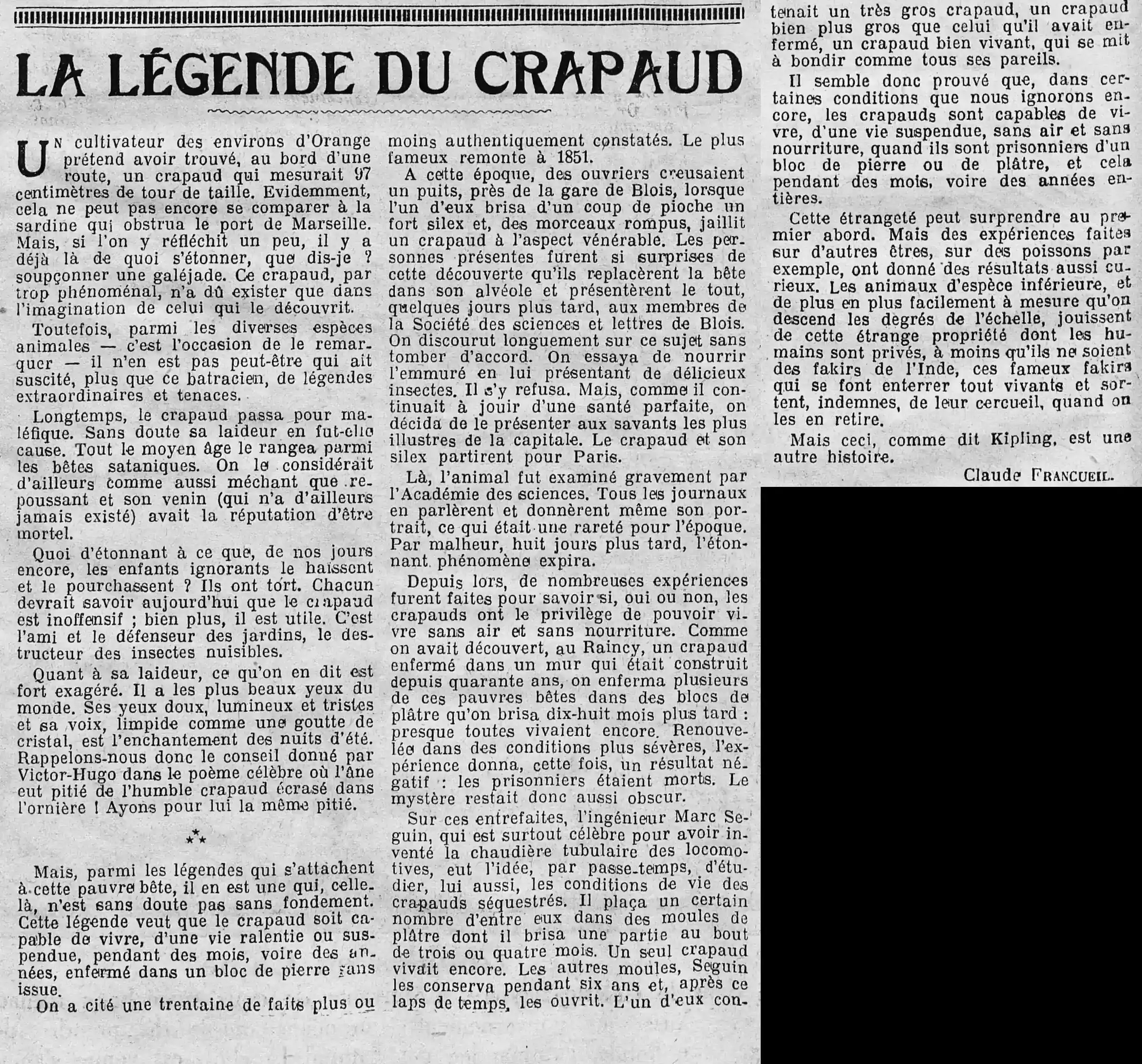
A farmer near Orange claims to have found, at the side of a road, a toad that measured 97 centimeters around the waist. Obviously, this cannot yet be compared to the sardine that blocked the port of Marseille. But, if we think about it a little, there is already reason to be astonished, what am I saying? to suspect a joke. This toad, too phenomenal, must have existed only in the imagination of the one who discovered it. However, among the various animal species this is the occasion to note it, there is perhaps none that has given rise to more extraordinary and tenacious legends than this batrachian. For a long time, the toad was considered evil. No doubt its ugliness was the cause. The entire Middle Ages ranked it among satanic beasts. It was considered as mean as it was repulsive and its venom (which never existed) had the reputation of being deadly. What is surprising that, even today, ignorant children hate it and chase it? They are wrong. Everyone should know today that the toad is harmless; indeed, it is useful. It is the friend and defender of gardens, the destroyer of harmful insects. As for its ugliness, what is said about it is greatly exaggerated. It has the most beautiful eyes in the world. Its soft, luminous and sad eyes and its voice, clear as a drop of crystal, are the enchantment of summer nights. Let us therefore remember the advice given by Victor Hugo in the famous poem where the donkey took pity on the humble toad crushed in the rut! Let us have the same pity for it. But, among the legends that attach to this poor beast, there is one that is probably not without foundation. This legend says that the toad is capable of living, a slowed down or suspended life, for months, even years, locked in a block of stone with no way out. About thirty more or less authentically recorded facts have been cited. The most famous dates back to 1851. At that time, workers were digging a well, near the Blois station, when one of them broke a large flint with a pickaxe and, from the broken pieces, a venerable-looking toad sprang forth. The people present were so surprised by this discovery that they replaced the beast in its socket and presented the whole thing, a few days later, to the members of the Society of Sciences and Letters of Blois. There was a long discussion on this subject without reaching an agreement. They tried to feed the walled-up creature by presenting it with delicious insects. He refused. But, as he continued to enjoy perfect health, it was decided to present him to the most illustrious scientists of the capital. The toad and its flint left for Paris. There, the animal was seriously examined by the Academy of Sciences. All the newspapers talked about it and even gave its portrait, which was a rarity for the time. Unfortunately, eight days later, the astonishing phenomenon expired. Since then, many experiments have been carried out to find out whether or not toads have the privilege of being able to live without air and without food. As a toad had been discovered, in Raincy, enclosed in a wall that had been built for forty years, several of these poor beasts were enclosed in blocks of plaster that were broken eighteen months later: almost all of them were still alive. Repeated under more severe conditions, the experiment gave, this time, a negative result: the prisoners were dead. The mystery therefore remained just as obscure. In the meantime, the engineer Marc Seguin, who is especially famous for having invented the tubular boiler for locomotives, had the idea, as a hobby, to study the living conditions of the sequestered toads. He placed a certain number of them in plaster molds, part of which he broke after three or four months. Only one toad was still alive. Seguin kept the other molds for six years and, after this period of time, opened them. One of them contained a very large toad, a toad much larger than the one he had locked up, a very lively toad, which began to jump like all its peers. It therefore seems proven that, under certain conditions that we are still unaware of, toads are capable of living a suspended life, without air or food, when they are imprisoned in a block of stone or plaster, and this for months, even years. This strangeness may surprise at first glance. But experiments made on other beings, on fish for example, have given equally curious results. Animals of lower species, and more and more easily as one descends the degrees of the scale, enjoy this strange property of which humans are deprived, unless they are fakirs of India, these famous fakiras who have themselves buried alive and emerge, unharmed, from their coffins, when they are removed. But this, as Kipling says, is another story. Claude FRANCUEIL. |
 |
| Retour - Back 14 septembre 1924 |