

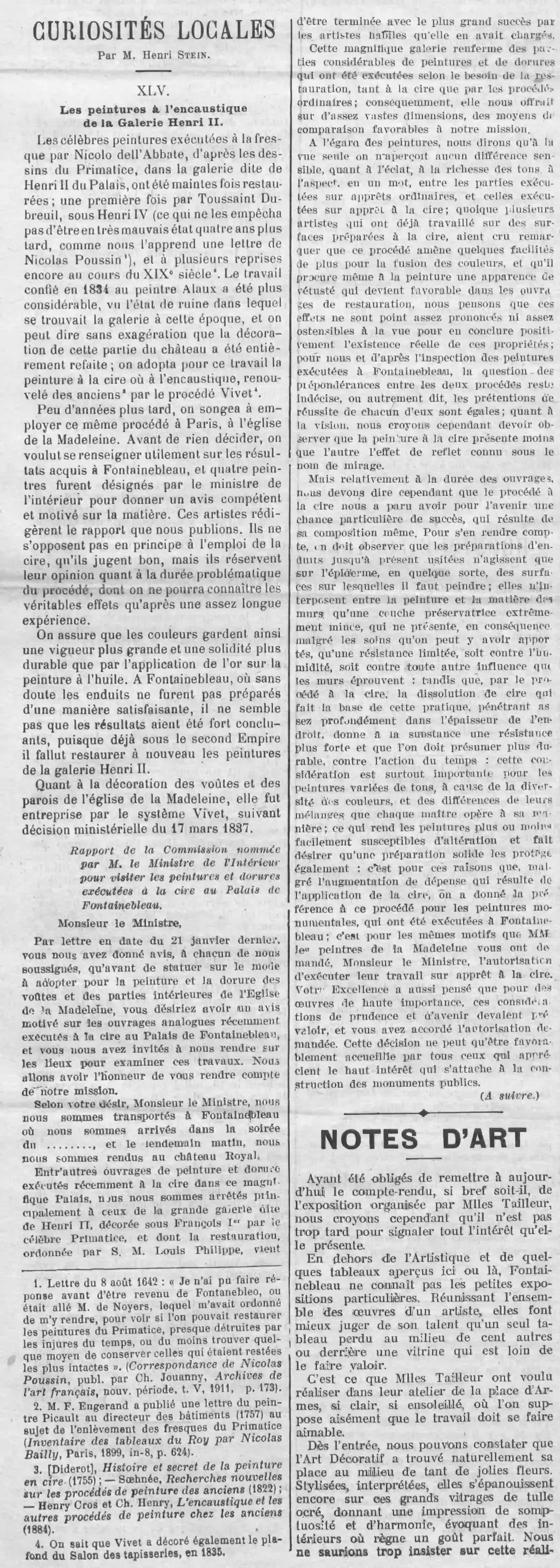
| L'Éclaireur du dimanche 22 juillet 1923 (art. page 21) |
|
LOCAL CURIOSITIES The encaustic paintings of the Henri II Gallery The famous fresco paintings by Nicolo dell'Abbate, based on Primaticce's drawings, in the so-called Henry II gallery of the Palace, have been restored many times; a first time by Toussaint Dubreuil, under Henri IV (which did not prevent them from being in very poor condition four years later, as we learn from a letter from Nicolas Poussin), and several times again during the 19th century. ° century. The work entrusted in 1834 to the painter Alaux was more considerable, given the state of ruin in which the gallery was at that time, and we can say without exaggeration that the decoration of this part of the castle was completely redone; Wax or encaustic paint was adopted for this work, renewed from the old ones by the Vivet process. A few years later, people thought of using this same process in Paris, at the Madeleine church. Before deciding anything, we wanted to obtain useful information on the results acquired at Fontainebleau, and four painters were designated by the Minister of the Interior to give a competent and reasoned opinion on the matter. These artists wrote the report that we are publishing. They are not opposed in principle to the use of wax, which they consider good, but they reserve their opinion as to the problematic duration of the process, the true effects of which will only be known after a fairly long experience. . It is ensured that the colors thus maintain greater vigor and more lasting solidity than by applying gold to oil paint. At Fontainebleau, where undoubtedly the coatings were not prepared in a satisfactory manner, it does not seem that the results were very conclusive, since already under the Second Empire it was necessary to once again restore the paintings of the Henri II gallery. As for the decoration of the vaults and walls of the Madeleine church, it was undertaken by the Vivet system, following a ministerial decision of March 17, 1887. Report of the Commission appointed by the Minister of the Interior to visit the paintings and gilding executed at the Palais de Fontainebleau. Minister, By letter dated January 21, you gave notice to each of us, the undersigned, that before deciding on the method to be adopted for the painting and gilding of the vaults and interior parts of the Church of La Madelelne , you wanted to have a reasoned opinion on the similar works recently executed in wax at the Palace of Fontainebleau, and you invited us to go to the site to examine this work. We will have the honor of reporting to you on our mission. According to your wishes, Mr. Minister, we transported ourselves to Fontainebleau where we arrived in the evening of ........, and the next morning, we went to the Royal Castle. Among other works of painting and gilding recently executed in wax in this magnificent Palace, we stopped mainly at those of the great gallery known as Henri II, decorated under Francis I by the famous Primaticce, and whose restoration, ordered by H.M. Louis Philippe, has just been completed with the greatest success by the skilful artists she had commissioned. This magnificent gallery contains considerable parts of paintings and gilding which were executed according to the needs of the restoration, both with wax and by ordinary processes; consequently, it offered us, over quite large dimensions, means of comparison favorable to our mission. With regard to the paintings, we will say that by sight alone we see no perceptible difference, as to the brilliance, the richness of the tones, the appearance, in a word, between the parts executed on primers ordinary, and those executed on wax primer; although several artists who have already worked on surfaces prepared with wax, have noticed that this process brings some additional facilities for the fusion of colors, and that it even gives the painting an apparent dilapidation which becomes favorable in works restoration, we think that these effects are not pronounced enough nor conspicuous enough to positively conclude the real existence of these properties; for us and after the inspection of the paintings executed at Fontainebleau, the question of the preponderances between the two processes remains undecided, or in other words, the claims of success of each of them are equal; as for vision, however, we believe we must observe that wax painting presents less than the other the reflection effect known under the name of mirage. But in relation to the duration of the works, we must say however that the wax process seemed to us to have a particular chance of success for the future, which results from its very composition. To realize this, we must observe that the coating preparations used until now only act on the epidermis, so to speak, of the surfaces on which it is necessary to paint; they are interposed between the paint and the material of the walls as an extremely thin preservative layer, which consequently presents, despite the care that may have been taken, only limited resistance, either against humidity or against any other influence that the walls experience: while, by the wax process, the dissolution of wax which is the basis of this practice, penetrating quite deeply into the thickness of the place, gives the substance a greater resistance strong and which must be presumed to be more durable, against the action of time: this consideration is especially important for paintings of varied tones, because of the diversity of colors, and the differences in their mixtures that each master operates in his own way. manner ; which makes the paints more or less easily susceptible to alteration and makes it desirable that a solid preparation also protects them: it is for these reasons that, despite the increase in expense which results from the application of wax, we gave preference to this process for monumental paintings, which were executed at Fontainebleau; it is for the same reasons as MM. The painters of the Madeleine have asked you, Mr. Minister, for authorization to carry out their work on a wax primer. 1. Letter of August 8, 1642: “I was unable to respond before returning from Fontainebleau, where Mr. de Noyers had gone, who had ordered me to go there, to see if we could restore the paintings of the Primaticce, almost destroyed by the ravages of time, or at least find some way of preserving those which had remained the most intact. (Correspondence of Nicolas Poussin, published by Ch. Jouanny, Archives of French art, new period, volume V, 1911, p. 173). 2. M. F. Engerand published a letter from the painter Picault to the director of buildings (1757) regarding the removal of the Primaticio frescoes (Inventaire des paintings du Roy by Nicolas Bailly, Paris, 1899, 8vo, p. 624) . 3. Diderot, History and secret of wax painting (1755); Sœhnée, New research on the painting processes of the ancients (1822); Henry Cros and Ch. Henry, Encaustic and other painting processes among the ancients (1884). 4. We know that Vivet also decorated the ceiling of the Tapestry Salon in 1835. |
 |