|
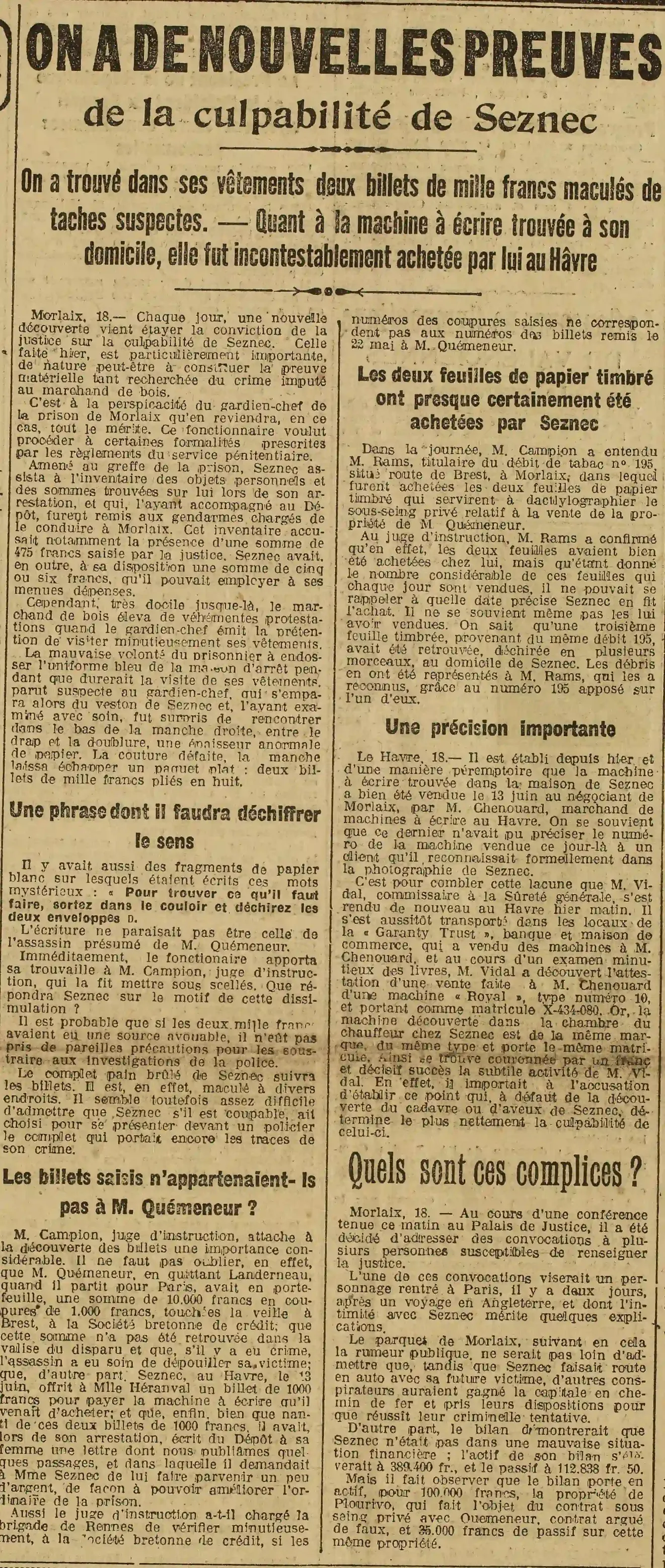
WE HAVE NEW EVIDENCE
of Seznec's guilt
Two 1000 franc notes with suspicious stains were found in his clothes. — As for the typewriter found at his home, it was undoubtedly purchased by him in Le Havre
Morlaix, 18.— Every day, a new discovery supports the justice's conviction of Seznec's guilt. The one made yesterday is particularly important, perhaps likely to constitute the much sought-after material proof of the crime attributed to the wood merchant.
In this case, all the credit will go to the insight of the head warden of Morlaix prison. This official wanted to carry out certain formalities prescribed by the prison service regulations. Brought to the prison registry, Seznec witnessed the inventory of personal objects and sums found on him during his arrest, which, having accompanied him to the depot, were handed over to the gendarmes responsible for taking him to Morlaix. This inventory notably revealed the presence of a sum of 475 francs seized by the courts. Seznec also had at his disposal a sum of five or six francs, which he could use for his small expenses. However, very docile until then, the wood merchant raised vehement protests when the head guard claimed to carefully examine his clothes. The prisoner's reluctance to don the blue uniform of the remand center while the inspection of his clothing lasted seemed suspicious to the head guard, who then took hold of Seznec's jacket and, having examined it carefully , was surprised to find at the bottom of the right sleeve, between the sheet and the lining, an abnormal thickness of paper.
The seam undone, the sleeve let out a flat package: two thousand franc notes folded into eight.
A sentence whose meaning will have to be deciphered
There were also fragments of white paper on which were written these mysterious words: “To find out what to do, go out into the hallway and tear up the two envelopes. The handwriting did not appear to be that of Mr. Quémeneur's alleged assassin. Immediately, the official brought his find to Mr. Campion, investigating judge, who had it sealed. What will Seznec say about the reason for this cover-up?
It is probable that if the two thousand francs had a reliable source, he would not have taken such precautions to shield them from police investigations.
Seznec’s complete pain brûlée will follow the tickets. It is, in fact, stained in various places. However, it seems quite difficult to accept that Seznec, if he is guilty, chose to appear before a police officer the suit which still bore the traces of his crime.
Didn’t the seized tickets belong to Mr. Quémeneur? Mr. Campion, investigating judge, attaches considerable importance to the discovery of the notes. We must not forget, in fact, that Mr. Quémeneur, upon leaving Landerneau, when he left for Paris, had in his wallet, a sum of 10,000 francs in denominations of 1,000 francs, received the day before in Brest, at the Société bretonne de credit; that this sum was not found in the missing person's suitcase and that, if there was a crime, the assassin took care to rob his victim; that, on the other hand. Seznec, in Le Havre, on June 13, offered Mile Héranval a 1000 franc note to pay for the typewriter he had just bought and that, finally, although he had these two 1000 franc notes, he had, during his arrest, wrote from Le Dépôt to his wife a letter of which we published some passages, and in which he asked Mrs. Seznec to send him some money, so as to be able to improve the ordinary conditions of the prison.
The investigating judge therefore instructed the Rennes brigade to carefully check, at the Société Bretonne de Crédit, whether the numbers of the denominations seized do not correspond to the numbers of the notes given on May 22 to Mr. Quémeneur.
The two sheets of stamped paper were almost certainly purchased by Seznec.
During the day, Mr. Campion heard from Mr. Rams, owner of tobacco shop number 195, located on Route de Brest, in Morlaix, where the two sheets of stamped paper were purchased which were used to type the private signature relating to the sale of M Quémeneur’s property. To the investigating judge, Mr. Rams confirmed that, in fact, the two sheets had indeed been purchased from him, but that given the considerable number of these sheets which are sold every day, he could not remember at what price. precise date Seznec purchased it. He doesn't even remember selling them to her. We know that a third stamped sheet, coming from the same debit 195, was found, torn into several pieces, at Seznec's home. The debris was shown to Mr. Rams, who recognized it, thanks to the number 195 affixed to one of them.
An important precision
Le Havre, 18.— It has been established since yesterday and in a peremptory manner that the typewriter found in the house of Seznec was indeed sold on June 13 to the merchant of Morlaix, by Mr. Chenouard, dealer in writing machines. write to Le Havre. We remember that the latter was unable to specify the number of the machine sold that day to a customer whom he formally recognized in Seznec's photograph.
It is to fill this gap that Mr. Vidal, Commissioner of General Security, went to Le Havre again yesterday morning. He immediately went to the premises of the "Guaranty Trust", a bank and trading house, which sold machines to Mr. Chenouard, and during a careful examination of the books, Mr. Vidal discovered the certificate of a sale made to Mr. Chenouard of a “Royal” machine “type number -10”, and bearing the registration number -X-434-080.
However, the machine discovered in the driver's room at Seznec is of the same brand, type and bears the same number.
Thus the subtle activity of Mr. Vidal is crowned by a frank and decisive success.
Indeed, it was important for the prosecution to establish this point and in the absence of the discovery of the corpse or confession from Seznec, determine the latter's guilt most clearly.
Who are these accomplices?
Morlaix, 18. — During a conference held this morning at the Palais de Justice, it was decided to send summons to several people likely to provide information to the justice system. One of these summons would target a person who returned to Paris two days ago after a trip to England, and whose intimacy with Seznec deserves some explanation.
The Morlaix public prosecutor's office, following public rumor, would not be far from admitting that, while Seznec was traveling by car with his future victim, other conspirators would have reached the capital by train and made arrangements to that their criminal attempt succeeds. On the other hand, the balance sheet would show that Seznec was not in a bad financial situation; the assets of its balance sheet would amount to 389,400 francs, and the liabilities to 112,838 francs. 50. But he points out that the balance sheet shows, as assets, for 100,000 francs, the property of Plourivo, which is the subject of the private contract with Quemeneur, a contract alleged to be false, and 45,000 francs of liabilities on this same property.
|
|
 |