

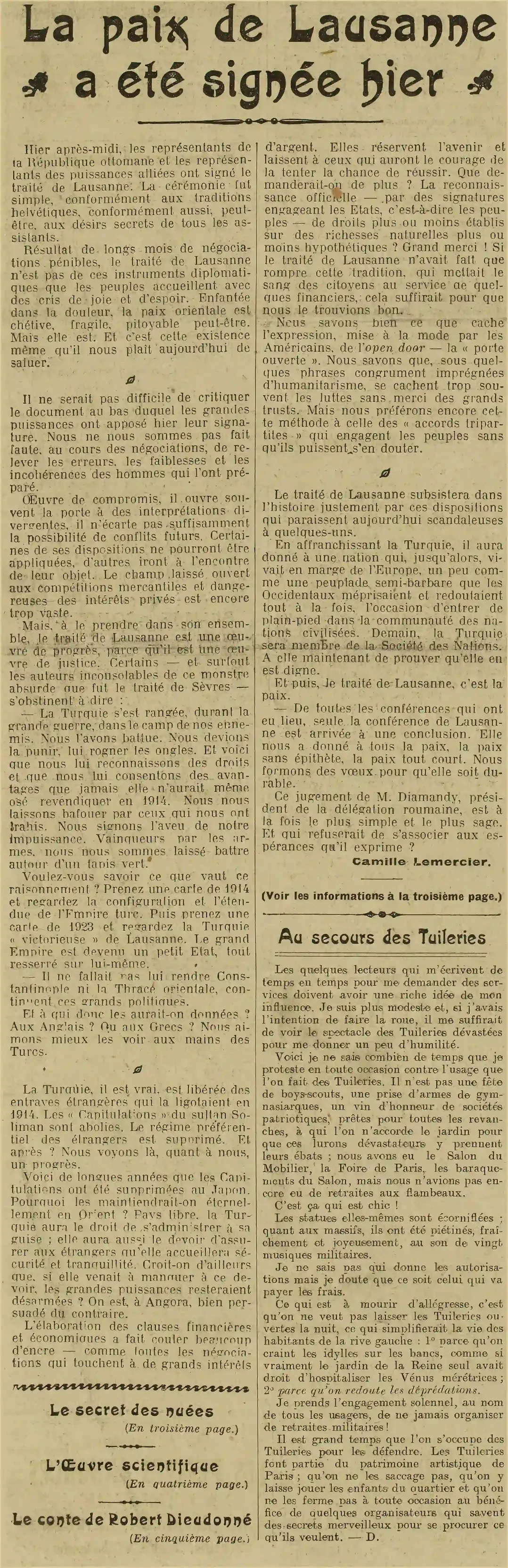
| L'Oeuvre 25 juillet 1923 (art. page une) |
|
The Peace of Lausanne was signed yesterday Yesterday afternoon, the representatives of the Ottoman Republic and the representatives of the Allied Powers signed the Treaty of Lausanne. The ceremony was simple, in accordance with Swiss traditions, in accordance also, perhaps, with the secret wishes of all those present. The result of long months of painful negotiations, the Treaty of Lausanne is not one of those diplomatic instruments that peoples welcome with cries of joy and hope. Born in pain, Eastern peace is puny, fragile, pitiful perhaps. But she is. And it is this very existence that we are pleased to salute today. It would not be difficult to criticize the document to which the great powers yesterday affixed their signatures. We did not fail, during the negotiations, to point out the errors, the weaknesses and the inconsistencies of the men who prepared it. Work of compromise, it often opens the door to divergent interpretations, it does not sufficiently rule out the possibility of future conflicts. Some of its provisions cannot be applied, others will go against their purpose. The field left open to the mercantile and dangerous competitions of private interests is still too vast. But, taken as a whole, the Treaty of Lausanne is a work of progress, because it is a work of justice. Some — and especially the inconsolable authors of that absurd monster that was the Treaty of Sèvres — persist in saying: = Turkey sided with our enemies during the Great War. We beat her. We had to punish her, trim her nails. And now we are recognizing her rights and granting her advantages that she would never even have dared to claim in 1914. We allow ourselves to be flouted by those who have betrayed us. We sign the admission of our impotence. Victors by arms, we let ourselves be beaten around a green carpet. Do you want to know what this reasoning is worth? Take a map from 1914 and look at the configuration and extent of the Turkish Empire. Then take a map from 1923 and look at Lausanne's "victorious" Turkey. The great Empire has become a small State, all squeezed in on itself. Constantinople or Eastern Thrace should not be returned to him, continue these great politicians. And to whom would they have been given? To the English? To the Greeks? We prefer to see them in the hands of the Turks. Turkey, it is true, is freed from the foreign shackles which bound it in 1914. The “Capitulations” of Sultan Soliman are abolished, The preferential regime for foreigners is suppressed. And after ? We see this as progress. Capitulations have been abolished in Japan for many years. Why should they be kept eternally in the East? A free country, Turkey will have the right to administer itself as it pleases; it will also have the duty to assure foreigners that it will welcome security and tranquillity. Besides, do we believe that, if it were to fail in this duty, the great powers would remain disarmed? We, in Angora, are convinced of the contrary. The elaboration of the financial and economic clauses has caused a lot of ink to flow — like all the negotiations which affect great financial interests. They reserve the future and leave to those who will have the courage to try it the chance to succeed. What more could one ask for? The official recognition - by signatures committing the States, that is to say the peoples - of rights more or less established on more or less hypothetical natural wealth? Big thanks ! If the Treaty of Lausanne had only broken this tradition, which put the blood of citizens at the service of a few financiers, that would be enough for us to find it good. We know well what the expression, made fashionable by the Americans, of the open door hides. We know that, under a few sentences congruently impregnated with humanitarianism, the merciless struggles of the big corporations are too often hidden. But we still prefer this method to that of “tripartite agreements” which commit the peoples without their being able to suspect it. The Treaty of Lausanne will survive in history precisely through these provisions which today seem scandalous to some. By freeing Turkey, he will have given a nation which, until then, had lived on the fringes of Europe, a bit like a semi-barbaric tribe that Westerners despised and feared at the same time, the opportunity to enter fully into the community of civilized nations. Tomorrow, Turkey will be a member of the League of Nations. Now it's up to her to prove she's worthy. And then, the Treaty of Lausanne is peace. Of all the conferences that have taken place, only the Lausanne conference has come to a conclusion. She gave us all peace, peace without epithet, peace in short. We wish for it to be long-lasting. This judgment of Mr. Diamandy, president of the Romanian delegation, is both the simplest and the wisest. And who would refuse to associate himself with the hopes he expresses? Camille Lemercier |
 |