

| Le Grand Écho du Nord 12 juillet 1923 (art. page une) |
|
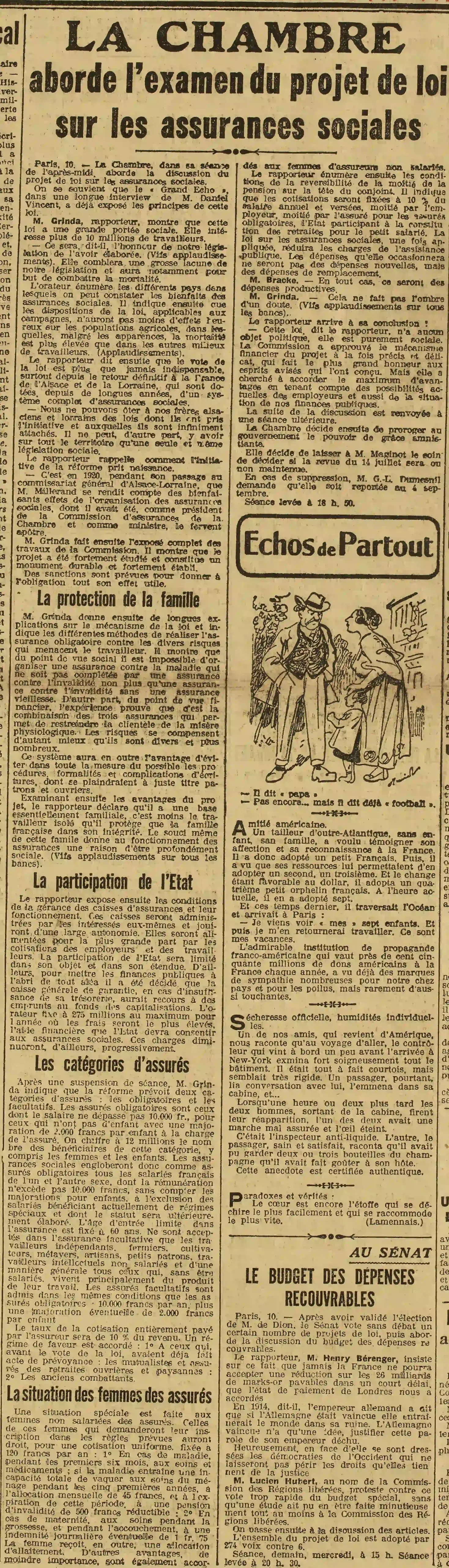
THE CHAMBER addresses the examination of the bill on social insurance Paris, 10, — The Chamber, in its afternoon session, addresses the discussion of the bill on social insurance. We remember that the “Grand Echo, in a long interview with Mr. Daniel Vincent, has already explained the principles of this law Protection of the family Mr. Grinda then gives long explanations on the mechanism of the law and indicates the different methods of achieving compulsory insurance against the various risks that threaten the worker. It shows that from a social point of view it is impossible to organize insurance against illness which is not supplemented by insurance against disability, any more than insurance against disability without old age insurance. State participation The rapporteur then sets out the conditions for the management of insurance funds and their operation. The funds will be administered by the interested parties themselves and will enjoy a large degree of autonomy. They will be financed for the most part by contributions from employers and workers. State participation will be limited in its purpose and extent. Moreover, to protect public finances from any hazard it was decided that the general guarantee fund, in the event of insufficient cash flow, would resort to borrowing from the capitalization fund. The speaker sets the financial aid that the State will have to grant to social insurance at a maximum of 275 million for the year when costs will be highest. These charges will, moreover, gradually decrease. Categories of insured After a suspension of the session, Mr. Grinda indicates that the reform provides for two categories of insured: compulsory and optional. Mandatory insured persons are those whose salary does not exceed 10,000 francs, for those who do not have children with an increase of 2,000 francs per child dependent on the insured person. The number of beneficiaries in this category is estimated at 12 million, including women and children. Social insurance will therefore include as compulsory insured persons all French employees of either sex, whose remuneration does not exceed 10,000 francs, not counting increases for children, excluding employees currently benefiting from special schemes. and whose status will be subsequently developed. The age limit for entry into insurance is set at 60 years. Only self-employed workers, farmers, cultivators, sharecroppers, artisans, small bosses, non-salaried intellectual workers and, in general, all those who, without being employees, live mainly from the product of their work are accepted for optional insurance. Optionally insured persons are admitted under the same conditions as compulsory insured persons: 10,000 francs per year, plus a possible increase of 2,000 francs per child. The contribution rate fully paid by the insurer will be 10% of income. A favorable regime is granted: 1° To those who, before the vote of the law, had already taken an act of foresight: mutual members and those insured with workers' and peasants' pensions: 2° Veterans. The situation of the wives of policyholders A special situation is given to non-employee wives of policyholders. Those of these women who request their registration in accordance with the rules provided for will be entitled, for a uniform contribution, set at 120 francs per year: 1° In the event of illness, during the first six months, to care and medication; if the illness results in a total inability to take care of the household during the first five years, to a monthly allowance of 45 francs, and at the end of this period, to a reducible disability pension of 500 francs. 2° In the event of maternity: care during pregnancy, and during childbirth, with a possible daily allowance of 1.75 francs. The woman also receives a breastfeeding allowance. Other advantages, of lesser importance, are also granted to the wives of non-employee insurers. The Rapporteur reaches his conclusion! — |
 |