

| La Presse 12 mars 1924 |
|
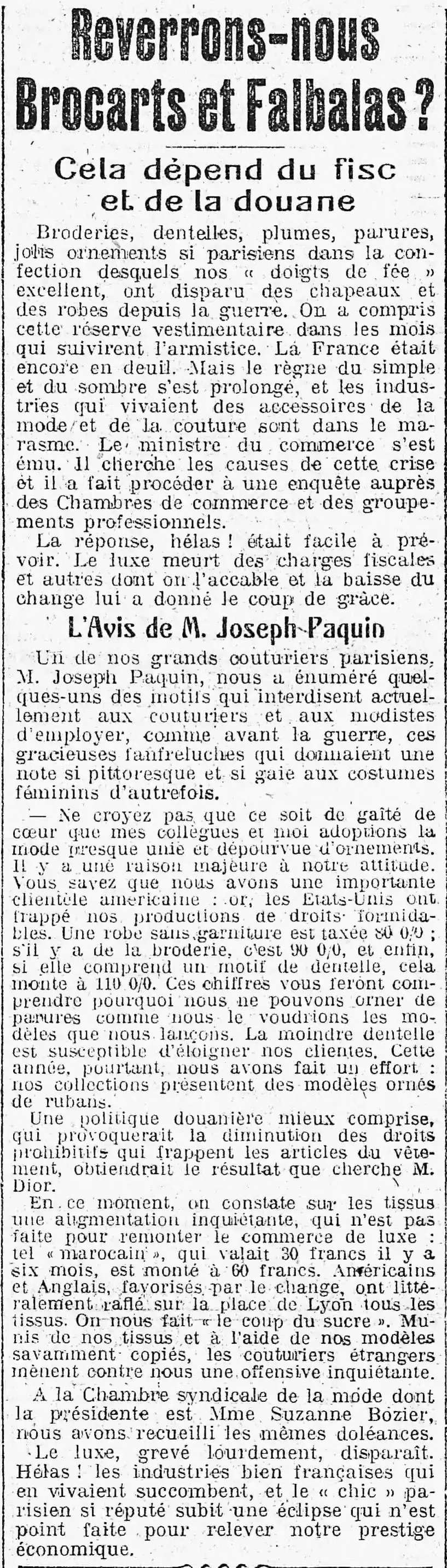
Will we see Brocades and Falbalas again? Embroidery, lace, feathers, ornaments, pretty Parisian ornaments in which our “fairy fingers” excel, have disappeared from hats and dresses since the war. The Minister of Commerce was moved. He is looking for the causes of this crisis and has carried out a survey among Chambers of Commerce and professional groups. The Opinion of Mr. Joseph-Paquin - Do not think that it was out of pleasure that my colleagues and I adopted the almost plain fashion without any ornaments. There is a major reason for our attitude. You know that we have a large American clientele: however, the United States has imposed formidable rights on our productions. A dress without trim is taxed 80%; if it has embroidery, it's 90%, and finally, if it includes a lace pattern, it goes up to 110%. A better understood customs policy, which would bring about a reduction in the prohibitive duties imposed on articles of clothing, would obtain the result that Mr. Dior is seeking. At the moment, we are seeing a worrying increase in fabrics, which is not designed to boost the luxury trade: such a Moroccan, which was worth 30 francs six months ago, has risen to 60 francs. Americans and English, favored by the exchange rate, literally raided all the fabrics on the Place de Lyon. They're giving us sugar.” Equipped with our fabrics and with the help of our carefully copied models, foreign designers are leading a worrying offensive against us. At the Fashion Trade Union Chamber, whose president is Ms. Suzanne Bozier, we have heard the same complaints. Luxury, heavily burdened, disappears. Alas! the very French industries that made their living from it succumbed, and the Parisian “chic” so renowned suffered an eclipse which was not designed to raise our economic prestige. |
 |