

| Le Petit Écho de la mode 16 mars 1924 |
|
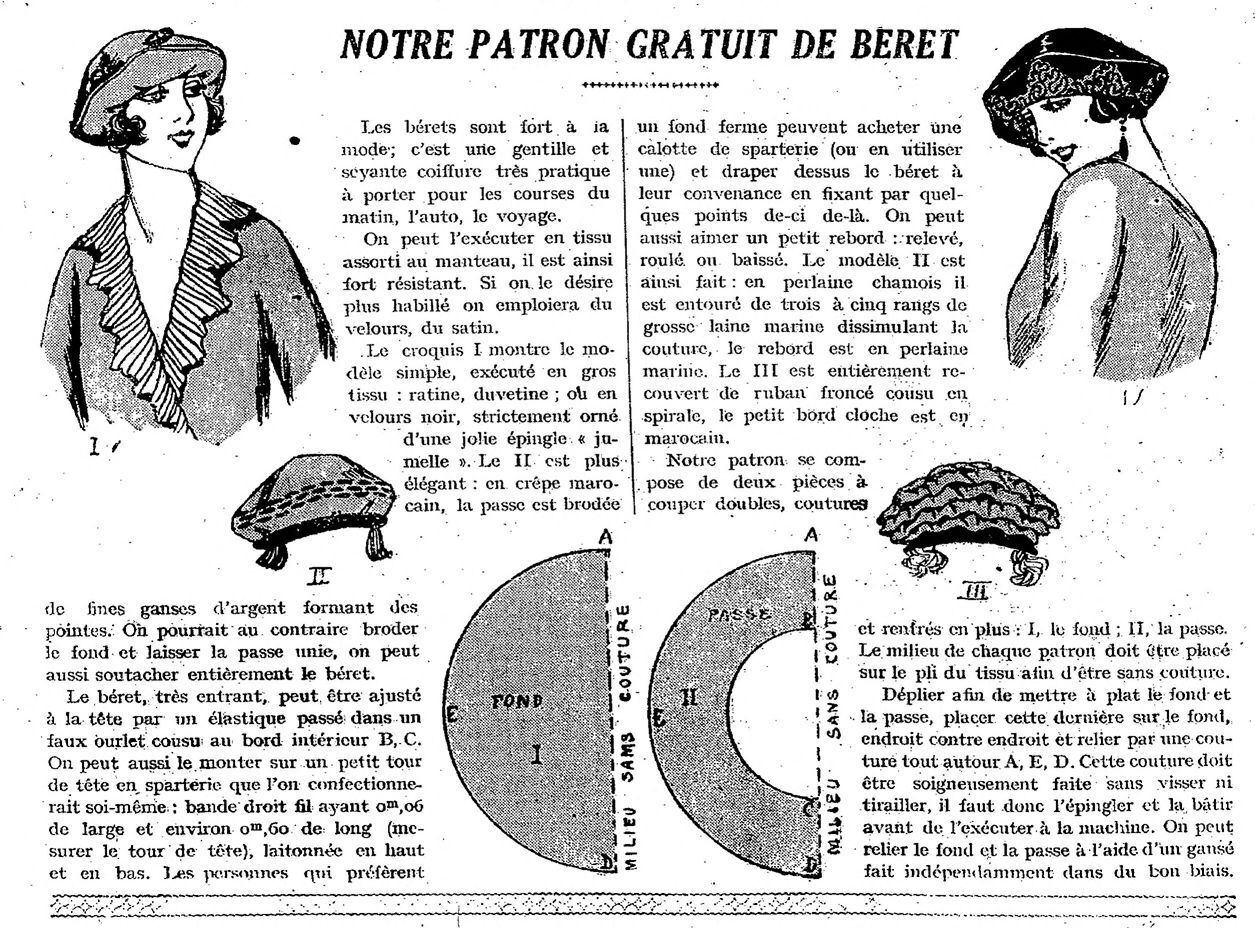
Berets are very fashionable; It's a nice and flattering hairstyle that's very practical to wear for morning errands, driving, or traveling. It can be made in fabric to match the coat, making it very durable. If you want it to be more formal, you will use velvet or satin. Sketch I shows the simple model, executed in large terry, down fabric; or in black velvet, strictly decorated. with a pretty twin pin. The II is more elegant in Moroccan crepe, the pass is embroidered with fine silver braid forming points. On the contrary, we could embroider the background and leave the pass plain, we can also tie the beret entirely. The beret, very fitted, can be adjusted to the head by an elastic passed through a false hem sewn to the inner edge B, C. It can also be fitted on a small esparto headband that you make yourself: straight wire strip 0.06m wide and approximately 0.60m long (measure the head circumference), brass-plated at the top and bottom. People who prefer a firm bottom can purchase a esparto cap (or use one) and drape the beret over it as they wish, securing with a few points here and there. You may also like a small raised, rolled or lowered edge. Model II is made in chamois perlain, it is surrounded by three to five rows of coarse navy wool concealing the seam, the edge is in navy perlain. The III is entirely covered with gathered ribbon sewn in a spiral, the small bell edge is in Moroccan. Our pattern consists of two pieces to be cut double, seams and additionally tucked in: I, the bottom; II, the pass. The middle of each pattern should be placed on the fold of the fabric so it is seamless. Unfold to lay the bottom and the pass flat, place the latter on the bottom, right sides together and connect with a seam all around A, E, D. |
 |