

| Le Grand Écho du Nord 16 mars 1924 |
|
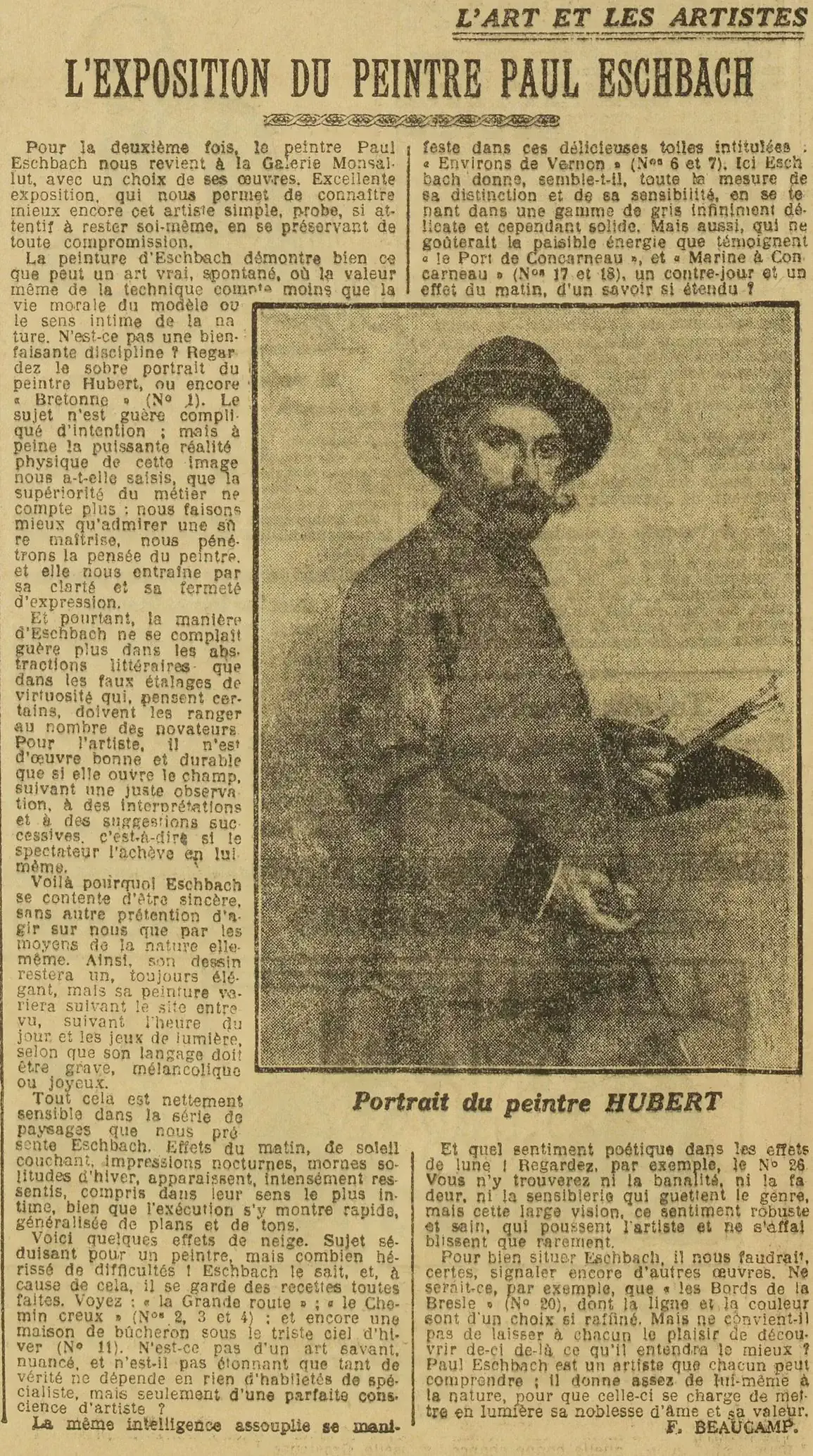
For the second time, the painter Paul Eschbach returns to us at the Monsallut Gallery, with a choice of his works. Excellent exhibition, which allows us to know even better this simple, honest artist, so careful to remain himself, while protecting himself from any compromise. Eschbach's painting clearly demonstrates what a true, spontaneous art can do, where the very value of the technique counts less than the moral life of the model or the intimate sense of nature. Isn't that a beneficial discipline? Look at the sober portrait of the painter Hubert, or even Bretonne (No. 1). The subject is hardly complicated in intention; but barely has the powerful physical reality of this image seized us, than the superiority of the craft no longer counts: we do more than admire a sure mastery, we penetrate the thought of the painter, and it draws us in with its clarity and firmness of expression. And yet, Eschbach's style hardly delights more in literary abstractions than in false displays of virtuosity which, some think, must rank them among the innovators. For the artist, a work is only good and lasting if it opens the field, following fair observation, to successive interpretations and suggestions, that is to say if the spectator completes it in himself. This is why Eschbach is content to be sincere, with no other claim to act on us than by the means of nature itself. Thus, his drawing will remain one, always elegant, but his painting will vary according to the site glimpsed, according to the time of day and the play of light, depending on whether his language must be serious, melancholy or joyful. All of this is clearly evident in the series of landscapes that Eschbach presents to us. Effects of the morning, of the setting sun, nocturnal impressions, dreary winter solitudes, appear, intensely felt, understood in their most intimate sense, although the execution appears rapid, generalized in planes and tones. Here are some snow effects. An attractive subject for a painter, but so fraught with difficulties! Eschbach knows this, and because of this, he avoids ready-made recipes. See the Great Road”; “the Hollow Path” (Nos. 2, 3 and 4): and again a lumberjack’s house under the sad winter sky (No. 11). Is it not a learned, nuanced art, and is it not surprising that so much truth depends in no way on specialist skills, but only on a perfect artist's conscience? The same relaxed intelligence manifests itself in these delicious paintings entitled “Environs de Vernon”. (Nos. 6 and 7). Here Eschbach gives, it seems, the full measure of his distinction and his sensitivity, remaining within a range of grays that is infinitely delicate and yet solid. But also, who would not enjoy the peaceful energy that “Le Port de Concarneau” and “Marine à Concarneau” (No. 17 and 18) demonstrate, a backlight and an effect of the morning, of such extensive knowledge? And what a poetic feeling in the moon effects Look, for example, at No. 26. You will find neither the banality, nor the blandness, nor the sentimentality that lurks the genre, but this broad vision, this robust and healthy feeling, which push the artist and rarely weaken. To properly situate Eschbach, we would certainly have to point out other works. Would it be, for example, only "les Bords de la Bresle" (No. 20), whose line and color are of such a refined choice. But isn't it appropriate to leave everyone the pleasure of discovering here and there what they will hear best? Paul Eschbach is an artist that everyone can understand; he gives enough of himself to nature, so that it takes charge of highlighting his nobility of soul and his value. F. BEAUCAMP. |
 |