

| Le Provençal de Paris 24 février 1924 |
|
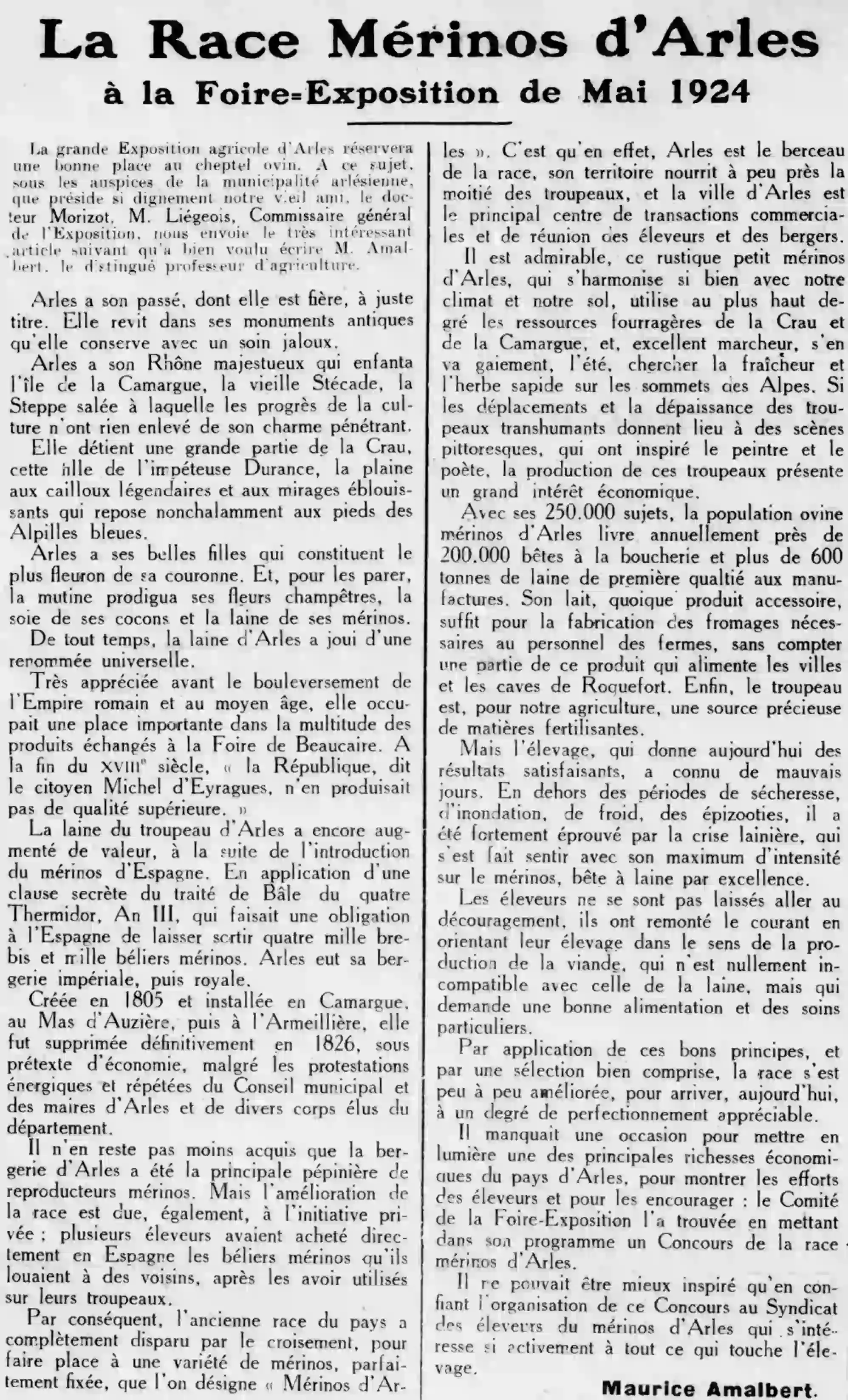
The great Arles Agricultural Exhibition will reserve a good place for the sheep herd. On this subject, under the auspices of the Arlesian municipality, over which our old friend, Doctor Morizot, so worthily presides, Mr. Liégeois, Commissioner General of the Exhibition, sends us the following very interesting article which Mr. Amalbert. the distinguished professor of agriculture.
Arles has its past, of which it is rightly proud. She lives again in her ancient monuments which she preserves with jealous care. Arles has its majestic Rhône which gave birth to the island of the Camargue, the old Stécade, the salty Steppe from which the progress of culture has taken nothing of its penetrating charm. It holds a large part of Crau, this daughter of the impetuous Durance, the plain with legendary pebbles and dazzling mirages which rests nonchalantly at the foot of the blue Alpilles.
Arles has its beautiful daughters who constitute the most beautiful jewel in its crown. And, to adorn them, the mutiny lavished her country flowers, the silk of her cocoons and the wool of her merinos. Arles wool has always enjoyed universal fame.
Very popular before the upheaval of the Roman Empire and in the Middle Ages, it occupied an important place in the multitude of products exchanged at the Beaucaire Fair. At the end of the 18th century, "the Republic," said citizen Michel d'Eyragues, "did not produce it of superior quality."
The wool of the Arles herd further increased in value, following the introduction of merino from Spain. In application of a secret clause of the Treaty of Basel of the four Thermidor, Year III, which made it an obligation on Spain to let out four thousand ewes and a thousand merino rams. Arles had its imperial, then royal, sheepfold.
Created in 1805 and installed in the Camargue, at Mas d'Auzière, then at Armeillière, it was definitively abolished in 1826, under the pretext of economy, despite energetic and repeated protests from the municipal council and the mayors of Arles and various elected bodies of the department.
It nevertheless remains certain that the Arles sheepfold was the main nursery for merino breeders. But the improvement of the breed is also due to private initiative; several breeders had purchased the merino rams directly in Spain which they rented to neighbors, after having used them on their herds.
Consequently, the old breed of the country completely disappeared through crossbreeding, to make way for a variety of merino, perfectly fixed, which is called “Merino of Arles”. This is because, in fact, Arles is the cradle of the breed, its territory feeds approximately half of the herds, and the city of Arles is the main center of commercial transactions and meetings of breeders and shepherds. It is admirable, this rustic little merino from Arles, which harmonizes so well with our climate and our soil, uses to the highest degree the forage resources of the Crau and the Camargue, and, an excellent walker, goes cheerfully, in summer, seeking freshness and palatable grass on the peaks of the Alps. If the movements and thinning of transhumant herds give rise to picturesque scenes, which inspired the painter and the poet, the production of these herds is of great economic interest.
With its 250,000 animals, the merino sheep population of Arles annually delivers nearly 200,000 animals to the butcher's shop and more than 600 tonnes of top quality wool to factories. Its milk, although an accessory product, is sufficient for the manufacture of cheeses necessary for farm staff, not to mention part of this product which supplies the towns and cellars of Roquefort. Finally, the herd is, for our agriculture, a valuable source of fertilizer.
But breeding, which today gives satisfactory results, has seen bad days. Apart from periods of drought, flood, cold and epizootics, it has been strongly affected by the wool crisis, which was felt with its maximum intensity on merino, the wool-producing animal par excellence. The breeders did not allow themselves to be discouraged, they turned the tide by directing their breeding in the direction of the production of meat, which is in no way incompatible with that of wool, but which requires good nutrition and special care.
By application of these good principles, and by a well-understood selection, the breed has gradually improved, to arrive, today, at an appreciable degree of perfection. An opportunity was missing to highlight one of the main economic assets of the country of Arles, to show the efforts of breeders and to encourage them. The Fair-Exhibition Committee found it by including a Breed Competition in its program. merino from Arles.
<br /> He could not have been better inspired than by entrusting the organization of this Competition to the Union of Merino Breeders of Arles which is so actively interested in everything relating to breeding.
Maurice Amalbert.
|
 |