

| Le Petit Journal illustré 10 février 1924 |
|
If the theater offers such an undeniable attraction for us, no doubt it is because it alone brings together, rather because it could bring together all the artistic emotions: plastic art, since it uses the resources of painting, music, eloquence and beauty; intellectual art, since it appeals to thought.
If this overall perfection is often not the case, alas! than theoretical, it is no less true that the setting plays an essential role in theater. The efforts of the decorator, that of the costume designer, have a direct influence on the value of a show, sometimes as direct as those of the writer and the actor. And to the great joy of our eyes, decorative painters work wonders. Here is what Victorien Sardou, who was a great technician of success, had to think one day: — Since I write historical plays, since, to stage them with great precision, I use paintings, engravings of the periods mentioned, why can't I succeed, with the help of the actors, the decorator, the costume designer, of the director, to reconstitute, in a sort of living picture, a work of art? In the meantime, Victorien Sardou had Thermidor performed at the Comédie-Française. The play was violently debated, then banned. And, in the heat of political passions, few spectators noticed that in the fourth act, the famous painting by Ch.-L. Muller, which can be admired at the Versailles museum, the Appeal of the Condemned, had been strictly reconstructed. The decor represents the small courtyard of the Conciergerie. On the left, in the second plan, the arcade, the gate and steps leading to the large courtyard. In the background, the door to the guardhouse. Beyond, we see, on the right, the colonnade of the central pavilion, and opposite, over the wing of the palace which returns towards the square, the Sainte-Chapelle without its spire. The gendarmes and the national guards form a hedge in two lines between the staircase and the door of the Conciergerie. All the characters on stage gather behind the two hedges. The benches are filled with curious people. A few years later, in the Affair of the Poisons, Sardou reproduced an evening at the Thétis cave, in Versailles, in 1665, based on an engraving by Lepautre. The Porte-Saint-Martin theater then spent 300,000 francs to execute this painting. This example did not fail to be followed. Antoine, at the Odeon, created the Roman Forum, conforming to Gérôme's painting, for the Death of Caesar, in Julius Caesar, by Shakespeare.
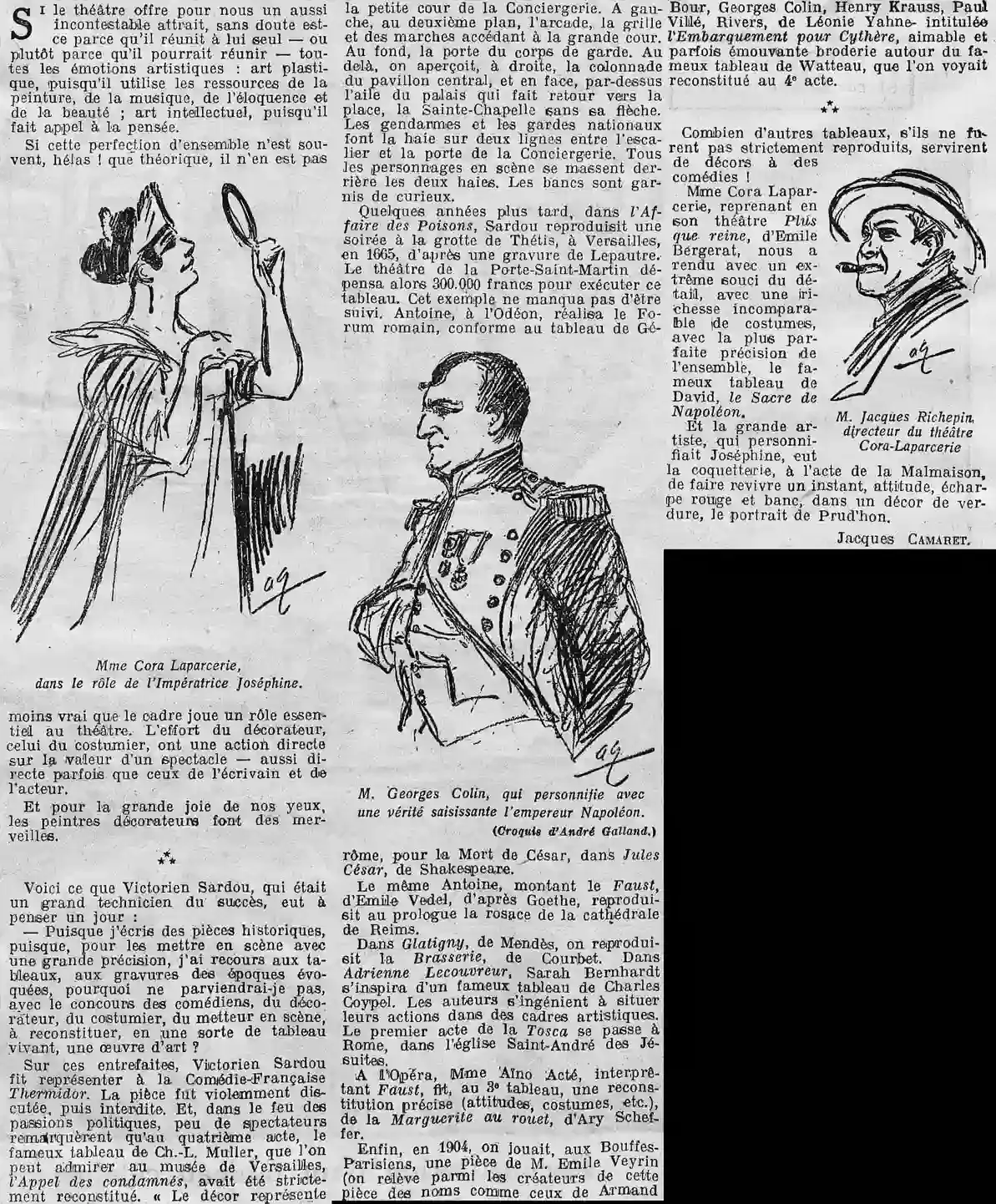
The same Antoine, staging Faust, by Emile Vedel, after Goethe, reproduced in the prologue the rose window of Reims Cathedral. In Glatigny, by Mendès, Courbet's Brasserie was reproduced. In Adrienne Lecouvreur, Sarah Bernhardt was inspired by a famous painting by Charles Coypel. The authors strive to situate their actions within artistic frameworks. The first act of Tosca takes place in Rome, in the Jesuit church of Saint Andrew. At the Opera, Ms. Aino Acté, interpreting Faust, made, in the third scene, a precise reconstruction (attitudes, costumes, etc.), of Marguerite at the spinning wheel, by Ary Scheffer. Finally, in 1904, a play by Mr. Emile Veyrin was performed at the Bouffes-Parisiens (we note among the creators of this play names such as those of Armand la petite cour de la Conciergerie. On the left, in the second ground, the arcade, gate and steps leading to the large courtyard. In the background, the gate of the guardhouse. Beyond, we can see, to the right, the colonnade of the central pavilion, and opposite, over the wing of the palace which returns towards the square, the Sainte-Chapelle without its spire. The gendarmes and the national guards form the hedge in two lines between the staircase and the door of the Conciergerie. All the characters on stage mass behind the two hedges The benches are filled with curious people. A few years later, in the Affair of the Poisons, Sardou reproduced an evening at the Thétis cave, in Versailles, in 1665, based on an engraving by Lepautre. The Porte-Saint-Martin theater then spent 300,000 francs to execute this painting. This example did not fail to be followed. Antoine, at the Odeon, created the Roman Forum, conforming to Gérôme's painting, for the Death of Caesar, in Julius Caesar, by Shakespeare. The same Antoine, staging Faust, by Emile Vedel, after Goethe, reproduced in the prologue the rose window of Reims Cathedral. In Glatigny, by Mendès, Courbet's Brasserie was reproduced. In Adrienne Lecouvreur, Sarah Bernhardt was inspired by a famous painting by Charles Coypel. The authors strive to situate their actions within artistic frameworks. The first act of Tosca takes place in Rome, in the Jesuit church of Saint Andrew. At the Opera, Ms. Aino Acté, interpreting Faust, made, in the third scene, a precise reconstruction (attitudes, costumes, etc.), of Marguerite at the spinning wheel, by Ary Scheffer. Finally, in 1904, a play by Mr. Emile Veyrin was performed at the Bouffes-Parisiens (we note among the creators of this play names such as those of Armand Bour, Georges Colin, Henry Krauss, Paul Villé, Rivers, Léonie Yahne- entitled Embarkation for Cythera, friendly and sometimes moving embroidery around the famous painting by Watteau, which we saw recreated in the 4th act. How many other paintings, if not strictly reproduced, served as settings for comedies! Ms. Cora Laparcerie, resuming in her theater Plús que Reine, by Emile Bergerat, has given us with extreme attention to detail, with an incomparable richness of costumes, with the most perfect precision of the whole, the famous painting by David, the Coronation of Napoleon. And the great artist, who personified Joséphine, had the coquetry, in the act of Malmaison, to revive for a moment, attitude, red scarf and bench, in a green setting, the portrait of Prud'hon. Jacques CAMARET. |
 |