


| Le Petit Écho de la mode 02 mars 1924 |
|
GOOD FRENCH CUISINE
ILE DE FRANCE MATELOTE
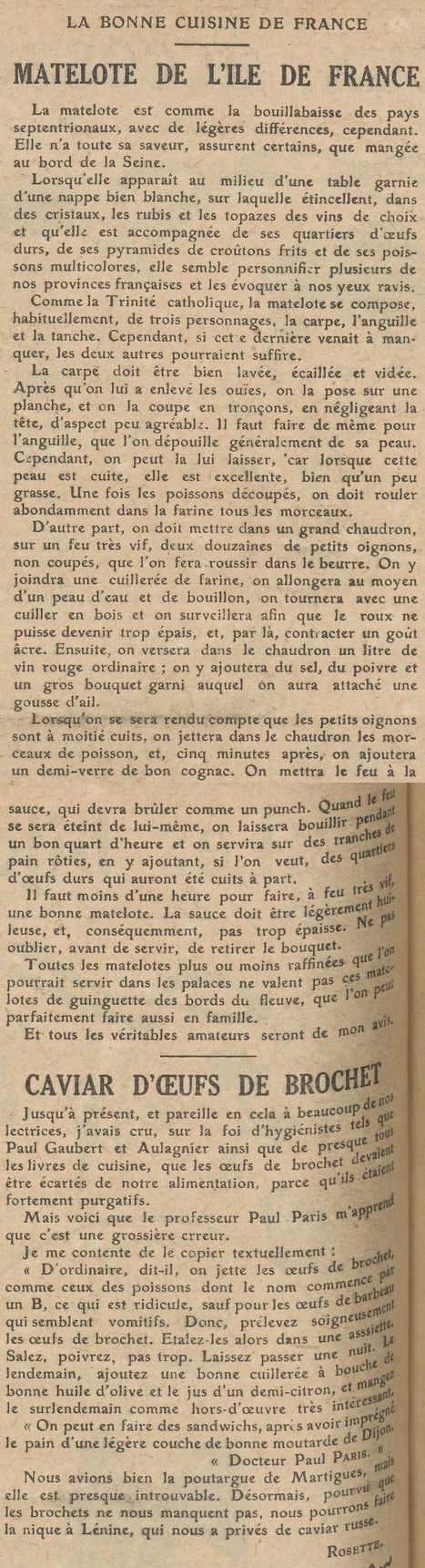
Matelote is like bouillabaisse from northern countries, with slight differences, however. It only has its full flavor, some say, when eaten on the banks of the Seine. When she appears in the middle of a table covered with a very white tablecloth, on which sparkle, in crystals, the rubies and topazes of choice wines and she is accompanied by her wedges of hard-boiled eggs, its pyramids of fried croutons and its multicolored fish, it seems to personify several of our French provinces and evoke them to our delighted eyes. Like the Catholic Trinity, the matelote is usually made up of three characters, the carp, the eel and the tench. However, if the latter were to be missing, the other two could be sufficient. The carp must be well washed, scaled and gutted. After removing the gills, place it on a board, and cut it into sections, neglecting the head, which has an unpleasant appearance. The same must be done for the eel, which is generally stripped of its skin. However, we can leave it to him, because when this skin is cooked, it is excellent, although a little oily. Once the fish have been cut, roll all the pieces abundantly in flour. On the other hand, we must put in a large cauldron, over a very high heat, two dozen small onions. uncut, which will be browned in butter. We will add a spoonful of flour, we will thin with a skin of water and broth, we will turn with a wooden spoon and we will watch so that the roux does not become too thick, and, by this, contract a acrid taste.
Then, a liter of ordinary red wine will be poured into the cauldron; we will add salt, pepper and a large bouquet garni to which we will attach a clove of garlic. When we realize that the onions are half cooked, we will throw the pieces of fish into the cauldron, and, five minutes later, we will add half a glass of good cognac. We will set the sauce on fire, which should burn like punch. When the fire has gone out by itself, let it boil for a good quarter of an hour and serve on slices of toasted bread, adding, if you wish, quarters hard-boiled eggs that have been cooked separately. It takes less than an hour to make a good matelote over very high heat. The sauce should be slightly oily, and therefore not too thick. Do not forget, before serving, to remove the bouquet. All the more or less refined matelotes that we could serve in the palaces are not worth those matelotes from taverns on the banks of the river, which we can also do perfectly well with the family. And all true amateurs will agree with me.
PIKE ROE CAVIAR
Until now, and like many of our readers, I had believed, on the basis of hygienists such as Paul Gaubert and Aulagnier as well as almost all cookbooks, that pike roe should be avoided. of our diet, because they were strongly purgative. But now Professor Paul Paris tells me that this is a big mistake. I am content to copy it verbatim “Usually,” he said, « we throw away pike eggs, like those of fish whose name begins with a B, which is ridiculous, except for barbel eggs which seem emetic. So, carefully collect the pike eggs. Then spread them on a plate, add salt and pepper, not too much... Leave to sit overnight.
The next day, add a good spoonful of good olive oil and the juice of half a lemon, and eat the next day as a very interesting appetizer You can make sandwiches with it, after impregnating the bread with a light coating of good Dijon mustard. » “Doctor Paul PARIS."
We had Martigues bottarga, but it is almost impossible to find. From now on, as long as we don't miss the pike, we will be able to piss off Lenin, who deprived us of Russian caviar.
ROSETTE.
|
 |